After a bad wind event, the cleanup itself is rarely the hard part. Cutting a limb into movable pieces is straightforward. What catches Sioux Falls homeowners out is the step after that: a pile of wood in the yard, no clear idea of whose job it is, and a reasonable-sounding assumption that leaving it at the curb will be enough. It usually is not. Here is exactly where storm debris goes in Sioux Falls, what the City handles, and what stays with you after a Sioux Falls storm.
Current storm response, verified 27 July 2026. Following the storms on 25 and 26 July, the City opened two free branch drop sites. They are running daily, 9 a.m. to 5 p.m., through Sunday 9 August 2026. Dates and hours change with every event, so confirm on the City of Sioux Falls landfill and recycling page before you load the trailer.
What the City Clears, and What It Leaves to You
Nearly every disagreement about storm debris in Sioux Falls traces back to one line: the boundary of the public right-of-way. Get that clear and the rest of the rules make sense.
The right-of-way, defined properly
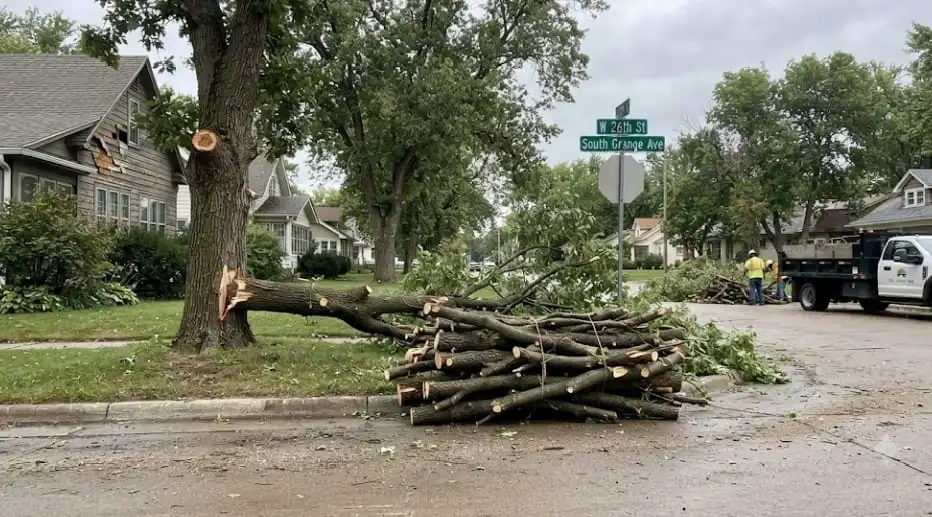
The public right-of-way covers streets, sidewalks, and boulevards. The boulevard is the strip of grass between the sidewalk and the curb, the piece most people think of as their lawn but which the City actually controls. Following a severe weather event, trees and limbs that fall from or land within that strip are the City’s responsibility, and City forestry crews work through them.
Trees and limbs that come down on private property belong to the property owner. Removal and disposal are yours to arrange. That holds regardless of where the tree originally stood, how large it is, or whether the storm was severe enough to make the news.
The practical test is simple. Stand at the curb and look back toward your house. Anything behind you, toward the street, is likely City work. Anything in front of you, toward your door, is yours.
The assumption that costs people a weekend
This is the one worth reading twice. Dragging debris from your yard out to the boulevard does not transfer it to the City. The City has stated plainly that it will not collect piles that property owners move into the right-of-way, and that includes material stacked in the driveway or along the curb.
Every storm produces the same pattern. Someone spends a Saturday cutting and hauling their own limbs out to the street, watches City crews work down the block for a week, and eventually realizes those crews were only ever collecting what fell in the right-of-way in the first place. The pile then has to be loaded a second time and driven to a drop site anyway.
If the material came off your property, plan on hauling it from the start. Working out the destination before you cut saves handling everything twice.
The Two Free City Drop Sites
When the City opens storm drop sites, it runs two of them, positioned on opposite sides of town so most residents have a reasonable drive. Both are free for residential use and both take the same material.
1015 E. Chambers Street (east side)
This site sits just west of the Household Hazardous Waste Facility. Access is from N. Cliff Avenue onto Chambers Street, and the driveway west of the hazardous waste building is the way in. If you are coming from the north or east side of Sioux Falls, this is almost always the shorter trip.
200 Lyon Boulevard (west side)
The west site is south of the W. H. Lyon Fairgrounds, near West 12th Street. Anyone west of the river or south toward Harrisburg and Tea will generally find this one faster. Fairgrounds traffic can make the approach slow during events, so allow extra time if something is running there.
Hours and cost
During the current storm response both sites run daily, Monday through Sunday, 9 a.m. to 5 p.m. That is a wider window than the City’s regular seasonal leaf and branch sites, which keep shorter Sunday hours. There is no charge for residents.
Worth knowing: these storm sites are opened in response to a specific event and closed once the backlog clears. They are not a year-round service, which is why the closing date matters as much as the address.
What Gets Accepted, and What Gets Turned Away
The storm sites take trees and branches only. That covers the overwhelming majority of what wind drops in a yard: snapped limbs, whole small trees, and cut sections from a larger one. It does not cover everything you might want to clear out while the trailer is already hooked up.
| Accepted at the storm drop sites | Not accepted |
| Broken and cut branches | Root balls |
| Whole small trees | Bagged leaves |
| Trunk sections cut to movable length | Stumps |
| Clean woody yard material | Grass clippings and garden waste |
| Residential loads | Commercial and contractor loads |
Root balls are the most common rejection. If a tree came out of the ground rather than snapping off, the root plate comes with a large mass of soil and stone attached. That material is not clean wood and the sites will not take it. Separate the root ball from the trunk before you load, or you will be turned around at the gate having driven there for nothing.
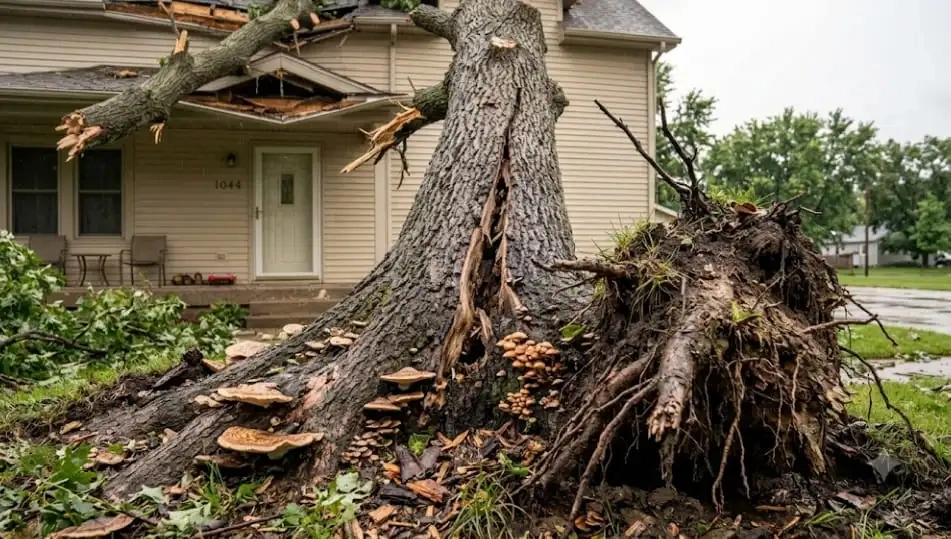
Stumps are a separate problem entirely. Digging one out to haul it is far more work than it looks, and it leaves a crater to backfill. Grinding it in place is almost always the cheaper and faster route, which is why stump grinding is handled as its own service rather than as part of a debris haul.
Bagged leaves belong to a different program. The City runs seasonal leaf and branch sites in spring and fall that do take leaves. The storm sites are a narrower response and stay focused on woody material.
Loading and Hauling Without Wasting the Trip
You unload the material yourself at the drop site. Nobody does it for you, and there is no equipment to help. A load that took twenty minutes to throw in can take an hour to pull back out if it went in badly.
Cut to a length one person can drag. Anything much over six feet becomes awkward in a trailer and worse coming out of one. Limbs that still have side branches attached tangle together into a single mass, so a few extra cuts while the wood is on the ground saves real effort later.
Load butt ends toward the tailgate. Stacking the cut ends toward the back means you can grab and drag rather than climb in and lift. It sounds minor. On a full trailer it is the difference between one trip and needing help.
Bring gloves and eye protection. Fresh storm wood is full of splinters and spring-loaded small branches, and you will be handling every piece twice.
Strap the load. Branches shift, and losing part of a load on Cliff Avenue creates a hazard for the driver behind you.
Be realistic about how many trips a full yard actually takes. A single mature limb section can fill a small trailer, and most storm-damaged yards run to four or five loads once everything is cut. That is usually the point where people start pricing out a crew instead.
Free Wood Disposal at Mueller Pallets
This is the option most Sioux Falls residents do not know about, and it stays open when the City sites close.
Mueller Pallets accepts trees, branches, and other clean wood debris at no charge. It sits at 46349 267th Street in Hartford, roughly half a mile west of the Sioux Falls Regional Landfill, so the two are a single trip if you have mixed material to get rid of.
- Normal hours: Mondays 7 a.m. to 5 p.m., Saturdays 7 a.m. to noon
- Added storm hours in 2026: noon to 5 p.m. on 26 July and 2 August
- Cost: free for clean wood
- Phone: 605-368-2440
The drive is longer than the City sites for most of Sioux Falls, so it makes the most sense when the City sites have closed, when you missed the daily window, or when you are already heading toward Hartford. Their hours are narrower than the City’s, so call before loading up.
The Paid Option: Sioux Falls Regional Landfill
The free residential drop sites are for residents. Commercial businesses and contractors take trees and branches to the Sioux Falls Regional Landfill in Hartford instead, where disposal fees apply. Current rates and hours are published on the City’s landfill page, and they change, so check rather than assume.
This matters to homeowners for one reason. If you hire a tree service, disposal should already be inside the quote. Ask the question directly and get the answer before work starts. A price that looks lower because hauling and tipping fees were left out is not actually a lower price, it is an invoice arriving in two parts. Our breakdown of tree removal costs in Sioux Falls covers what should and should not be bundled.
Which option fits your load
| Option | Cost | Best for |
| City storm drop sites | Free, residential | Storm limbs during an active response window |
| Mueller Pallets, Hartford | Free, clean wood | Year-round disposal once City sites close |
| Sioux Falls Regional Landfill | Fees apply | Contractors, mixed loads, root balls and stumps |
| Hire a crew | Quoted per job | Large volume, hazardous trees, no hauling equipment |
How to Report a Downed Tree or Hazardous Debris
If a tree is blocking a street or sidewalk, or debris sitting in the right-of-way looks dangerous, report it rather than waiting for a crew to find it.
Reports go through siouxfalls.gov/report or the City’s mobile app. That puts the location into a queue with an address attached. After a widespread event, crews work from that list, and a hazard nobody reported simply is not on it.
Useful details to include: the nearest street address, whether the tree is fully or partly across the roadway, whether a sidewalk is impassable, and whether anything appears to be leaning on a structure or a line.
When it is not a report, it is an emergency
If a limb or tree is touching a power line, stay away from it and call 911 and your electric utility. Treat every downed line as live, including lines that look like phone or cable. Keep people and pets well back, and do not move branches that are in contact with a conductor even if the power appears to be out.
This is not a job for a homeowner, a neighbor with a chainsaw, or a tree crew. The line has to be de-energized and made safe by the utility before anyone cuts anything, and that includes us. It is the one situation in storm cleanup where waiting is unambiguously the correct decision.
For a tree on a house, a vehicle, or blocking your only way out, that is an emergency tree service call rather than something to schedule for next week. If a tree has already come down on your property, our guide on what to do in the first hour covers the safety and insurance steps in order.
When Hauling It Yourself Stops Making Sense
Plenty of storm cleanup is genuinely a weekend job. A few limbs on the lawn, a hand saw, two trailer loads, done by Sunday afternoon. There is no reason to pay someone for that.
Some of it is not, and the dividing line is clearer than most people expect. Four situations account for nearly every serious storm cleanup injury.

1. Anything still hanging in the canopy. A broken limb caught in the branches above you is holding stored energy and is not resting where it appears to be. Cutting or pulling from below releases it in a direction that is difficult to predict, and it arrives faster than anyone can move. Arborists call these hangers, and they are the reason cleanup crews look up before they look down.
2. A tree resting on a roof, fence, vehicle, or shed. The weight is being held somewhere, usually in more than one place. Cutting in the wrong order shifts that load onto the structure instead of off it, and a tree that was doing modest damage starts doing serious damage. Removing weight in the right sequence is most of the skill involved.
3. A partly uprooted tree. When the root plate lifts but the tree does not fall, the roots are acting like a spring under tension. Cutting the trunk can let that plate snap back and drop the tree in the opposite direction to the lean. Trees that look stable in this condition regularly are not.
4. Anything near a service line, or needing a ladder and a running saw. A chainsaw takes both hands. A ladder needs at least one. That combination puts a spinning chain at chest height with nothing holding you in place, and it is a common way for a manageable cleanup to become a hospital visit.
There is also a plain volume threshold. Past roughly four or five trailer loads, the fuel, the weekend, and the wear on your vehicle start to add up to something close to what a crew would have charged to do the whole thing in an afternoon and take the wood with them.
What a Full Storm Cleanup Includes
If you decide to hand it over, it helps to know what a complete job should cover so you can compare quotes on the same terms.
- Hazard assessment first. Hangers, tension in fallen trunks, compromised root plates, and anything leaning toward a structure get identified before a saw starts.
- Sectional removal in a planned order so weight comes off structures rather than onto them.
- Assessment of trees still standing. Storm damage is often invisible from the ground, and a cracked union or a partly lifted root plate becomes next season’s failure.
- Full debris removal and haul-away, so nothing is left for you to load, and no disposal trip lands back on you.
- Documentation for an insurance claim, including photographs before work begins.
- Site cleanup, meaning raked ground and cleared drives rather than a yard of chip and sawdust.
Where a damaged tree cannot be saved, the job becomes a tree removal rather than a cleanup, and the stump is usually handled separately. Where a tree is salvageable, corrective tree trimming after a storm does more to prevent the next failure than anything else you can do.
Before hiring anyone in the days after a storm, it is worth reading how to tell a certified arborist from an unlicensed crew. South Dakota does not license tree work, and storm weeks bring out-of-state door-knockers in numbers.
Common Questions About Storm Debris in Sioux Falls
Will the city pick up tree branches from my yard after a storm?
No. The City clears trees and limbs in the public right-of-way, meaning streets, sidewalks, and boulevards. Debris that came off private property stays the owner’s to remove and dispose of, and moving it to the curb does not change that. It has to go to a drop site.
Are the branch drop sites free?
Yes, for residential use. Commercial businesses and contractors use the Sioux Falls Regional Landfill instead, where disposal fees apply.
Can I bring a stump or a root ball?
No. Root balls are not accepted, because the soil and stone attached to them is not clean wood. Stumps are better ground in place than dug out and hauled, both for cost and for the hole it would otherwise leave.
Can I bring bagged leaves?
Not to the storm drop sites, which take trees and branches only. The City’s seasonal leaf and branch sites in spring and fall are the ones that handle leaves.
Where do I take branches once the sites close?
Mueller Pallets in Hartford takes clean wood debris free of charge year round during its normal hours. The Sioux Falls Regional Landfill is the paid alternative and accepts material the free sites will not, including root balls.
How long do the storm drop sites stay open?
They open in response to a specific storm and close once the backlog clears, so the window changes every time. For the 2026 event the sites are running through 9 August. Confirm current dates with the City before driving out, because an expired date is the most common reason for a wasted trip.
A tree fell on the line running to my house. What now?
Stay away from it, keep others back, and call 911 and your electric utility. The line has to be made safe before anyone cuts anything, including a professional crew. Do not attempt to move branches that are touching it, even if your power is already out.
Does my insurance cover debris removal?
It depends on the policy and on what the tree hit. Coverage is generally stronger when a tree damaged a structure than when it simply fell in the yard, and many policies cap debris removal separately. Photograph everything before you cut, and check with your carrier before assuming either way.
More Debris Than You Want to Move
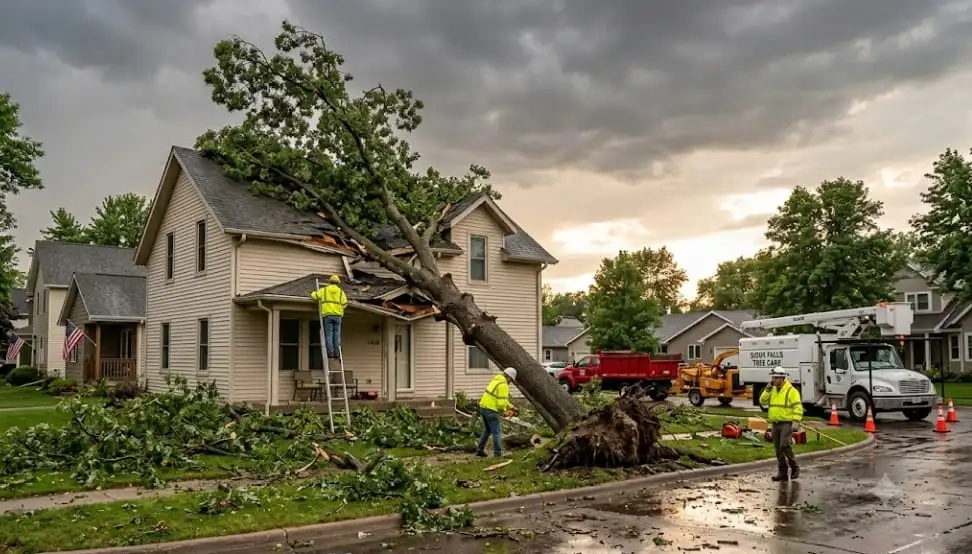
If the pile in your yard runs past a few trailer loads, or there is a tree you would rather not put a saw into, we can look at it and give you a number before anything starts. Every job includes full debris removal, so there is no drop site trip left waiting for you at the end of it.
We work throughout Sioux Falls and the surrounding communities, including Brandon, Harrisburg, Tea, Hartford, Crooks, Garretson, Lennox, Renner, and Dell Rapids.
Call (605) 405-0960 or send us the details and we will tell you honestly whether it is a job worth paying for or one you can finish yourself in a weekend.
Every Town Around Sioux Falls Does This Differently
The rules are stricter and more varied than most people expect. Brandon takes branches only, on Saturdays, with a 12 inch diameter limit and a separate leaf drop at McHardy Park. Harrisburg runs a compost site that closes whenever it has rained in the previous 24 hours. Hartford has the longest season in the area, first Saturday in April through the Saturday after Thanksgiving. Garretson opens six hours a week. Dell Rapids charges by the load but accepts construction debris as well as branches. Tea ran a temporary storm drop-off that has since closed. Crooks has no year-round site, and Renner, being unincorporated, has none at all.