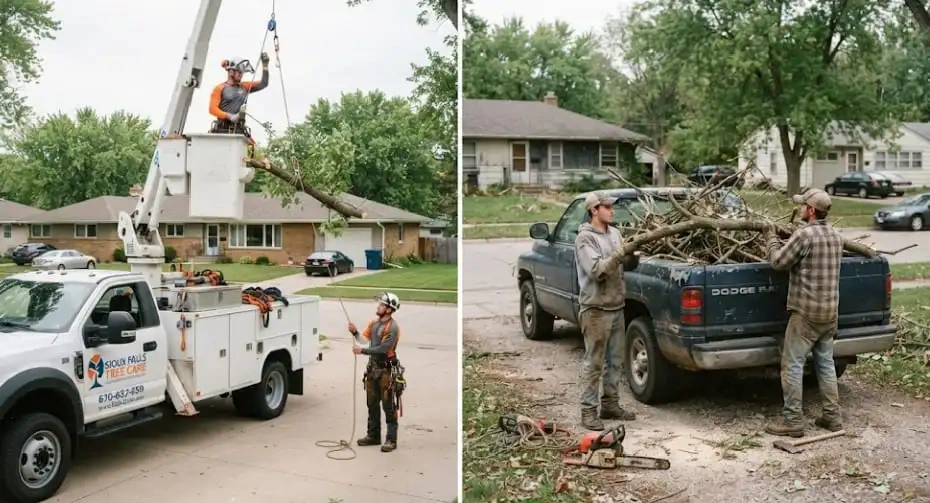
Two tree service companies quote the same job in Sioux Falls. One has an ISA Certified Arborist on staff. The other is a crew of three with a truck and a chainsaw. The price difference is $300. Which do you choose?
To answer that question well, you need to understand what the ISA credential actually represents, what South Dakota’s regulatory framework for tree work actually requires, and what the practical consequences of choosing an unqualified crew actually look like. This guide covers all three.
Understanding the Landscape: What Credentials Actually Exist in South Dakota
Before discussing what credentials mean, it helps to know what the regulatory environment looks like in South Dakota and Sioux Falls specifically.
At the state level: South Dakota does not have specific licensing requirements for tree removal companies. Unlike states such as Maryland, New Jersey, Louisiana, or Utah, which require state-issued arborist or tree contractor licenses, South Dakota imposes no statewide competency license for tree removal or trimming on private property.
Every contractor doing business in South Dakota must hold a Contractor’s Excise Tax License from the South Dakota Department of Revenue under SDCL §10-46A. This is a tax compliance registration, not a competency or safety credential. It confirms that a contractor is paying the required excise tax. It says nothing about their knowledge, training, equipment, or safety practices.
One meaningful exception exists for pesticide application: Any contractor applying commercial pesticides, including emerald ash borer treatments on living trees, must hold a Commercial Pesticide Applicator certification from the South Dakota Department of Agriculture and Natural Resources under SDCL §38-21. This is a genuine, legally required competency credential for that specific work. If you need EAB treatment and not just removal, ask explicitly whether the contractor holds this certification.
At the city level: The City of Sioux Falls does maintain a municipal arborist license requirement under its Code of Ordinances (Chapter 94: Forestry). The city publishes an annual Licensed Arborist list and requires licensed arborists for work on street trees and trees in public spaces within city limits. The 2026 Licensed Arborist List is publicly available through the city. This municipal license is the closest thing to a local competency vetting system for tree contractors in the Sioux Falls area, though it applies specifically to work in public spaces and on street trees, not to most private residential property work.
What this means for homeowners: Because South Dakota imposes no statewide competency license for private property tree work, the ISA Certified Arborist credential becomes more important, not less. In states with mandatory licensing, the state does baseline competency screening. In South Dakota, homeowners must do it themselves, and ISA certification is the most reliable tool available for that purpose.
What Is an ISA Certified Arborist?
The International Society of Arboriculture is the leading global professional organization for the science and practice of arboriculture. The ISA Certified Arborist credential is the foundational professional certification the organization offers, and it is accredited by the American National Standards Institute, meeting and exceeding ISO 17024 international standards for personnel certification programs.
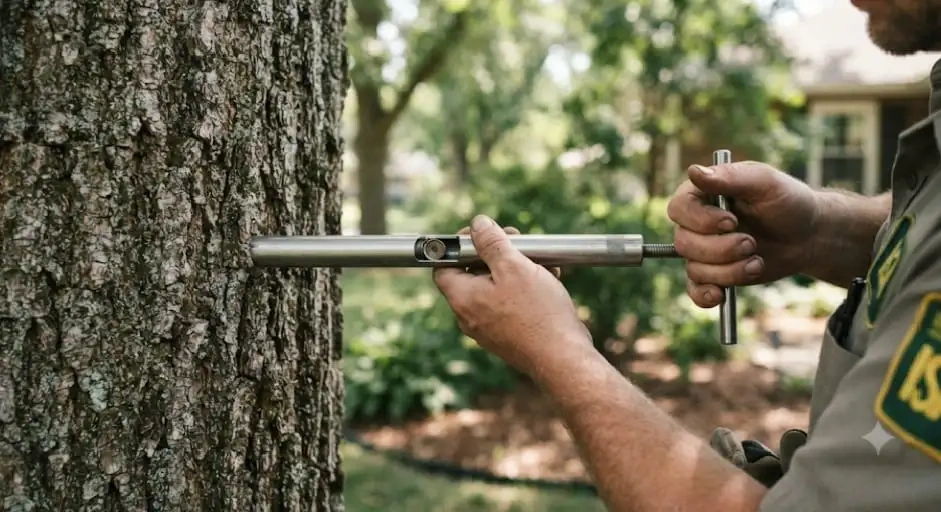
An ISA Certified Arborist is an individual who has demonstrated verified competence in arboriculture through a combination of documented field experience, a rigorous written examination, and an ongoing commitment to professional development.
To earn an ISA Certified Arborist credential, you must be trained and knowledgeable in all aspects of arboriculture. ISA Certified Arborists must also adhere to a Code of Ethics that strengthens the credibility and reliability of the workforce.
The certification covers ten areas of knowledge tested in the written exam, including tree biology, soil management, water management, pruning, installation and establishment, safe work practices, tree risk assessment, plant health diagnostics, urban forestry, and professional development.
How ISA Certification Is Earned and Maintained
The path to becoming an ISA Certified Arborist is not a weekend course or an online quiz. Understanding what the credential actually requires helps you appreciate what it verifies.
Eligibility requirements:
To be eligible for the ISA Certified Arborist exam, you must have one or both of the following: three or more years of full-time, eligible, practical work experience in arboriculture, or a degree in the field of arboriculture, horticulture, landscape architecture, or forestry from a regionally accredited educational institute.
The examination:
The exam consists of 200 multiple-choice questions covering a wide range of topics including tree biology, pruning, diagnosis and treatment of tree problems, and safety. To pass the exam, you must score at least 72% or higher.
Maintaining certification:
All ISA Certifications are valid for three years. To maintain your certification, you must earn a minimum number of ISA Continuing Education Units (CEUs) by the end of the three-year period and pay a recertification fee. For the standard Certified Arborist credential, 30 CEUs must be earned over each three-year period.
Recertification through continuing education provides incentives for individuals to improve their level of technical competency. It creates a greater opportunity for practitioners to write, publish, and speak on technical issues.
This means an ISA Certified Arborist with a credential that is currently in good standing has not only passed a comprehensive examination but has also maintained active engagement with continuing education for the entire duration they have held the credential. An expired certification is no longer valid. You can verify the current status of any ISA credential through the find-an-arborist tool.
What an Unlicensed Tree Crew Actually Means
“Unlicensed” in the South Dakota context does not mean the crew is operating illegally, given that no state competency license exists for most private property tree work. It means they hold no verified credential indicating that anyone on the crew has been assessed for arboricultural knowledge, follows professional standards, or maintains any commitment to continuing education.
An unlicensed tree crew in Sioux Falls may be:
- A general landscaping company that added tree work to its service list without specialized training
- A seasonal crew that works in lawn care in summer and offers tree work as an extension of that work
- An individual operator with a truck and equipment who learned through informal on-the-job experience
- A storm-chaser crew that appeared in the area after a weather event with no local business history
None of the above categories is necessarily dishonest or incompetent. Some operators with years of field experience produce good work without formal credentials. But the credential is the only verifiable, standardized signal available to you as a homeowner when you cannot personally evaluate someone’s knowledge of tree biology, pruning mechanics, or risk assessment methodology.
The critical point is this: without a credential, you have no objective basis for evaluating competence beyond price and verbal assurances.
Full Comparison Table: ISA Certified Arborist vs. Unlicensed Crew
| Factor | ISA Certified Arborist | Unlicensed Tree Crew |
|---|---|---|
| Eligibility requirement | 3+ years field experience OR arboriculture degree | None verified |
| Written examination | 200-question exam, 72% passing score required | None |
| Areas of knowledge tested | 10 domains: biology, pruning, soil, risk, safety, diagnosis and more | Unverified |
| Code of Ethics | Required, enforced by ISA | None |
| Continuing education | 30 CEUs per 3-year certification period required | None required |
| Pruning standards followed | ANSI A300 industry standards | Not verified |
| Tree risk assessment capability | Trained, may hold TRAQ credential | Variable and unverifiable |
| Disease and pest diagnosis | Covered in exam and continuing education | Variable and unverifiable |
| Credential verification | Public lookup at isa-arbor.com | Not possible |
| Accountability mechanism | ISA can suspend or revoke credential for ethics violations | None beyond civil legal remedies |
| Pesticide application legality | Must separately hold SD pesticide applicator license | Must hold same license; often do not |
| Property damage awareness | Training covers protecting property during work | Variable and unverifiable |
| Professional standing in industry | Recognized by municipalities, insurers, and commercial clients | No industry standing |
| Consumer recourse | ISA ethics complaint process available | Civil remedies only |
What Can Go Wrong When Tree Work Is Done Incorrectly?
This section is where most competitor articles are weakest. They mention risks in passing without explaining the specific consequences or mechanisms. Here are the documented outcomes of poor tree work.
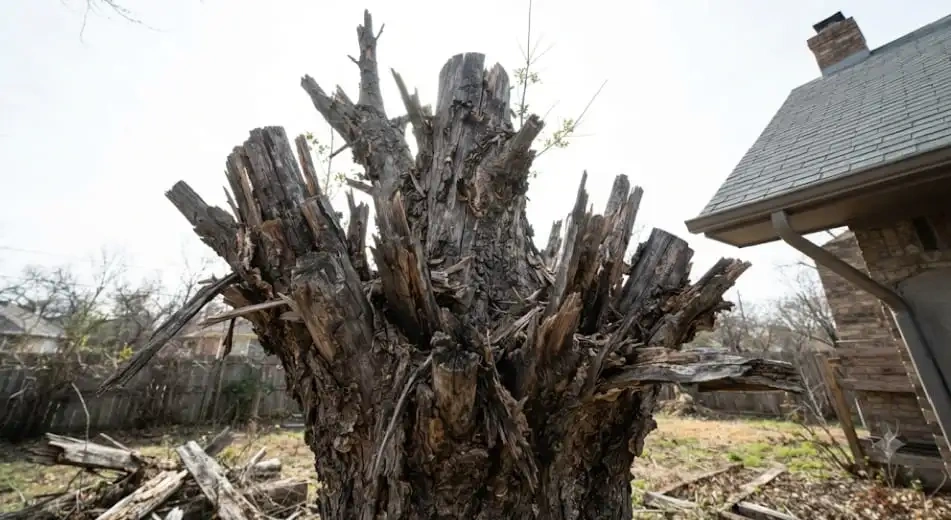
Improper pruning that permanently damages tree structure. The most common mistake made by untrained crews is topping, which involves cutting a tree back to large stubs rather than making proper reduction cuts. Topping destroys the natural structure of a tree, creates numerous large wounds that the tree cannot adequately seal, and produces rapid but structurally weak regrowth. A topped tree is more hazardous than one that was never pruned. This damage is irreversible. A tree that was worth thousands of dollars in property value and storm protection may be permanently compromised by a single bad pruning job.
Lion’s tailing, which strips interior branches. Removing too many interior and lower branches leaves a tree with a tufted, palm-like appearance and shifts excessive weight to the outer ends of branches. This increases the leverage stress on branch unions during wind events and dramatically increases the probability of branch failure in Sioux Falls’s documented high-wind environment.
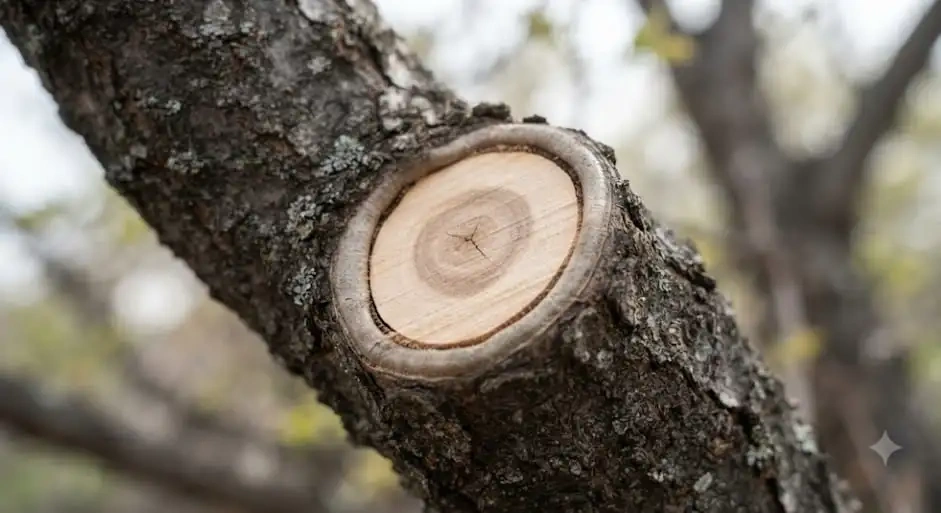
Flush cuts that eliminate the branch collar. The branch collar is a specialized zone of tissue at the base of a branch that allows the tree to seal over a properly made cut. Cutting through or inside the branch collar eliminates this sealing mechanism and creates an open wound that remains vulnerable to decay fungi and insect entry for the life of the tree.
Property damage from uncontrolled removal. An experienced arborist uses rigging, ropes, block and tackle systems, and planned section removal to control where wood falls. An untrained crew may simply cut limbs and sections without adequate control systems. A large limb landing on your roof, fence, or vehicle is not covered by the crew’s insurance if they are uninsured or underinsured, and it happens to be your problem.
Disease spread between trees. Pruning tools used on a diseased tree and not properly sanitized between cuts can transmit fungal and bacterial pathogens to otherwise healthy trees. Dutch elm disease, fire blight, and oak wilt are all transmitted this way. A single uncleaned saw can effectively infect multiple trees across your property in one afternoon.
Incorrect hazard assessment. An untrained crew assessing a leaning ash tree may look at it visually and declare it fine when a trained arborist would recognize root plate movement or internal decay patterns indicating a genuine failure risk. The consequence of a missed hazard assessment can be structural damage or personal injury during the next significant storm.
Hidden long-term costs. A tree pruned incorrectly often requires corrective work by a certified arborist years later. Sometimes that corrective work is impossible and removal becomes the only option for a tree that could have been preserved. The money saved on the cheaper initial job is consumed many times over by the subsequent cost of corrective pruning, tree removal, and stump grinding.
Insurance complications after damage. If property damage occurs during tree work performed by an uninsured or underinsured crew, your homeowner’s insurance becomes the primary mechanism for covering that damage. This is an avoidable transfer of financial risk from the contractor to you.
The ANSI A300 Standard: Why Pruning Science Matters
ANSI A300 is the American National Standard for tree care operations. It represents the consensus of industry professionals, researchers, and arboriculture scientists on best practices for pruning, bracing, cabling, fertilization, lightning protection, and other tree care activities.
ISA Certified Arborists are expected to know and follow the ANSI A300 standards. Unlicensed crews have no exposure to them unless they have sought out the information independently.
The practical relevance of this standard for a Sioux Falls homeowner is straightforward. The ANSI A300 pruning standard specifies where cuts should be made on branches, how much of the live crown should be removed in a single pruning cycle, and how to prioritize which wood to remove for optimal structural outcomes. Violations of these standards are what produce the permanently damaged, structurally weakened trees that cost homeowners money for years after the work is done.
When a contractor tells you they are going to “clean up the tree,” ask them what standard they follow for their pruning cuts. A trained arborist will reference ANSI A300 without hesitation. An untrained crew will likely not know what you are asking about.
The City of Sioux Falls Arborist License: What Homeowners Should Know
The City of Sioux Falls maintains a municipal arborist licensing system under Chapter 94 of its Code of Ordinances (FORESTRY section). The city publishes a Licensed Arborist List annually, and the 2026 list is publicly available through the city’s Planning and Development department.
The Sioux Falls Code of Ordinances covers trees on private property, trees in public places, and specifically prohibits the planting of ash trees (§94.019).
This ash tree planting prohibition is directly relevant to homeowners planning new tree installations. Any contractor suggesting ash tree planting as a replacement in Sioux Falls is either unaware of this ordinance or ignoring it. An arborist familiar with local regulations will not recommend ash trees for any new planting in the city.
The city’s licensed arborist requirement applies primarily to work on street trees and trees in public areas, not to most private residential property work. However, the Licensed Arborist List is a useful reference for homeowners. Contractors who appear on that list have met the city’s municipal requirements and have demonstrably engaged with the local regulatory process.
For any work involving trees adjacent to the street, in a public right-of-way, or near city infrastructure, verify that your contractor is on the current Licensed Arborist List before proceeding.
Sioux Falls-Specific Risks That Make Credentials More Important
Sioux Falls presents tree care challenges that make professional competence more consequential than in many other markets.
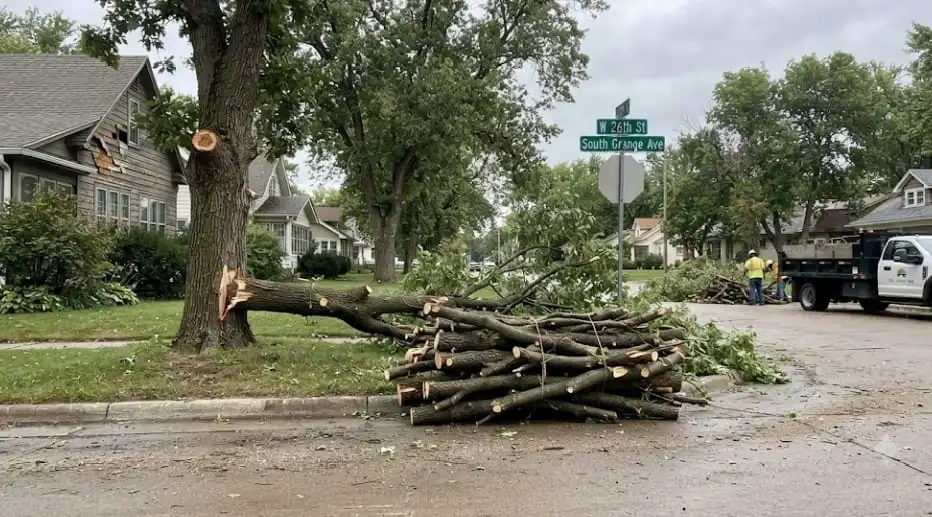
Derecho wind events. Sioux Falls sits in a corridor with documented recurring derecho events producing straight-line winds exceeding 60 to 100+ mph. A tree that has been improperly pruned, with excessive end weight from lion’s tailing or weakened branch unions from improper cuts, is dramatically more likely to fail in these conditions than one that has received structurally sound pruning. The difference between a well-pruned and poorly pruned tree is often the difference between a tree that comes through a derecho intact and one that comes through your roof.
Emerald ash borer. The EAB has established itself in the Sioux Falls area, and green ash trees, which are widespread in residential neighborhoods throughout the city, are at risk. Proper EAB management, including injected insecticide treatments, requires a SDDANR Commercial Pesticide Applicator certification. A crew offering EAB treatment without this certification is either applying pesticides illegally or is misrepresenting the service they are providing. An ISA Certified Arborist familiar with EAB management protocols knows the treatment timing, application methods, and realistic expectations for treated trees versus those too far into decline to save.
Ice storm damage assessment. Sioux Falls winters periodically produce significant ice accumulation events that split branches and structurally compromise otherwise healthy trees. Post-ice-event assessment requires knowing the difference between cosmetic surface damage and structural compromise that predicts future failure. This distinction requires tree biology knowledge that untrained crews often do not have.
Cottonwood and silver maple root systems. Large cottonwoods are common throughout the Sioux Falls area, particularly along drainage corridors. Their shallow, aggressive root systems create specific challenges for removal and can threaten underground utilities, sidewalks, and foundations. An arborist understands root zone mechanics and can advise on whether removal, root pruning, or redirection of drainage is the appropriate response to a root problem. An untrained crew typically only sees the visible portion of the problem.
Is an ISA Certified Arborist Worth the Cost?
The honest answer is: it depends on what you need.
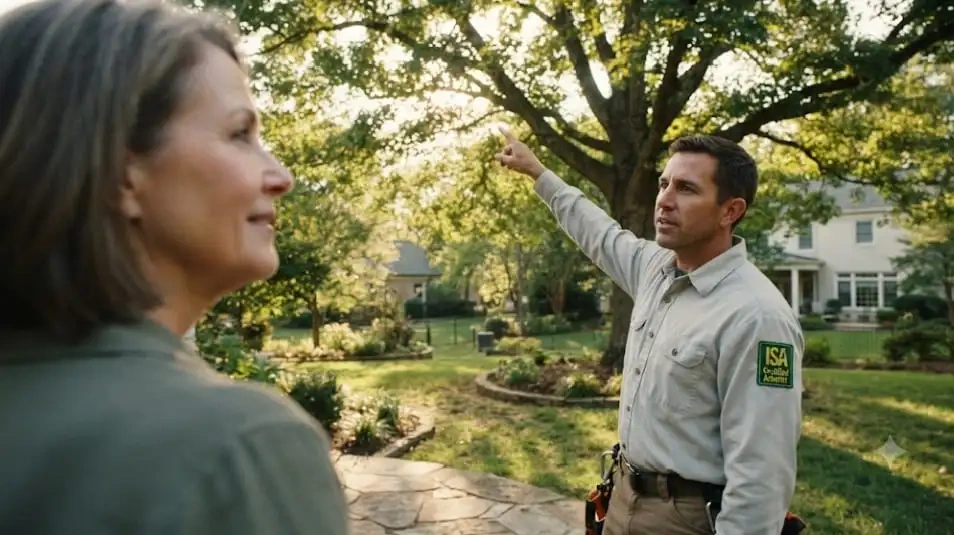
For simple, straightforward jobs like removing a small ornamental tree in an open yard with no hazards or nearby structures, a well-insured, experienced unlicensed crew may produce entirely acceptable results at a lower cost.
For situations involving any of the following, the credential matters substantially:
- A tree near your home, garage, or other structures
- A tree with visible signs of disease, decay, or structural problems
- A decision about whether a tree should be removed or can be preserved
- Pruning of a mature tree where structural decisions have long-term consequences
- Any tree that fell or may fall where liability exposure is present
- Post-storm hazard assessment of trees that appear to have shifted or been damaged
- Any work requiring pesticide application for disease or pest management
- Any work near public right-of-way or street trees in Sioux Falls
The cost premium for certified arborist involvement is typically modest relative to the total cost of a tree job. On a $1,200 removal, the difference between the cheapest crew and a certified arborist-backed company might be $150 to $300. That difference buys you verified competence, professional accountability through the ISA ethics system, and the knowledge that decisions about your trees are being made by someone who passed a comprehensive professional examination and keeps their knowledge current.
Frequently Asked Questions
1. Does South Dakota require arborists to be licensed?
South Dakota does not issue a statewide arborist or tree contractor license for private property work. Every contractor must hold a Contractor’s Excise Tax License from the SD Department of Revenue. Pesticide applicators must hold a SDDANR certification. The City of Sioux Falls requires a municipal arborist license for street tree and public-area work. ISA certification is voluntary but represents the most meaningful competency credential in the absence of a mandatory license.
2. What does the ISA Certified Arborist exam cover?
The written exam content is divided into 10 areas of knowledge, including tree biology, soil management, water management, pruning, installation and establishment, safe work practices, tree risk assessment, plant health diagnostics, urban forestry, and professional development. The exam consists of 200 multiple-choice questions with a passing score of at least 72%.
3. How long is an ISA certification valid?
All ISA Certifications are valid for three years. To maintain certification, you must earn a minimum number of ISA Continuing Education Units and pay a recertification fee within that three-year period. An expired credential is no longer valid and will not appear as active in the ISA’s public verification tool.
4. Can I hire a non-certified crew for basic tree trimming?
For very simple trimming of small trees with no structural complexity and no proximity to structures or utilities, an experienced unlicensed crew may produce acceptable results. For any work involving pruning decisions on mature trees, work near structures or utility lines, or situations requiring assessment of tree health or risk, the credential matters significantly to the quality and long-term consequences of the work.
5. What is the ANSI A300 standard and why should I care?
ANSI A300 is the American National Standard for tree care operations. It specifies best practices for where pruning cuts should be made, how much live crown should be removed per pruning cycle, and how to approach various tree care activities to support long-term tree health and structural integrity. ISA Certified Arborists are expected to follow this standard. Unlicensed crews often are not aware of it, and violations of the standard are what produce the permanently damaged, structurally weakened trees that cost homeowners significantly in the long term.
6. What is a TRAQ credential and when do I need it?
The ISA Tree Risk Assessment Qualification is a specialized credential for systematic evaluation of tree failure probability and consequence. An arborist with TRAQ training uses a structured methodology rather than a visual eyeball assessment when evaluating whether a potentially hazardous tree poses a genuine risk. This credential is most relevant when you have a tree showing warning signs, a tree that has shifted or been storm-damaged, or any situation where you need a defensible assessment for insurance or liability purposes.
7. Are there tree services in Sioux Falls on the city’s Licensed Arborist List?
Yes. The City of Sioux Falls publishes an annual Licensed Arborist List through its Planning and Development department. The 2026 list is publicly available at siouxfalls government official website. This list covers contractors approved for work on street trees and public-area trees within city limits. For private property work, the list is not a requirement but is a useful reference when evaluating local contractors.
8. Can a contractor legally treat my ash trees for emerald ash borer without certification?
No. Any commercial pesticide application in South Dakota, including insecticide injection treatments for EAB management, requires a Commercial Pesticide Applicator certification from SDDANR under SDCL §38-21. A contractor offering this service without the certification is either applying pesticides illegally or misrepresenting the nature of the service they are providing.
9. What happens if an uncertified crew damages my property?
If the contractor carries adequate liability insurance, the damage should be covered under their policy. If the contractor is uninsured or underinsured, which is more common among unlicensed operators, the damage may fall to your homeowner’s insurance or to you directly. This is why verifying a Certificate of Insurance before any work begins is essential, regardless of credentials.
10. What is the ISA Code of Ethics?
The ISA Code of Ethics requires certified arborists to provide honest and competent service, make decisions in the best interest of the client and the trees involved, maintain current knowledge through continuing education, and represent themselves accurately regarding their credentials and capabilities. Violations of the Code of Ethics can result in suspension or revocation of certification by the ISA. Unlicensed crews have no equivalent accountability mechanism.
11. Does a company need an ISA certification, or just one person on staff?
ISA credentials are issued to individuals, not companies. A company can truthfully say it employs ISA Certified Arborists only if specific named individuals on its staff hold current, active credentials. When evaluating a company, ask for the specific name and certification number of the credentialed arborist who will be involved in your job, and verify that credential independently.
12. Does the City of Sioux Falls prohibit planting ash trees?
Yes. The Sioux Falls Code of Ordinances Chapter 94 specifically prohibits the planting of ash trees (§94.019). Any contractor recommending ash tree planting as a replacement or new installation in Sioux Falls is unfamiliar with or disregarding local ordinances. An arborist familiar with local regulations will not recommend ash for new plantings within city limits.
13. Is it cheaper to hire an unlicensed crew?
Often, yes, by a margin. However, the savings are meaningful only if the work produces good long-term outcomes. Improperly pruned trees may require costly corrective work or removal in subsequent years. Property damage caused by uncontrolled work may cost far more than the initial savings. The cost premium for certified arborist involvement is typically modest relative to the total value of the work.
14. How do improper pruning cuts actually damage a tree?
A properly made pruning cut is made just outside the branch collar, a specialized zone of tissue that allows the tree to seal over the wound through a process called compartmentalization. A flush cut made inside or through the branch collar removes this sealing mechanism and creates a permanent wound that remains vulnerable to decay and insect entry. A stub cut made too far outside the collar leaves dead wood that the tree cannot seal over and that attracts decay organisms. Both types of incorrect cuts are common in untrained crews and produce cumulative structural damage over years.
15. What should I do if I suspect a tree on my property is hazardous?
Contact a tree care professional who holds, or employs someone who holds, ISA certification and ideally a TRAQ credential. Request a written hazard assessment documenting the observed conditions, the identified risks, and the recommended response. This documentation protects you if the tree subsequently fails and creates a record that you responded appropriately to a known or suspected condition. Do not rely solely on a visual estimate from someone without training in systematic tree risk assessment.
This Stops Being Theoretical After a Storm
On the evening of 25 July 2026 the National Weather Service recorded 92 mph in Tea and 82 mph just north of Harrisburg, with tree and fence damage logged across Brandon. Out-of-town crews arrived across the metro within days. That is exactly the moment when the difference between a certified arborist and a man with a chainsaw and a flyer becomes expensive.