24/7 Emergency Tree Service in Sioux Falls
If a tree has fallen on your home, is blocking your driveway, or is hanging dangerously after a South Dakota storm, call TreePro immediately for safe emergency tree removal. Do not attempt to handle it yourself.
- Licensed & Fully Insured
- ISA Certified Arborists
- 200+ 5-Star Reviews
- 20+ years Local Experience
Describe Your Tree Emergency
What Counts as a Tree Emergency in Sioux Falls And Why Waiting Can Cost You More
Not every tree situation is an emergency but several scenarios need to be treated as one. Here is how to read the situation.
A tree that has already fallen on your home, roof, garage, fence, or vehicle is an active emergency. A tree that is visibly leaning toward a structure at a noticeably different angle than it was before the storm is an emergency that has not happened yet and those are often more dangerous, because they can fail without further warning. A major limb that is cracked at the branch attachment point and hanging over your roof, driveway, or a frequently used outdoor area is a hanging hazard that needs immediate attention.
After a significant South Dakota wind event, the demand for emergency tree service across Sioux Falls rises sharply sometimes tying up crews for several days as the volume of calls comes in simultaneously. If your tree situation involves a real risk to your home or family, calling early rather than waiting gives you the best chance of fast service when demand is high.
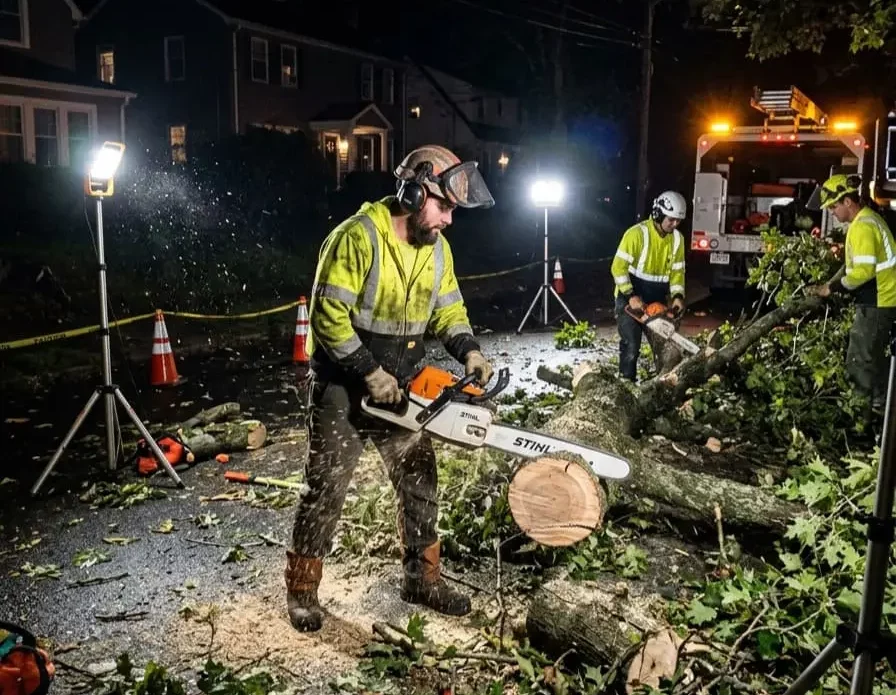
If a Tree Just Came Down Do These Things First
Follow these steps in order before doing anything else.
Get everyone away
Get everyone away from the tree and stay away. Do not go near a downed tree, a split trunk, or hanging limbs under any circumstances. The situation can change without warning, and what looks stable can shift and become extremely dangerous.
Do not touch the Tree
If any part of the tree is touching or near a power line, call your utility company immediately. Do not touch the tree, the ground near it under any circumstances. Contact your utility provider before calling anyone else for safety reasons.
Document everything
Take photos and video of the tree, the damage to your property, and the surrounding area. Do this from a safe distance. Your homeowners insurance claim will depend on this documentation and once the tree is removed, that evidence is gone.
Call TreePro
We will ask you a few quick questions about the situation, the tree's location relative to your home, and access to your property to better understand the urgency and scope. Then we mobilize quickly with the right crew and equipment for the job without unnecessary delays or confusion.
Why Sioux Falls Trees Are Especially Vulnerable to Storm Damage
Not all trees in Sioux Falls carry the same storm risk and understanding which species are most vulnerable helps you identify problems before they become emergencies.
Cottonwood Trees
Cottonwoods are among the most common large trees in Sioux Falls yards and among the most storm-vulnerable. They grow fast, which means the wood is softer and more brittle than slower-growing species. In high winds, cottonwood limbs do not flex and bend they snap at the joint. A mature cottonwood positioned over or near a home represents a genuine risk in any severe South Dakota storm, and it is worth having assessed before the next wind event if you have one.
Silver Maples
Silver maples are common in older Sioux Falls, and their wide-spreading canopies catch enormous wind load during storms. Their rapid growth produces wood that is structurally weaker than native hardwoods, making branch failures common in high winds. Large silver maple removals especially after storm damage require equipment with significant reach, up to 50 feet or more, to safely handle the upper canopy. Ladders and homeowner equipment cannot safely manage these jobs.
Ash Trees
This is the most important and least understood storm risk on Sioux Falls properties right now. An ash tree that appears healthy and full of leaves from the outside may have been significantly weakened structurally by years of emerald ash borer activity beneath the bark. EAB larvae feed on the tissue that moves water and nutrients through the tree — once that system is compromised enough, the structural integrity of the entire tree degrades in ways that are not visible until the tree fails. Many Sioux Falls homeowners have been shocked to see what looked like a perfectly healthy ash tree split or fall completely in a storm that neighboring trees handled without any damage. If you have ash trees on your property that have not been professionally assessed for EAB, that assessment is worth having done before storm season.
Old Bur Oaks
Bur oaks are generally among the most storm-resistant trees in the Sioux Falls area they are slow-growing, hard-wooded, and structurally strong when healthy. The concern with older specimens is what happens over decades of age and environmental stress from wind, drought, and soil changes. Internal rot, hollow trunks, and root decay are often completely invisible from street level or casual inspection by homeowners or neighbors without proper diagnostic tools. A tree that has appeared healthy for forty years can fail completely in a single severe storm once that interior decay has progressed far enough without obvious external warning signs. If you have a large, old bur oak near your home, a professional health assessment every few years is a reasonable precaution for long-term safety.
Tree Fell on Your House in Sioux Falls? What to Know About Your Insurance Claim
When a tree falls on your home or another structure on your property, homeowners insurance typically covers the damage to the structure itself under your dwelling coverage. The cost of removing the tree that caused the damage may also be covered, up to your policy’s limits, when the tree has damaged an insured structure. Coverage varies significantly by policy and insurance carrier read your policy or call your agent as soon as it is safe to do so.
Here is why the order of operations matters for your claim. Before any tree removal begins, document the full scene thoroughly photograph the tree, all points of contact with the structure, interior damage if accessible, and the surrounding area. Do this from a safe distance. Once the tree is removed, that documentation cannot be recreated, and your adjuster will be working from whatever evidence exists after the fact. A thorough photo and video record taken immediately after the event protects your claim.
After documenting, remove debris and begin mitigation which is where calling TreePro comes in. Most insurance policies require that homeowners take reasonable steps to prevent further damage after an event. Removing a tree from a compromised roof or structure promptly is part of that mitigation obligation. Waiting too long can actually complicate your claim.
We are not insurance agents and cannot advise on your specific policy, contact your insurer directly for coverage questions. What we can tell you is that fast, professional tree removal with full documentation of what was done and when is the best thing you can do for both your property and your claim.
Why Sioux Falls Homeowners Call TreePro for Emergency Tree Service
We Respond Quickly
Emergency calls get priority. When you call TreePro about a downed tree or hanging hazard, we quickly gather the key information about your situation and location details, then mobilize with the equipment the job requires. We do not send a crew to assess and then schedule a second visit to do the work—we come fully prepared and ready to handle the situation in one response safely, efficiently, and without unnecessary delays or complications in the field.
We Work Safely
Emergency tree situations are inherently more dangerous than planned removals. Storm-damaged trees have unpredictable stress points, weakened attachment zones, and structural failures that are not always visible from the outside. Our crew assesses every emergency situation before touching anything identifying where the tree may shift, what rigging is needed, and how to complete the removal without making a bad situation worse.
Roofs and Structures
A tree resting on your home requires a completely different approach than a tree that has fallen in an open yard. Removing weight from a compromised roof structure without causing additional damage and doing it with equipment that can reach the position safely, is the kind of emergency work that requires both experience and proper equipment. We have handled these situations across Sioux Falls properties and we know what they require.
Hazardous Situation
Some crews remove the obvious fallen section and leave hanging limbs or secondary risks for a follow-up visit. We clear the immediate hazard completely before we leave. If there is additional work needed follow-up trimming, stump grinding, or a full assessment of other trees on the property we will tell you clearly and honestly, but we do not leave your property in an unsafe state at the end of the visit.
Fully Licensed and Insured
Emergency work carries higher risk than planned work, for the tree, the property, and the crew, during severe weather conditions and unstable ground situations. We carry full liability insurance and workers' compensation on every job. If you need documentation for your insurance claim, we can provide detailed records of the work performed, including photos and service reports.
Emergency Tree Service Available Across Sioux Falls and Surrounding Communities
TreePro responds to emergency tree situations throughout Sioux Falls and the surrounding Minnehaha County communities, including
Frequently Asked Questions About Emergency Tree Services in Sioux Falls
Have a question not listed here? Give us a call, we’re happy to talk through your specific situation.
What should I do immediately after a tree falls on my property?
Keep everyone away from the tree and the area around it. If any part of the tree is touching or near a power line, do not approach it and call your utility company before anyone else. From a safe distance, photograph and video the full scene the tree, the damage, the point of contact with any structure. This documentation is critical for your insurance claim and cannot be recreated after the tree is removed. Then call a tree service.
Is a tree touching a power line always an emergency?
Yes. A tree in contact with an active power line is a life safety hazard. The tree itself can carry an electrical charge to the surrounding ground, making the area around it dangerous even without direct contact. Contact your utility company before a tree service crew can safely approach the work zone. Do not attempt to move the tree yourself under any circumstances.
Does homeowners insurance cover a tree that fell on my house?
In many cases, yes homeowners insurance typically covers damage to structures caused by a fallen tree, and may also cover a portion of removal costs when the tree has damaged an insured structure. Coverage limits and conditions vary significantly by policy. Contact your insurance agent or carrier directly for specifics. What matters most in the immediate aftermath is documenting the full scene thoroughly before removal begins, since that documentation forms the basis of your claim.
Will insurance cover tree removal if the tree fell in my yard but did not hit a structure?
Generally, no. Most homeowners policies do not cover tree removal when no insured structure was damaged even if the fallen tree is blocking your driveway or causing a mess in your yard. There are exceptions, so checking your policy is always worthwhile. Regardless of coverage, a tree blocking your driveway or access points still needs to be dealt with promptly.
Can a storm-damaged tree be saved, or does it always need to come down?
It depends on the extent and nature of the damage. A tree that has lost several branches but retains its main structural leader and root system may recover with proper pruning and care. A tree that has split at the main trunk, lost more than a third of its canopy, sustained major root damage from uprooting, or is an ash tree compromised by emerald ash borer activity typically needs to come down. We assess every situation honestly and will tell you clearly whether saving the tree is realistic.
Is emergency tree removal more expensive than planned removal?
Yes, typically. Emergency work involves after-hours response, hazardous working conditions, unpredictable tree positions relative to structures, and higher risk overall all of which factor into the cost. Emergency tree removal in Sioux Falls costs more than scheduled removal, and that difference reflects the real complexity of the work, not arbitrary pricing. We give you a clear assessment of the job and what it involves before work begins.
Should I try to remove a hanging or leaning branch myself?
No. A partially detached branch or a tree that is leaning after storm damage may look manageable from the ground, but the structural forces involved are unpredictable. A branch that appears to be hanging in place can fall the moment weight distribution shifts including when someone attempts to move it. Do not touch it, do not go under it, and keep others away until a professional crew can assess the situation.
Tree Emergency in Sioux Falls? Call TreePro Now
Every hour that a damaged tree rests on a structure, blocks access to your property, or hangs in an unstable position is another hour of risk to your home, your family, and your insurance situation. TreePro serves all of Sioux Falls and the surrounding Minnehaha County communities. Call us now and we will respond as quickly as possible.