A tree falling on your home during a Sioux Falls storm is a disorienting experience. What felt like a safe yard an hour ago is now a scene of broken wood, cracked roofing, and uncertainty. The decisions you make in the next sixty minutes matter significantly, both for your physical safety and for your insurance claim.
The First 60 Seconds: What to Do Right Now
Do not go outside yet.
That sounds counterintuitive, but the immediate instinct to rush out and assess damage is responsible for injuries every year after storm events. Before you step out the door, run through these five checks from inside your home.
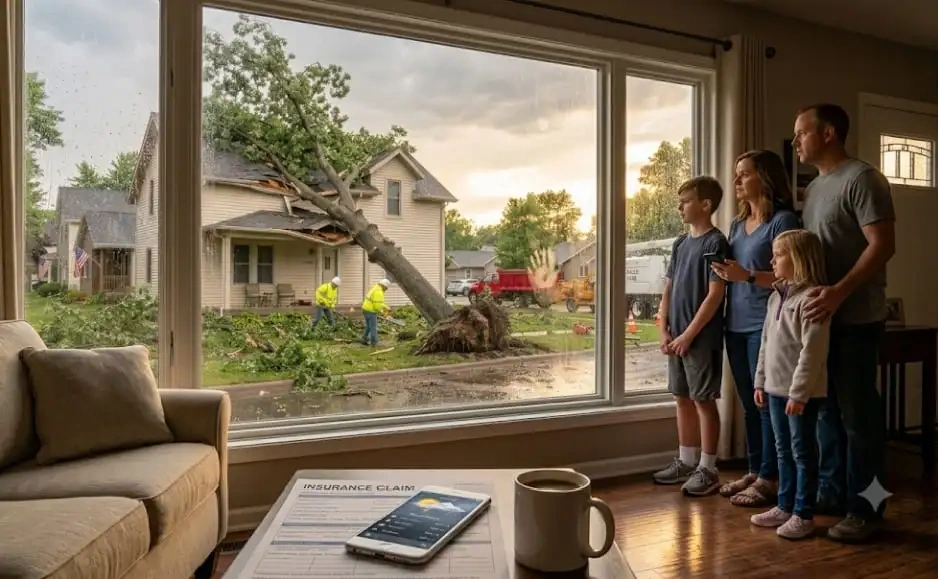
1. Account for everyone in the house. People, children, and pets. Make sure no one is near the area where the tree came down, including interior rooms below the impact point.
2. Look and listen for signs of structural compromise. Cracking sounds from walls or ceilings, visible sagging, doors that have jammed or sprung open unexpectedly, or cracks spreading across plaster are all signals that the tree has affected the structural integrity of your home.
3. Check for the smell of gas. A strong sulfur or rotten egg odor means a gas line may have been ruptured. Do not use light switches, phones inside the house, or any open flame. Exit immediately through an undamaged door and call your gas utility from outside or a neighbor’s home.
4. Look for electrical hazards indoors. Flickering lights, sparks, burning smells, or a tripped breaker panel may indicate the tree has damaged your electrical service. If you see or smell burning, do not touch switches. Exit the home.
5. Assess whether leaving is necessary. If the tree has penetrated the roof or wall, if you can see open sky, or if any of the warning signs above are present, leave the home and move to a neighbor’s house or your vehicle at a safe distance from the tree.
Get Out or Stay In? How to Assess Structural Danger
Not every tree fall requires evacuation, but some do. The structural risk depends on where the tree landed and how much of it is resting on your home.
Higher risk situations that warrant leaving the property:
- The tree has penetrated the roof or a load-bearing wall
- Ceilings are visibly bowed or cracking inside
- The tree has struck a chimney, which can destabilize masonry throughout the structure
- The tree is only partially down and still leaning under significant tension toward the house
- Electrical arcing or sparking is visible anywhere
Lower risk situations where staying may be acceptable:
- The tree fell in the yard without contacting the structure
- A small tree or limb has damaged a fence, garage, or shed but left the main house intact
- The impact point is clearly peripheral and the home feels structurally sound
When in doubt, leave. You can always re-enter after a professional assessment. You cannot undo a decision that puts someone in a collapsing structure.
The Single Most Dangerous Hazard: Downed Power Lines
If a tree has taken down a power line, or if you see lines on the ground anywhere near the fallen tree, the rules change completely.
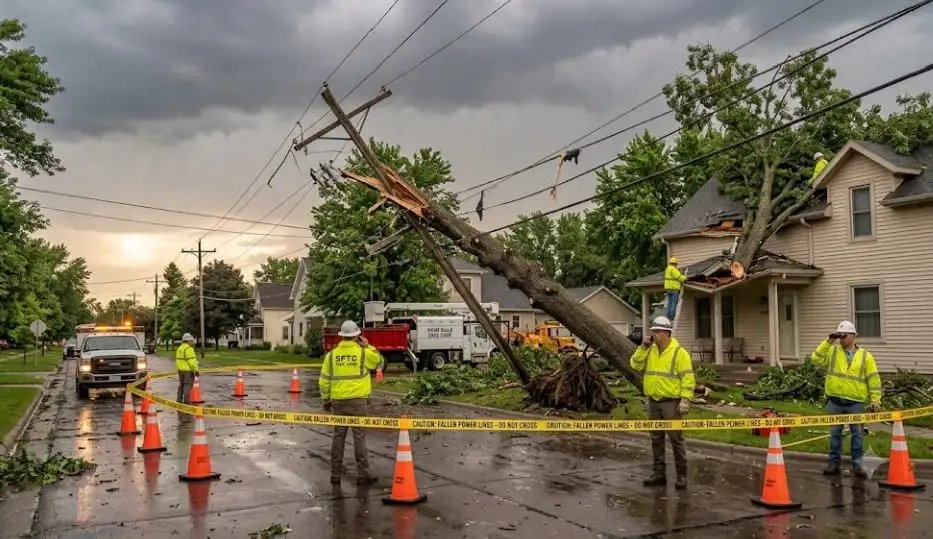
Assume every downed line is live. Even if the power is out on your street, a downed line may still carry lethal voltage. Electricity can travel through the tree itself, through the wet ground surrounding a downed wire, and through standing water. A commonly cited safety buffer is at least 30 to 50 feet from any downed line.
Do not touch the tree if it is in contact with a line. This includes trying to move it, cut it, or push it away with any tool, wooden or otherwise.
Do not drive through or park near downed lines. If a line is across a road or your driveway, stop and stay in your vehicle if you are already inside it. If you must exit, jump clear without touching the vehicle and the ground simultaneously, and shuffle away with both feet together rather than taking normal steps.
What NOT to Do After a Tree Falls
Important distinction: There are two types of power lines that may be affected by a fallen tree. The utility’s main distribution lines run from pole to pole and are the utility company’s responsibility. The service drop, which is the wire that runs from the utility pole specifically to your home, occupies a gray area. Homeowners are typically responsible for the service drop, though utility company may address it as a public safety measure depending on circumstances. Ask when you call.
This section may be the most important part of this guide. The following actions have caused injuries, complicated insurance claims, and created additional property damage after tree emergencies.
Do not go near a fallen tree in the dark without a flashlight and a clear view of what you are walking into. Post-storm debris is unpredictable. There may be additional hanging branches under tension above you, called widow makers by arborists, that are not visible at ground level.
Do not attempt to cut the tree yourself. A partially fallen tree under tension behaves nothing like a standing tree being felled. When a log under tension is cut, it can spring back with sudden and violent force, fast enough to cause serious injury before you can react. This is a known cause of chainsaw accidents in post-storm cleanup.
Do not remove the tree before contacting your insurance company. This is one of the most costly mistakes homeowners make. If you remove the evidence before an adjuster documents it, your claim may be reduced or disputed. Photograph everything first. Call your insurer before calling the tree company.
Do not enter rooms directly below the impact point. Even if the ceiling looks intact, a tree resting on roof structure is adding continuous downward load. Interior ceilings and walls may fail without warning.
Do not allow children or pets outside after the storm. Trees weakened by the original event can drop additional branches minutes or hours later. Saturated soil can allow standing trees that appear stable to tip over well after wind has passed.
Do not assume standing trees nearby are safe. A storm severe enough to bring one tree down has likely stressed neighboring trees. Roots may have shifted. Structural cracks may be invisible at ground level.
Emergency Response Checklist: The First Hour
Use this checklist to organize your response.
Immediately (first 5 minutes):
- Account for all people and pets in the house
- Check for gas odor and electrical burning smell
- Assess whether the home structure is compromised
- Decide to stay or evacuate
- If power lines are down, call Utility company
Within 15 minutes:
- If evacuating, gather medications, documents, phones, and chargers
- Do not use elevators in multi-family buildings after structural impact
- Notify a neighbor or family member of your situation
Within 30 minutes:
- Begin photographing all damage from safe positions before anything is moved
- Photograph the fallen tree from multiple angles
- Photograph all roof, wall, and structural damage visible
- Photograph interior ceilings and rooms below the impact point
- Record video walking around the perimeter if safe
Within 60 minutes:
- Contact your homeowner’s insurance company to begin a claim
- Ask specifically about emergency temporary repairs (tarping)
- Contact a professional emergency tree service to assess and secure the site
- If temporary boarding of windows or tarping is needed, save all receipts
Within 24 hours:
- Obtain a written assessment from the tree service
- Get a structural inspection from a licensed contractor if the home was impacted
- Follow up with your insurance adjuster on timeline
- Notify your mortgage company if required by your loan terms
Why Sioux Falls Has So Many Tree Emergencies
Sioux Falls sits in one of the most storm-active corridors in the northern Great Plains. The city’s tree emergency calls are not random events. They follow predictable patterns that every homeowner in the area should understand.
Derechos are the primary culprit. A derecho is a long-lived, fast-moving band of severe thunderstorms that produces straight-line wind damage across hundreds of miles. Unlike a tornado, which damages a narrow path, a derecho affects an entire region simultaneously. Sioux Falls has been struck by documented derecho events repeatedly, with notable events in 2020, 2022, and again in July 2025, when wind gusts of 68 mph were recorded in the Harrisburg and Lincoln County areas and widespread tree and structural damage was reported across the metro. The 2022 events produced gusts exceeding 105 mph within 60 miles of Sioux Falls. These are not exceptional storms for this region. They are recurring seasonal events.
Ice storms create a different type of failure. Heavy wet ice accumulates on branches and multiplies their weight dramatically. Bur oaks, hackberry trees, and silver maples, three of the most common species in Sioux Falls residential areas, can hold tremendous ice loads before branch failure occurs, but when failure happens, it is sudden and without warning. Ice storms often occur overnight, meaning homeowners wake to find damage without having heard or witnessed the event.
Cottonwood trees along drainage areas are particularly vulnerable. The Big Sioux River corridor and its branches run through significant portions of Sioux Falls. Large, mature cottonwoods are common in these areas. Cottonwoods have shallow, wide-spreading root systems that perform poorly in saturated soil. A storm that combines heavy rain and high wind is precisely the combination most likely to uproot a cottonwood. Saturated root zones from heavy rain, followed by derecho winds, is the documented mechanism behind many of the most damaging tree falls in this area.
Green ash decline is an escalating concern. The emerald ash borer has established itself throughout South Dakota, and Sioux Falls has a significant population of ash trees throughout its residential neighborhoods. Ash trees killed by the beetle become structurally unpredictable within one to three years of death. A standing dead ash may look intact from the ground but have significant internal decay. These trees are far more likely to fail during storms than living trees of equivalent size and species.
Does Homeowners Insurance Cover a Fallen Tree?
This is the question most homeowners ask within minutes of a tree falling. The answer depends on specific circumstances, not just the event itself.
When Insurance Typically Pays
Most standard homeowner’s insurance policies will cover:
- Damage to your home’s structure (roof, walls, windows, framing) caused by a tree that fell due to wind, lightning, or another covered peril
- Damage to attached structures like a garage
- Interior damage caused by water entering through the breach the tree created
- Damage to detached structures such as a fence or shed, usually under the “other structures” portion of your policy, often capped at 10% of your dwelling coverage limit
- Tree removal costs when the tree damaged a covered structure, typically subject to a separate sub-limit that varies by policy, often $500 to $1,500
- Temporary housing costs under “loss of use” coverage if the home is uninhabitable
When Insurance May Not Pay
- If the tree fell in the yard without hitting any structure, most policies will not cover removal costs
- If the tree was visibly dead, diseased, or structurally compromised before it fell and you were aware of it, your insurer may argue failure to maintain and reduce or deny the claim
- Damage to power lines from the utility pole to the street is generally the utility company’s responsibility, not your insurer’s
- If your policy has a specific wind or storm exclusion (less common but worth checking)
The Negligence Exception in Neighbor Disputes
If a neighbor’s tree falls on your property, your insurance typically covers the damage first. However, if you can demonstrate that the tree was visibly dead, diseased, or hazardous, and that the neighbor had been notified or was reasonably aware of the risk, their liability coverage may apply. Documenting your notification of a neighbor about a hazardous tree, in writing, creates a record that matters in these situations.
Documenting Damage for Your Insurance Claim
Documentation done correctly, and done before anything is moved, is the most financially important thing you can do in the first hour.
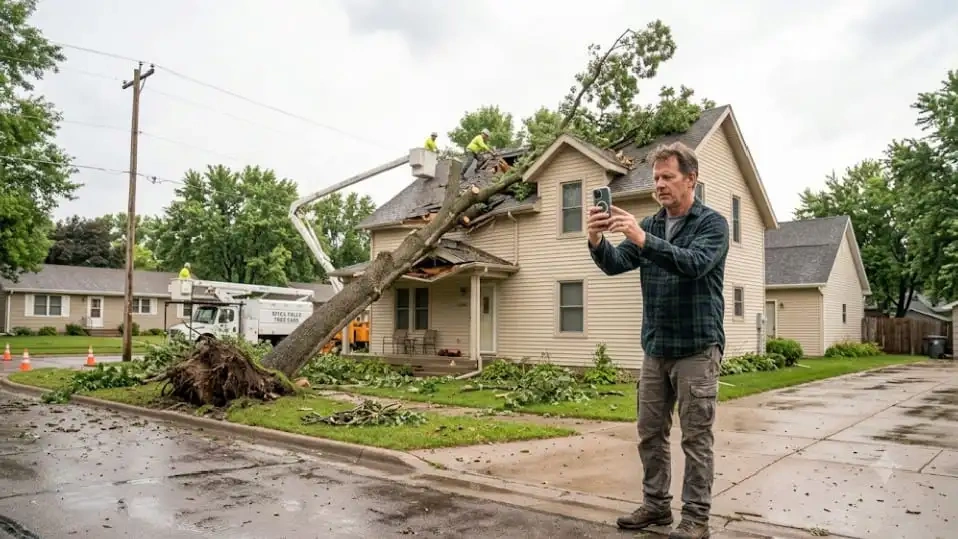
Photography checklist:
- Wide-angle shots of the entire fallen tree from the road or safe distance
- Close-up shots of the root ball (if uprooted) or the base failure point
- Roof and structural damage from ground level and from all four sides of the home
- Every window or wall area that sustained damage
- Interior rooms: ceiling, flooring, and any personal property affected
- Any vehicles damaged on the property
- Neighbor’s property if their property was also affected
- Downed power lines if any, from a safe distance only
Written documentation:
- Note the exact date and time the tree fell
- Note the weather conditions (wind, lightning, ice)
- If a severe weather event was declared or announced by the National Weather Service for Sioux Falls, include that in your claim documentation, as it establishes the covered peril without ambiguity
- Save all receipts for emergency tarping, boarding, or temporary repairs
Timing of the claim: Contact your insurer the same day if possible. Most policies have language requiring “prompt” notification. Calling within hours, rather than days, removes any ambiguity about timing.
How to Hire an Emergency Tree Service in Sioux Falls
After a major storm event in Sioux Falls, demand for emergency tree services spikes sharply and immediately. Contractors who are normally available within a day or two may be booked for five to seven days after a significant derecho. This creates two problems: the wait for service, and the increased presence of unqualified operators driving through neighborhoods offering quick cash deals.
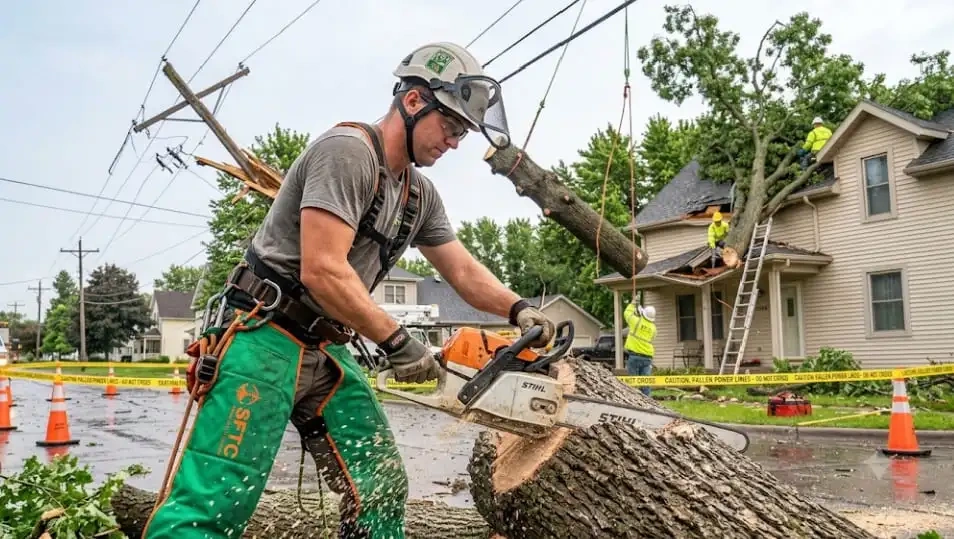
What to verify before hiring:
- The contractor carries current liability insurance and workers’ compensation. Ask for the certificate, not just verbal confirmation.
- The contractor has a physical local presence, not just a temporary operation set up after the storm
- You receive a written, itemized quote before work begins
- The quote specifies exactly what is included (removal, debris hauling, stump grinding if needed)
Warning signs of a problematic contractor:
- Demands full payment in cash before the job begins
- Refuses to provide proof of insurance
- Quotes a price that is dramatically lower than others
- Claims a local address but has no verifiable business history
On cost: Emergency tree removal in Sioux Falls after a storm runs $1,000 to $5,000 or more depending on tree size, location, and hazard level. For more detailed pricing guidance, see our full tree removal cost guide for Sioux Falls.
Warning Signs a Tree May Fall Before It Does
The best emergency is the one that never happens. Several observable warning signs indicate a tree is approaching structural failure. Recognizing them before a storm allows for proactive removal at a fraction of the cost of emergency removal.
Visible warning signs worth a professional assessment:
- A lean that has developed or worsened recently, particularly toward your home
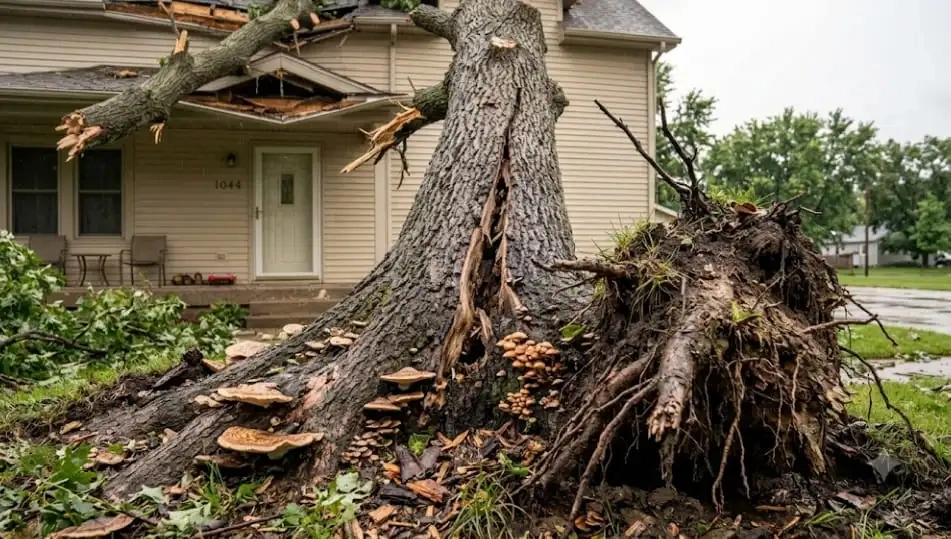
- Mushrooms, conks, or other fungal growth at or near the base of the trunk, which reliably indicates internal decay
- Large sections of missing bark revealing discolored or wet wood beneath
- A trunk with visible cracks, especially vertical splits or cracks at branch unions
- A significant portion of the upper canopy that is dead or leafless during the growing season
- Soil heaving or cracking around the root zone, which suggests the root system is shifting under load
- Branches that have previously failed and dropped in calm conditions
Green ash trees showing a thinning, declining canopy in the Sioux Falls area are a particular priority, as emerald ash borer mortality progresses quickly once visible symptoms appear.
Storm Preparedness: How to Reduce Your Risk
Sioux Falls homeowners who act before storm season arrive significantly better prepared than those who react after a tree falls.
Before spring storm season each year:
- Walk your property in late March or April after snow has melted and assess any trees that are near the home, garage, driveway, or overhead lines
- Look specifically for the warning signs listed in the section above
- Schedule a professional assessment for any tree you are uncertain about
- Consider having high-risk trees removed in fall or winter, when demand is lower and pricing is typically more favorable
During a severe weather watch or warning:
- Move vehicles away from trees where possible
- Bring in outdoor furniture, children’s play equipment, and anything that could become airborne
- Stay inside and away from rooms directly beneath large trees
- Monitor National Weather Service alerts for the Sioux Falls area at weather.gov/fsd
Maintain relationships with local tree services before emergencies occur. Contractors who know your property and have existing records for it are better positioned to respond quickly and accurately when an emergency does arise. A cold call to a stranger the morning after a derecho puts you at the back of the line.
Frequently Asked Questions
1. How much does emergency tree removal cost in Sioux Falls?
Emergency tree removal in Sioux Falls typically starts around $1,000 and can reach $5,000 or more for large trees or situations involving structures or power lines. After widespread storm events that generate many simultaneous calls, rates can be higher due to crew overtime and extended wait times.
2. Does homeowners insurance cover a tree that falls in my yard but misses my house?
Usually not. Most standard policies cover tree removal only when the tree has damaged a covered structure. A tree that lands in the yard without hitting your home, garage, fence, or other covered structure is typically not covered for removal costs. Check your specific policy language for exceptions.
3. What if my neighbor’s dead tree falls on my property?
Your homeowners insurance typically covers the structural damage first. If you can demonstrate that the neighbor knew or reasonably should have known the tree was dead or hazardous, their liability coverage may apply. If you previously notified your neighbor in writing about the tree’s condition, that documentation becomes important evidence.
4. Is a leaning tree after a storm always an emergency?
Not automatically, but any tree that has developed a new lean during a storm, particularly one directed toward a structure or public area, should be assessed by a professional as soon as possible. Trees with freshly exposed root balls or root zones with soil heaving are especially high priority. Do not assume a leaning tree is stable just because it has not fallen yet.
5. Can I tarp my roof before the insurance adjuster arrives?
Yes. Insurers expect and typically encourage homeowners to take reasonable steps to prevent further damage after a covered event. Tarping a breached roof is considered a reasonable step. Save all receipts for materials and labor. Do not make permanent structural repairs before the adjuster has documented the damage.
6. What should I do if a tree falls on my car?
Photograph the damage before moving the vehicle if it is safe to do so. Your auto insurance under comprehensive coverage typically handles tree damage to vehicles, not your homeowner’s policy. File a claim with your auto insurer. Do not move the vehicle if it is entangled with a power line.
7. Who do I call for downed power lines in Sioux Falls?
Call 911 first to secure the area and alert emergency services. Then call utility company. Do not approach the downed lines under any circumstances while waiting. Keep others away as well, including pedestrians and vehicles approaching the area.
8. How long do I have to file an insurance claim after storm damage?
Policies vary, but most insurers expect prompt notification. Calling the same day or within 24 hours is strongly recommended. Delays can raise questions about the timeline of events. Notify your insurer even before you have a full assessment of the damage.
9. Does my insurance cover the cost of lodging if my home is unsafe after a tree fall?
Most standard homeowners policies include loss of use coverage, which pays for alternative accommodations if your home is rendered uninhabitable by a covered event. Keep all hotel and meal receipts and ask your adjuster specifically about loss of use reimbursement at the time you open the claim.
10. What is the most dangerous thing to do after a tree falls in a storm?
Approaching or attempting to cut a tree that is in contact with a power line is the highest-risk action. The second most dangerous is cutting a partially fallen tree that is under tension without understanding exactly where the tension force is directed. Both situations require trained professionals with proper equipment.
11. Are there permits required to remove a fallen tree in Sioux Falls?
Emergency removals following storm damage are generally exempt from standard permit requirements. For non-emergency removals or for trees near public right-of-way, check with the City of Sioux Falls. Your tree service contractor should be able to advise you on permit requirements for your specific situation.
12. Why is Sioux Falls especially vulnerable to storm-related tree damage?
Sioux Falls sits in a corridor that regularly produces derechos, which are long-lived, fast-moving wind events producing straight-line gusts that can exceed 70 to 100 mph across a wide area simultaneously. The city also has a significant population of green ash trees that have been weakened or killed by the emerald ash borer, making them structurally unpredictable during storms.
13. How quickly will an emergency tree service arrive after a storm in Sioux Falls?
After isolated incidents, response times are typically a few hours to one business day. After widespread storm events affecting the entire metro area, waits of three to seven days or more are possible as crews work through a large backlog. Document damage thoroughly, tarp breaches, and call as early as possible to get on the schedule.
14. What is a widow maker and why does it matter?
A widow maker is a large, broken branch that has been caught in the upper canopy and has not yet fallen. These branches are extremely dangerous because they are not visible from ground level and can fall without warning. After any storm that brings down major branches, the surrounding canopy should be inspected by a professional before anyone works or spends extended time beneath those trees.
15. Should I stay home or leave if a tree is resting on my roof?
If the tree has penetrated the roof surface, if you can see or hear structural movement, if any utilities are compromised, or if you are uncertain about the structural integrity, leave the home and stay elsewhere until a professional has assessed the situation. Your homeowners insurance loss of use coverage is there precisely for this scenario.
How Hard Your Town Was Actually Hit
The 25 July 2026 line did not treat the metro evenly. The National Weather Service recorded 92 mph in Tea, 82 mph just north of Harrisburg, 72 mph at the Sioux Falls airport and 69 mph in Brandon. In Dell Rapids the bigger risk is flood-weakened anchorage, which makes trees fail at wind speeds they should survive.