Emerald ash borer gets the most attention from Sioux Falls homeowners, and for good reason. It is confirmed in Minnehaha and Lincoln Counties, and it kills ash trees reliably within three to five years if untreated. But EAB is not the only tree pest threatening South Dakota residential landscapes.
SDSU Extension monitors multiple tree pests across South Dakota through its weekly Tree Pest Alerts, and 2025 confirmed active populations of bronze birch borer, fall webworm, Ips engraver beetles, European elm scale, bagworms, and several other insects alongside the expanding EAB situation.
Misidentifying a tree pest has real consequences. Treating a tree for EAB when the actual problem is bronze birch borer, drought stress, or a clearwing ash borer means the wrong solution, at the wrong time, for the wrong tree. This guide gives you the scientific identification tools to distinguish EAB from the other pests most likely to threaten trees in the Sioux Falls area.
The Primary vs. Secondary Pest Distinction: Your Most Important Identification Shortcut
Before examining individual pests, there is one biological concept that dramatically simplifies identification. Tree pests in South Dakota fall into two categories.
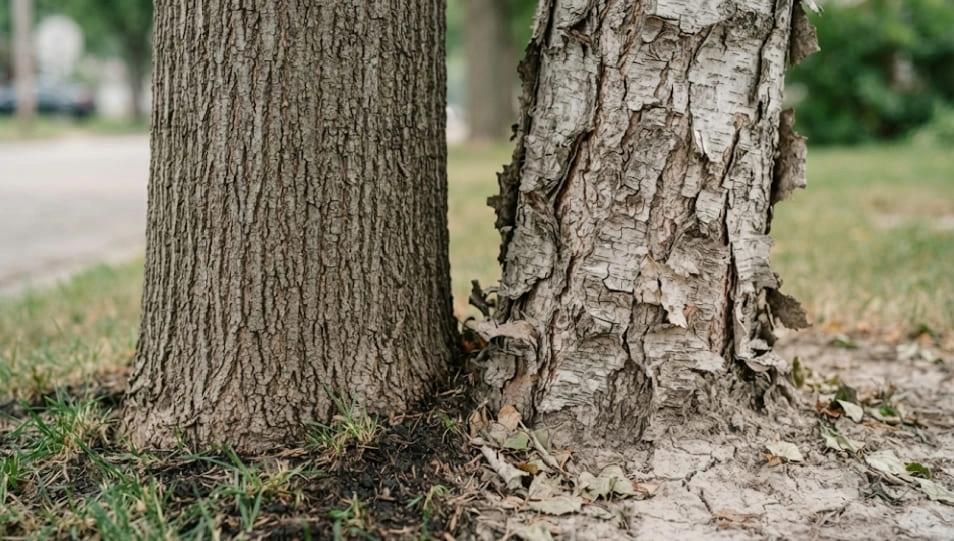
Primary pests attack healthy, vigorous trees. They do not need a stressed or weakened host to establish and kill. Emerald ash borer is the most important example in the Sioux Falls area. EAB will attack and kill a perfectly healthy, well-watered ash tree. This characteristic is what makes it so devastating and why healthy trees in an EAB zone require preventive treatment.
Secondary pests attack trees that are already weakened by drought, disease, root damage, poor planting, or other stressors. A healthy, vigorous tree with adequate moisture typically resists secondary pest attack. Bronze birch borer is a secondary pest that feeds on birch trees weakened from drought, poor growing conditions, or other insect infestations. Native borers in ash trees (including the clearwing ash borer and the redheaded ash borer, which appear in SDSU Extension alerts) follow the same secondary pest pattern.
The practical shortcut: If your previously healthy tree suddenly has a serious borer infestation without any prior signs of stress, drought, or root damage, EAB or another primary pest is the more likely culprit. If your tree has been visibly stressed for a season or two before the borer signs appeared, a secondary pest attacking an already weakened tree is more likely.
This distinction does not replace a professional assessment. But it is a useful starting framework when you are trying to understand what you are looking at.
Emerald Ash Borer (EAB): The High-Priority Threat in Sioux Falls
Pest type: Primary pest, invasive (native to northeast Asia)
Host trees: Ash trees only (Fraxinus species). No other tree species are susceptible.
Status in South Dakota: Confirmed in 13 communities including Sioux Falls, Brandon, Tea, Lennox, Harrisburg, and throughout Minnehaha and Lincoln Counties. As of June 2025, EAB was confirmed in Watertown, expanding the affected zone further.
Key identification signs:
- D-shaped exit holes approximately 1/8 inch (3 to 4 mm) wide in the bark
- S-shaped or serpentine larval galleries beneath the bark, packed with fine frass
- Crown dieback starting in the upper canopy and progressing downward
- Increased woodpecker activity and bark blonding (pale patches from woodpecker feeding)
- Vertical bark splits with galleries visible beneath
- Epicormic shoots (leafy sprouts from trunk or root flare)
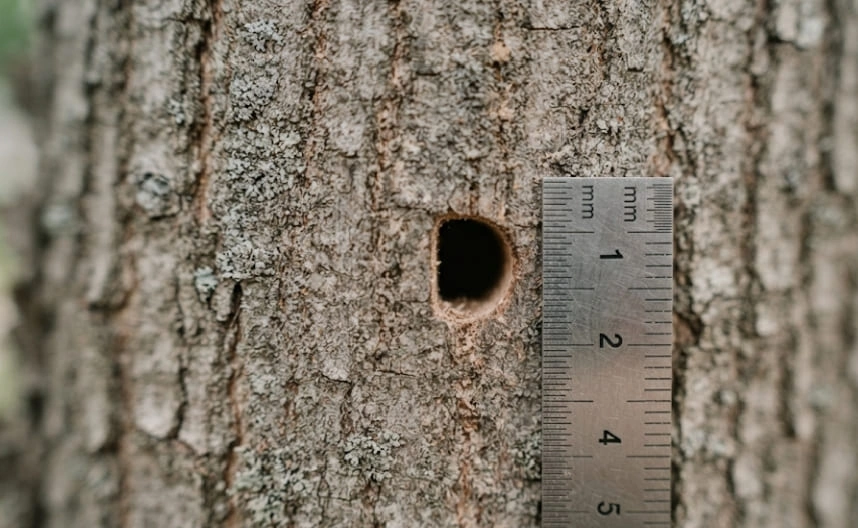
Speed of damage: Three to five years from initial infestation to tree death without treatment.
Can the tree be saved? Yes, if treatment begins before the tree has lost more than approximately 30% of its canopy. The most effective treatment is trunk injection of emamectin benzoate, requiring a licensed pesticide applicator under South Dakota law (SDDANR Commercial Pesticide Applicator certification required).
City of Sioux Falls requirement: Homeowners must either treat ash trees with an ongoing program or remove them. New ash planting is prohibited under city ordinance §94.019.
For a complete identification guide including all seven warning signs, see our full EAB warning signs article for Sioux Falls homeowners. For treatment and removal guidance, see our complete EAB treatment guide.
Bronze Birch Borer: The EAB of Birch Trees
Pest type: Secondary pest, native to North America
Host trees: Birch trees, primarily white birch (Betula papyrifera), European white birch (Betula pendula), and related ornamental cultivars. European birch (Betula pendula) is highly prone to borer attack. River birch (Betula nigra) is thought to be resistant or more tolerant.
Relevance in Sioux Falls: SDSU Extension confirmed bronze birch borer is native to North America and is an active concern in South Dakota, particularly during drought years when birch trees are already stressed. White and European birches are common ornamental trees in Sioux Falls residential yards and are frequently planted along driveways and in landscape beds, often in full sun conditions that predispose them to stress.
Key identification signs:
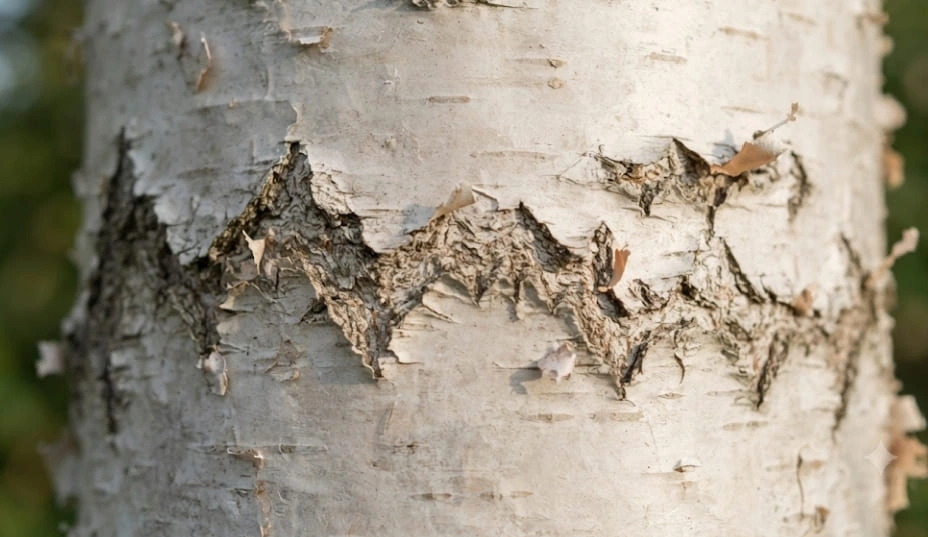
Signs of bronze birch borer include off-color and sparse foliage in the upper canopy, dead branches in the upper crown, and swollen ridges on the trunk and branches. Small D-shaped holes in the bark are the exit points of the adult beetle.
The swollen ridges are the most distinctive feature separating bronze birch borer from EAB. BBB larvae feed relatively close to the bark surface, and the tree’s callus tissue response creates visible raised, zig-zag ridges on branches and trunk. These raised ridges are not typically present with EAB.
EAB vs. Bronze Birch Borer: How to tell them apart:
Both pests produce D-shaped exit holes and gallery damage beneath the bark. The key distinctions are:
- Host tree: EAB attacks only ash trees. Bronze birch borer attacks only birch trees. If you have D-shaped holes in an ash tree, suspect EAB. D-shaped holes in a birch tree suggest bronze birch borer.
- Swollen ridges: Present in BBB infestations. Not a typical EAB symptom.
- Pest origin: BBB is native. EAB is invasive. BBB is a secondary pest requiring prior tree stress. EAB attacks healthy trees.
Speed of damage: Without treatment, the majority of infected birches die between two and four years.
Can the tree be saved? One can achieve a 70 to 85 percent success rate using proactive treatment when canopy decline is less than 40 percent. Imidacloprid soil drenches delivered between April 1 and May 15 penetrate roots during peak transport activity, providing high efficacy for trees with less than 40 percent canopy loss. Professional trunk injections of emamectin benzoate offer deeper penetration and sustained effect.
Prevention: The single most effective prevention is tree selection. River birch (Betula nigra) demonstrates remarkable resistance, with virtually no observed colonization. European white birch (Betula pendula) faces near-complete mortality under BBB pressure. In Sioux Falls’s hot, dry summers, European and ornamental white birches planted in full sun are under constant stress. If you are replacing a birch, river birch is the resistant alternative.
Clearwing Ash Borer: The EAB Look-Alike on Ash Trees
Pest type: Secondary pest, native to North America
Host trees: Ash trees (same host as EAB), occasionally lilac, privet, and other hosts.
Why this matters: The clearwing ash borer is specifically mentioned in SDSU Extension Tree Pest Alerts as a relevant South Dakota tree pest. It attacks ash trees, produces borer damage beneath the bark, and can cause homeowners to believe they are dealing with EAB when they are not.
Key identification signs:
- Round or oval exit holes, not D-shaped. This is the critical distinguishing feature.
- Exit holes are typically larger and more oval than EAB holes.
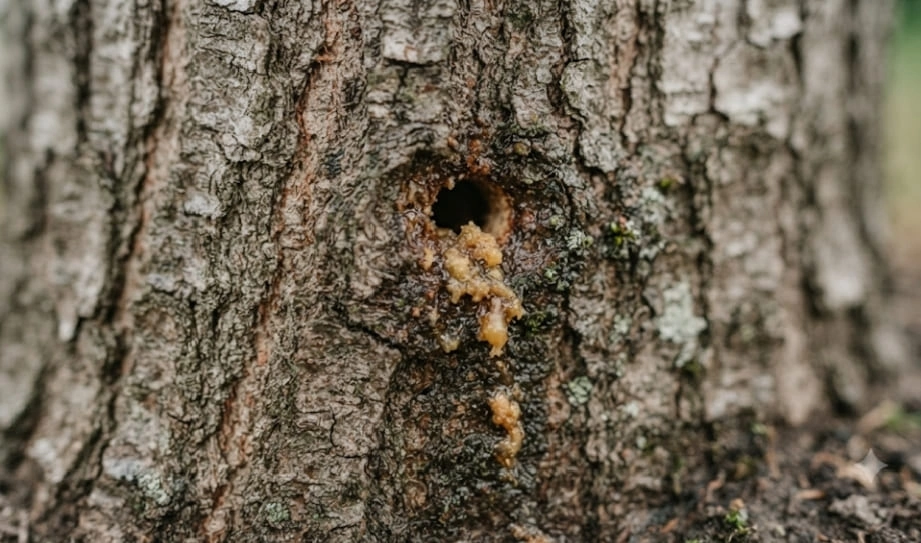
- Gummy, sawdust-like frass pushed out around the base of exit holes.
- Attacks concentrated on trunk, often at soil level or within the first few feet of the trunk.
- Galleries run vertically through the bark rather than in the S-shaped horizontal pattern of EAB.
Clearwing ash borer vs. EAB: How to tell them apart:
The exit hole shape is definitive. EAB produces a distinctly D-shaped hole approximately 1/8 inch wide. Clearwing ash borer produces a round or oval hole, larger and often surrounded by gummy frass at the entry or exit point. If you have round holes in an ash tree, a native clearwing borer is more likely than EAB.
Additionally, clearwing ash borer is a secondary pest. It attacks ash trees already weakened by drought, mechanical damage, or other stressors. A vigorous, healthy ash tree in good growing conditions typically resists clearwing ash borer effectively. EAB attacks regardless of tree health.
Speed of damage: Clearwing ash borer can cause significant structural damage at the base of the tree, but it is far less lethal than EAB and does not universally kill infested trees the way EAB does.
Treatment: Improving overall tree health and addressing the underlying stress factor is the primary management strategy. SDSU Extension recommends bark spray treatments containing permethrin applied in late spring for clearwing ash borer.
European Elm Bark Beetle and Dutch Elm Disease
Pest type: Secondary pest (bark beetle itself), but vector for Dutch elm disease (a primary pathogen)
Host trees: American elm and other elm species.
Relevance in Sioux Falls: American elms remain common in older Sioux Falls neighborhoods, parks, and along established streets. Dutch elm disease, transmitted by the European elm bark beetle as it moves between trees, has been reducing American elm populations in the region for decades. The elm bark beetle was referenced in SDSU Extension alerts for South Dakota in 2025 as an active local concern, including European elm scale on American elm in the Sioux Falls area.
Key identification signs:
- Yellowing and wilting of leaves on individual branches in summer (called flagging).
- Brown streaking in the wood beneath bark when infected branches are cut.
- Small, round exit holes approximately 1/16 to 1/8 inch across, much smaller and rounder than EAB holes.
- Frass and boring dust at the base of the tree.
- Rapid spread of crown dieback if disease takes hold.
EAB vs. Dutch elm disease: How to tell them apart:
These pests attack completely different trees. EAB attacks only ash trees. Dutch elm disease, transmitted by the elm bark beetle, attacks only elm trees. If your tree is a green ash with D-shaped holes, think EAB. If your tree is an American elm with round holes and sudden branch dieback (wilting leaves still attached), think Dutch elm disease.
Speed of damage: Dutch elm disease can kill an American elm within one season in aggressive infections. Slower-progressing infections may allow trees to survive for several years with ongoing management.
Treatment: Fungicide trunk injections (propiconazole) can protect or rescue American elms if applied early. Removing and destroying infected wood before beetle emergence prevents spread to neighboring elms. Maintaining tree vigor through proper watering and mulching is the primary prevention.
Fall Webworm: A Common but Less Lethal Nuisance
Pest type: Secondary pest (a defoliator, not a borer), native to North America
Host trees: Cottonwood, hackberry, black walnut, crabapple, and many other hardwoods. Extremely broad host range covering more than 100 tree species.
Relevance in Sioux Falls: Fall webworm is one of the most visible tree pests in Sioux Falls each summer, producing the distinctive silken web tents on the branch tips of cottonwoods, hackberries, and crabapples throughout the metro area. SDSU Extension confirmed fall webworm was active throughout South Dakota in 2025 and noted that permethrin and Spinosad are effective management options with Spinosad having minimal impact on predators.
Key identification signs:
- Silken web tents enclosing branch tips and leaves, not the branch crotches.
- White or cream-colored caterpillars inside the tent, visible when the web is opened.
- Defoliated, browned leaves within and near the tent.
- Tents typically begin appearing in mid-summer and increase through fall.
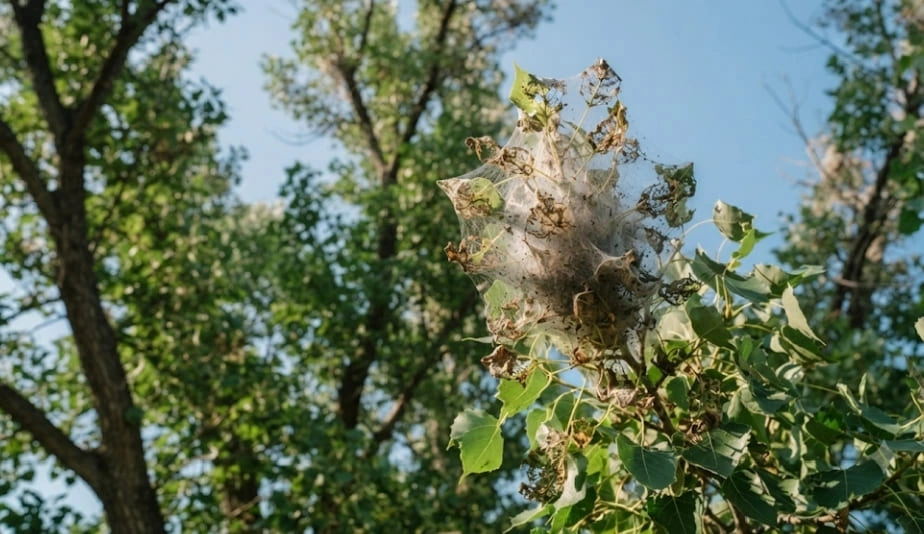
EAB vs. Fall Webworm: How to tell them apart:
These pests could not be more visually different. Fall webworm produces obvious, visible web tents on branch tips. EAB produces no visible tents and its damage is hidden beneath the bark. If you see tents, the problem is fall webworm or eastern tent caterpillar (which creates tents in branch crotches in spring). If you see bark damage, canopy thinning, and no tents, look for borer activity.
Speed of damage: Fall webworm is a defoliator, not a killer. Healthy trees typically recover from defoliation, even severe defoliation over multiple seasons. Repeated heavy defoliation over many consecutive years can weaken trees and make them more susceptible to secondary pests.
Treatment: Hand removal of tents while small and before larvae disperse is effective and requires no pesticides. For larger infestations, Spinosad and Bt (Bacillus thuringiensis) are effective biological insecticides that have minimal impact on beneficial insects. Synthetic permethrin-based treatments are effective but should be used with more caution given their effects on pollinators.
Bagworms: A Serious Threat to Sioux Falls Evergreens
Pest type: Primary pest (attacks vigorous plants), native to eastern North America
Host trees: Juniper, arborvitae, eastern redcedar, pine, and spruce are the primary evergreen hosts in the Sioux Falls area. Bagworms can also infest deciduous trees including elm, hackberry, and maple, though damage is more severe on evergreens.
Relevance in Sioux Falls: Eastern redcedar and arborvitae are among the most common evergreens in Sioux Falls residential yards and windbreaks. Bagworms are a recurring annual threat to these trees throughout the region.
Key identification signs:
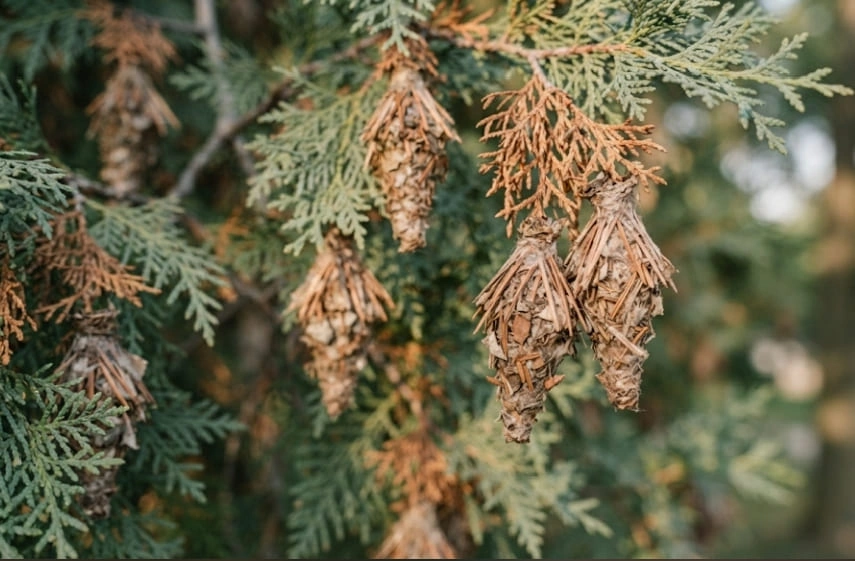
- Distinctive spindle or cone-shaped bags, 1 to 2 inches long, covered with bits of foliage from the host plant.
- Bags hang from branch tips like ornaments.
- Defoliation and browning of foliage in the areas surrounding bag attachment.
- When bagworms feed on evergreens, they can induce plant bronzing, where formerly green sections become bronze or brown. These areas will likely never recover.
EAB vs. Bagworms: How to tell them apart:
There is no meaningful visual overlap. Bagworms produce the most distinctive, visible pest sign of any tree insect in South Dakota. The bags are unmistakable. EAB produces no visible bags, tents, or external structures. If you see conical bags hanging from your evergreen branches, bagworms are the problem.
Speed of damage: A heavy bagworm infestation on an eastern redcedar or arborvitae can kill the tree in two to three consecutive seasons of severe defoliation, particularly because evergreens cannot refoliate from stripped branches the way deciduous trees can.
Treatment: Management is dependent on catching the infestation early in May or June and using biorational insecticides such as Bt (Bacillus thuringiensis), neem, or Spinosad. Older and larger bagworms found in late summer can be partially managed with synthetic insecticides like bifenthrin and carbaryl. Hand removal of bags is also effective. Bags removed in winter and early spring before egg hatch should be destroyed rather than left on the ground, as eggs within the bags remain viable.
Ips Engraver Beetles: A Black Hills and Pine Country Concern
Pest type: Secondary pest, native to North America
Host trees: Ponderosa pine (primary host in South Dakota), also spruce and other conifers.
Relevance in South Dakota: Ips engraver beetles are a significant concern in the Black Hills region of South Dakota, particularly during and after drought conditions. They are referenced repeatedly in SDSU Extension Tree Pest Alerts for the Lawrence County and Black Hills area. They are less directly relevant to Sioux Falls residential yards (which have few ponderosa pines) but are important for any South Dakota homeowner with pine or spruce.
Key identification signs:
- Small, round entry and exit holes in pine bark.
- Distinctive Y-shaped or H-shaped egg galleries beneath the bark (compared to EAB’s S-shaped galleries).
- Reddish-brown boring dust and pitch tubes (small masses of resin) on bark surface.
- Rapid yellowing and browning of needles, often on specific sections of the crown.
- Pitch tubes distinguishable from mere exit holes; the resin flow indicates active attack.
EAB vs. Ips beetles: How to tell them apart:
These pests attack entirely different tree species. EAB attacks only ash trees. Ips beetles attack only pines, spruce, and related conifers. If your tree is a pine or spruce with round holes, boring dust, and needle browning, Ips beetles are the relevant concern. The gallery shape beneath the bark also differs: EAB creates S-shaped horizontal galleries, while Ips beetles create Y-shaped or H-shaped galleries radiating from a central egg-laying chamber.
Speed of damage: SDSU Extension notes that ponderosa pines are susceptible to attack when drought conditions reduce spring precipitation to less than 75% of average. Trees killed by Ips beetles can die rapidly, within a single season in stressed trees.
Treatment: Maintaining tree vigor through watering during drought is the primary prevention. Chemical bark spray treatments with permethrin or carbaryl can protect high-value trees if applied before beetle attack. Removing and chipping or burning infested material before adult emergence prevents population spread.
Cottonwood Borer: A Large Beetle with a Distinctive Appearance
Pest type: Secondary to primary pest (more aggressive than typical secondary pests), native to North America
Host trees: Cottonwood, poplar, and willow species.
Relevance in Sioux Falls: Cottonwoods are among the most common native trees in Sioux Falls, particularly along the Big Sioux River corridor, drainage areas, and older residential neighborhoods. The cottonwood borer is a large, visually distinctive beetle.
Key identification signs:
- Large adult beetles approximately 1 to 1.5 inches long with striking geometric black and white or yellow patterns on the wing covers.
- Larval feeding at the base of the tree or on roots, which can weaken or kill young cottonwoods.
- Large, oval exit holes at or near the soil line.
- Girdling of the root system in young trees, which causes sudden wilting.
EAB vs. Cottonwood Borer: How to tell them apart:
Host tree is the definitive distinction. EAB attacks only ash trees. The cottonwood borer attacks only cottonwood, poplar, and willow. If your cottonwood has large oval holes near the base and weakening symptoms, the cottonwood borer is the more likely explanation than EAB.
Speed of damage: Most severe on young trees under three to four years old. Established mature cottonwoods can tolerate some cottonwood borer activity without severe damage, though repeated heavy attack can significantly weaken them.
Treatment: The best control for the cottonwood borer is to maintain a vigorous, healthy stand. While some systemic insecticides have shown promise, there is currently no registered chemical control method.
How to Tell Which Tree Pest You Are Dealing With
The following identification framework uses the most reliable diagnostic indicators to narrow down which pest you are dealing with.
Step 1: Identify the host tree species.
This single step eliminates the majority of possible pests immediately.
- Ash tree with problems? EAB and clearwing ash borer are the relevant borers.
- Birch tree with problems? Bronze birch borer is the relevant borer.
- Elm tree with problems? European elm bark beetle and Dutch elm disease.
- Cottonwood or poplar with problems? Cottonwood borer or fall webworm.
- Juniper, arborvitae, eastern redcedar with problems? Bagworms first.
- Pine or spruce with problems? Ips engraver beetles if in eastern Black Hills or pine country.
Step 2: Look at the external damage symptoms.
- Visible silk tents on branch tips? Fall webworm.
- Visible conical bags on branches? Bagworms.
- No visible external structure, just canopy decline and bark damage? Borer activity.
Step 3: Examine the exit holes.
- D-shaped holes approximately 1/8 inch wide in ash bark? Strong indicator for EAB.
- D-shaped holes with swollen ridges in birch bark? Bronze birch borer.
- Round or oval holes in ash bark with gummy frass? Clearwing ash borer.
- Small round holes in elm bark? Elm bark beetle.
- Large oval holes at base of cottonwood? Cottonwood borer.
- Round holes with pitch tubes or boring dust on pine? Ips beetles.
Step 4: Examine under the bark where possible.
- S-shaped galleries in ash? EAB confirmed.
- Winding galleries with raised ridges in birch? Bronze birch borer.
- Vertical channels in ash bark near soil line? Clearwing ash borer.
- Y or H-shaped galleries in pine? Ips beetles.
Step 5: Consider tree health history.
- Was the tree previously healthy and vigorous? Primary pest (EAB or bagworms on evergreens) more likely.
- Has the tree been drought-stressed or root-damaged? Secondary pest more likely.
Inspection Checklist:
- Identify the host tree species before investigating symptoms
- Examine the canopy from a distance for thinning, dieback direction, and any silk structures
- Walk around the entire trunk at close range looking for exit holes
- Measure or estimate exit hole size and note shape (D-shaped vs. round vs. oval)
- Check for bark swelling, ridges, or pitch tubes
- Look into any bark cracks or splits for gallery evidence
- Note where damage is concentrated (upper canopy vs. trunk base vs. branch tips)
- Photograph all findings before calling a professional
Prevention Guide for South Dakota Homeowners
Maintain tree health as the foundation of all pest resistance.
For most secondary pests, a healthy and well-maintained tree is substantially more resistant to infestation. The clearwing ash borer, bronze birch borer, Ips beetles, and elm bark beetle all attack trees that are already under stress. Addressing the stress factors reduces susceptibility.
Watering is the single highest-impact maintenance action:
South Dakota summers are periodically drought-stressed, particularly in years when spring precipitation falls below average. Proper watering of high-value trees during dry periods, particularly birch trees which are drought-intolerant and European white birch which is already highly susceptible to bronze birch borer, directly reduces infestation risk.
Mulching:
A 3 to 4 inch layer of organic mulch over the root zone (keeping mulch away from direct trunk contact) moderates soil temperature, retains moisture, and reduces competition from grass. This is particularly beneficial for birch trees and other species sensitive to hot, dry soil conditions.
Annual visual inspections:
Walk your property each spring (late April through May) and again in late summer to monitor for the pest signs listed in this guide. The specific timing:
- April through May: Check for overwintering bagworm bags before egg hatch. Monitor birch trees for early bronze birch borer woodpecker activity. Begin monitoring ash trees for woodpecker blonding.
- May through July: Peak emergence window for EAB, bronze birch borer, and clearwing ash borer. Look for fresh exit holes and adult insect activity.
- July through August: Fall webworm tents begin appearing on cottonwood, hackberry, and crabapple. Bagworm caterpillars actively feeding on evergreens.
- September through October: Final inspection of ash trees for canopy changes since spring. Good window for stump-to-canopy assessment of overall tree condition.
Firewood movement precautions:
EAB spreads primarily through the movement of infested ash firewood, logs, and nursery stock. The South Dakota DANR quarantine prohibits transport of hardwood firewood out of Minnehaha, Lincoln, Brookings, Grant, Turner, and Union counties. Do not transport firewood from South Dakota quarantine counties, and do not bring untreated hardwood firewood into the state from other EAB-confirmed areas.
Species selection for new plantings:
Every tree you plant is a long-term commitment. Selecting pest-resistant species reduces future maintenance burden significantly.
- For birch replacements: River birch (Betula nigra) has very high resistance to bronze birch borer.
- For ash replacements: Ash planting is prohibited in Sioux Falls. Bur oak, hackberry, and Kentucky coffeetree are recommended alternatives.
- For windbreak and screen plantings: Diversify species to avoid creating monocultures vulnerable to any single pest.
Professional inspections:
For high-value specimen trees, a professional assessment by an ISA Certified Arborist every two to three years provides an objective evaluation of tree health, early pest detection, and treatment planning that exceeds what a homeowner visual inspection can reliably achieve.
Frequently Asked Questions
1. How do I know if my tree has EAB or a different borer?
The most reliable first step is identifying the host tree species. EAB attacks only ash trees. Bronze birch borer attacks only birch. Clearwing ash borer attacks ash and lilac. Cottonwood borer attacks cottonwood and poplar. If you have identified the host tree, examine the exit holes. D-shaped holes in ash trees point to EAB. Round or oval holes in ash trees point to a native borer. D-shaped holes with swollen ridges in birch trees point to bronze birch borer.
2. Is bronze birch borer as dangerous as EAB?
Bronze birch borer is serious for birch trees but differs from EAB in important ways. BBB primarily attacks stressed trees, meaning a healthy, well-watered birch has meaningful resistance. EAB attacks healthy ash trees regardless of condition. Both can kill trees without treatment. Both produce D-shaped exit holes and gallery damage. Choosing a resistant birch species (river birch) rather than European or ornamental white birch is the most effective long-term solution.
3. What are the white silk tents on my cottonwood tree?
Silk tents on cottonwood branch tips are almost certainly fall webworm. This is a native caterpillar that builds expanding tents on the branch tips of cottonwoods, hackberries, crabapples, and many other hardwoods. It is a defoliator, not a borer. It does not burrow under bark or produce exit holes. Healthy trees typically recover from fall webworm defoliation. Management involves hand removing tents while small or applying Bt or Spinosad.
4. Can bagworms kill my juniper or arborvitae?
Yes, particularly in repeated infestations. Evergreens, unlike deciduous trees, cannot refoliate from branches that have been completely stripped of needles. Repeated heavy defoliation from bagworms over two to three seasons can kill sections of an arborvitae or eastern redcedar permanently. Early detection in May through June when caterpillars are small, combined with Bt or hand removal, is the most effective approach.
5. Do Ips beetles affect trees in Sioux Falls?
Ips engraver beetles primarily affect ponderosa pine and spruce in the Black Hills and western South Dakota. They are less directly relevant to most Sioux Falls residential yards, which have few ponderosa pines. If you have pines or spruce in your Sioux Falls yard and they are showing rapid browning and round exit holes with boring dust, Ips beetles are worth investigating. Contact SDSU Extension for confirmation.
6. What should I do if I have both ash and birch trees in my Sioux Falls yard?
Each species has its own specific pest threats. Your ash trees require monitoring for EAB (confirmed in Minnehaha County) and annual visual inspection for D-shaped exit holes and canopy thinning. Your birch trees require monitoring for bronze birch borer, which is triggered by drought stress. Watering birch adequately during dry summers is the most important prevention. If you have ornamental European white birch, consider whether replacement with river birch (the resistant species) makes long-term sense.
7. Is Dutch elm disease still a threat in Sioux Falls?
Yes. American elms remain in Sioux Falls’s older neighborhoods, parks, and street plantings. Dutch elm disease, transmitted by the European elm bark beetle, remains an active concern wherever American elms grow. If your elm shows sudden flagging (wilting, brown leaves still attached on individual branches) in summer, contact a licensed arborist promptly. Propiconazole fungicide injection can protect or rescue elms when applied early.
8. How do I tell the difference between fall webworm and eastern tent caterpillar?
Both produce silk tents but at different times and locations. Eastern tent caterpillar appears in spring (April through May) and builds tents in branch crotches. Fall webworm appears in summer and fall and builds tents at branch tips. Both are defoliators and rarely kill healthy trees. Management approaches are similar (Bt, Spinosad, hand removal).
9. My ash tree has round holes, not D-shaped holes. Does that mean it does not have EAB?
Round holes on ash trees suggest a native borer such as the clearwing ash borer or the redheaded ash borer rather than EAB. EAB specifically produces D-shaped exit holes approximately 1/8 inch wide. However, round holes on an ash tree in a confirmed EAB zone are still worth a professional assessment, since EAB could be present even if the visible holes are from a native borer. A professional can examine the gallery pattern beneath the bark to distinguish the two.
10. How can I verify which pest I am dealing with before calling a professional?
Photograph everything systematically: the host tree from a distance for canopy condition, close-ups of any exit holes with a coin or ruler for scale, any bark damage, any visible galleries if bark is cracked, and any webbing or bags. This documentation allows a professional arborist or SDSU Extension specialist to provide a much more informed assessment. You can also submit photographic samples to SDSU Extension’s plant diagnostic clinic.
11. Are there pests that affect oak trees in Sioux Falls?
Bur oak, the most common native oak in the Sioux Falls area, is relatively pest-resistant compared to ash and birch. Oak galls, caused by various gall wasps and midges, are common and appear as lumps or balls on leaves, twigs, or branches. They are generally cosmetic and not dangerous to established oaks. Two-lined chestnut borer can attack oaks under drought stress. Maintaining adequate soil moisture for oak trees during summer drought periods is the primary prevention.
12. Can I treat tree pests myself without hiring a professional?
For some pests, yes. Bagworms can be hand-removed by homeowners. Fall webworm can be managed with homeowner-available Bt or Spinosad. Homeowner-labeled imidacloprid soil drench products are available for some borer pests. However, for EAB specifically, the most effective treatment (emamectin benzoate trunk injection) requires a SDDANR Commercial Pesticide Applicator certification under South Dakota law. Professional application produces significantly more reliable results than homeowner products for ash trees.
13. When should I call SDSU Extension versus a licensed arborist?
SDSU Extension is excellent for pest identification questions and can review photographic samples through their diagnostic services. They publish weekly Tree Pest Alerts at extension.sdstate.edu that cover active SD concerns. A licensed arborist is the right contact for treatment decisions, hazard tree assessments, and actual tree care work. For suspected EAB, contact a licensed arborist with a SDDANR pesticide applicator certification. For unusual damage you cannot identify, SDSU Extension’s diagnostic resources are a good starting point.
14. Should I be more worried about EAB or bronze birch borer in Sioux Falls?
If you have ash trees: EAB is the priority threat. It is confirmed in your area and requires proactive management. If you have ornamental white or European birch: bronze birch borer is the priority threat, particularly after dry summers. If you have both, both pests require attention but on their respective host trees. The two pests do not interact or compete with each other.
15. How do I report a suspected new or unusual tree pest in South Dakota?
Report suspected new EAB infestations or unusual tree pest activity to the South Dakota Department of Agriculture and Natural Resources at emeraldashborerinsouthdakota.sd.gov or through the SDDA main contact. You can also contact SDSU Extension by emailing photographic samples to their plant diagnostic clinic or by reaching Extension county offices throughout the state.
Once You Have Confirmed It Is EAB
What happens next depends on where you are. Crooks has been dealing with confirmed emerald ash borer since May 2022 and is further along the decline curve than anywhere nearby. Lennox only saw confirmation in April 2024, so more trees there remain treatable. In Dell Rapids, river-corridor ash carries flood stress on top of borer damage.