The emerald ash borer has arrived in Sioux Falls and the surrounding region. If you have ash trees on your property, you are already in the affected zone. This is not a future threat. It is a current one.
The good news is that ash trees treated at the right time with the right product can be effectively protected. The difficult news is that the window for treatment closes as the infestation progresses. Trees that cross a critical threshold of canopy decline become too compromised to respond to treatment, and removal becomes the only responsible path forward.
This guide uses official government recommendations, peer-reviewed research, and verified local data to help you understand your situation, evaluate your options, and make the best decision for your specific trees.
What Is Emerald Ash Borer and Why Does It Matter in Sioux Falls?
The emerald ash borer (Agrilus planipennis) is an invasive beetle native to northeast Asia. Native to northeast Asia, EAB likely made its way to the U.S. in shipping containers. It was first discovered in North America in 2002 near Detroit, Michigan, where urban ash trees were observed declining and dying at an unprecedented rate.
The presence of EAB in South Dakota was not officially confirmed until 2018. In March 2025, the USDA reported that EAB is currently present in 37 states, as well as the District of Columbia. The National Park Service estimates that EAB has killed tens of millions of U.S. ash trees over the last two decades.
Where EAB has been confirmed in South Dakota:
EAB has now been confirmed in a total of 13 communities in South Dakota. Affected cities include Sioux Falls, Tea, Dakota Dunes, Lennox, Baltic, Brandon, Worthing, Canton, Hartford, Crooks, Humboldt, Brookings, and Milbank (confirmed June 2025).
If you have ash trees in Sioux Falls, in Brandon, in Tea, in Harrisburg, or anywhere in Minnehaha or Lincoln County, your trees are not waiting for EAB to arrive. They are already in confirmed infestation territory.
Why ash trees matter in Sioux Falls:
Green ash (Fraxinus pennsylvanica) was one of the most heavily planted street and landscape trees in Sioux Falls developments throughout the 1980s, 1990s, and 2000s. It was selected precisely for its fast growth, tolerance of South Dakota’s climate, and hardiness in urban conditions. That widespread planting means the city now has a very large, concentrated ash population that is uniformly vulnerable.
How to Identify an Ash Tree in Your Yard
Before making any treatment or removal decision, confirm the tree in question is actually an ash tree. EAB does not affect other species, so accurate identification matters.
Key identification features of green ash:
Compound leaves. Ash trees have compound leaves with five to nine leaflets arranged in opposite pairs along a central stem, with one terminal leaflet at the tip. The leaflets are typically lance-shaped with slightly toothed or serrated margins.
Opposite branching. Ash trees have branches that grow directly across from each other, not in an alternating pattern. This opposite branching pattern is a reliable identifier when leaves are absent.
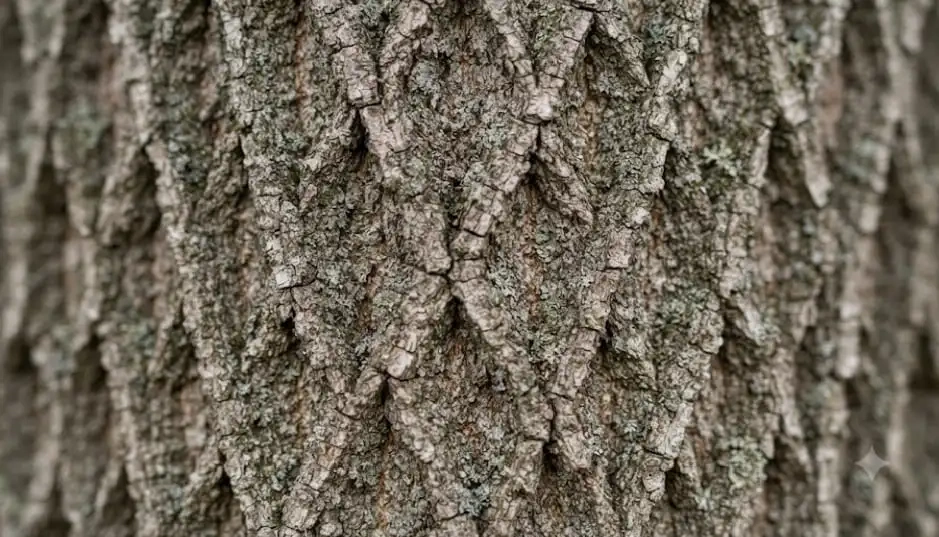
Distinctive bark. Young ash trees have relatively smooth gray bark. Mature trees develop a distinctive diamond-shaped or interlocking ridge pattern that looks like a series of crossing arcs.
Seed clusters. Green ash produces clusters of single-winged seeds called samaras, which look like a narrow paddle or canoe oar. These persist on the tree into fall and winter, making winter identification easier.
Important clarification: Mountain-ash (Sorbus spp.) is not a true ash tree and is not susceptible to EAB. Mountain-ash is not susceptible to EAB because it is not a true ash tree. If your tree has clusters of red-orange berries in fall, it is likely mountain-ash and requires no EAB treatment.
How EAB Kills an Ash Tree: The Biology Behind the Damage
Understanding why EAB is so destructive helps explain why early detection and treatment matter so much.
Adult EAB beetles are small, metallic green insects roughly half an inch long. They emerge from infested trees in late spring and early summer, typically from May through July in South Dakota, and feed briefly on ash leaves. This adult feeding causes minor, largely cosmetic damage. The real destruction happens underground in the larval stage.
After mating, female beetles lay eggs in bark crevices and under bark flaps. The eggs hatch into cream-colored larvae that bore through the outer bark and feed in the phloem, which is the tree’s vascular layer that transports sugars produced by photosynthesis down from the leaves.
The vast majority of damage comes from feeding by the larvae in the phloem tissue, just under the bark. EAB larval galleries also can extend into the sapwood. This feeding behavior damages the vascular system of the tree, blocking water and nutrient transport.
The serpentine or S-shaped tunnels larvae carve through the phloem disrupt the tree’s ability to move water and nutrients between roots and canopy. As infestations build over multiple years and larvae from successive generations carve progressively more galleries through the phloem, the damage compounds. The tree loses the capacity to sustain its canopy, and progressive dieback begins from the top down.
An infected ash tree can no longer transport essential nutrients, which causes it to gradually decline within three to five years.
How to Tell if Your Ash Tree Has Emerald Ash Borer
Early-stage EAB infestation is notoriously difficult to detect visually. The larvae operate beneath the bark, and the adult beetles are small and fast-moving. By the time symptoms are clearly visible to an untrained observer, an infestation has typically been present for two or more years.
Early Symptoms (Years 1 to 2 of Infestation)
At this stage, the tree may appear largely healthy. Signs to look for:
- Subtle thinning in the upper canopy. The very top of the tree may have slightly less leaf density than in prior seasons. This is easy to dismiss as normal annual variation.
- Unusual woodpecker activity. Woodpeckers are attracted to EAB-infested trees, and excessive pecking damage by woodpeckers may be another visible symptom of EAB presence. Woodpeckers are highly effective at detecting larvae through bark. Increased flicker or sapsucker activity on a specific ash tree is a meaningful early warning sign.
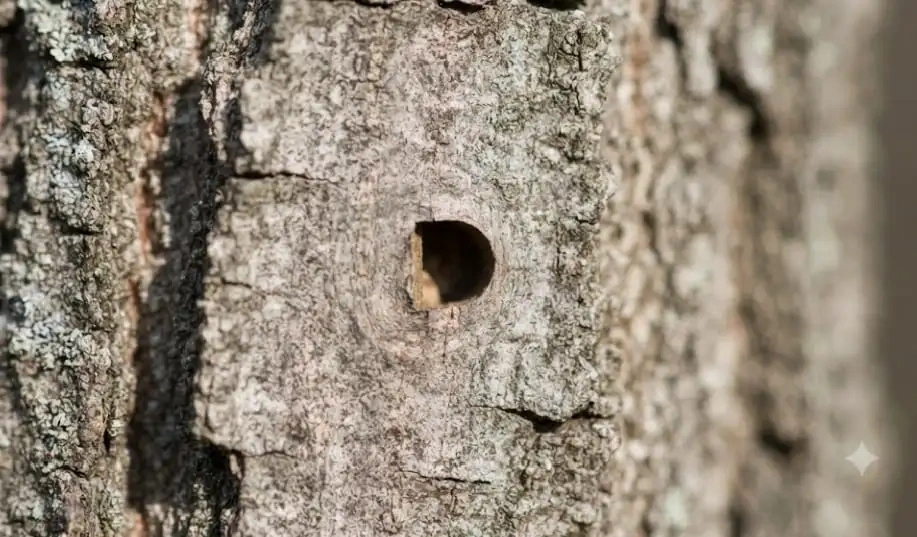
- D-shaped exit holes. Adult beetles emerge from beneath the bark through small, distinctively D-shaped holes roughly 3 to 4 millimeters wide. These holes are flat on one side, matching the shape of the beetle’s body. They may be scattered across the trunk and larger branches.
Moderate Symptoms (Years 2 to 3)
- Visible canopy thinning, 10 to 30% crown dieback. Sections of the canopy are noticeably less dense, with dead branch tips appearing in clusters.
- Bark cracking and splitting. As larvae galleries expand beneath the bark, the bark surface may crack or lift in response to the disrupted tissue beneath.
- Epicormic shoots. The tree begins producing small, leafy shoots directly from the trunk or major branches below the area of canopy dieback. These are a stress response, an attempt by the tree to restore photosynthetic capacity below the damaged phloem zone.
- S-shaped galleries visible under bark. If bark is peeled away from a suspect area, the winding S-shaped galleries carved by larvae will be visible in the cambium and phloem layer.
- Cream-colored larvae may be visible around the bark, which may be 1.5 inches long.
Advanced Symptoms (Years 3 to 5+)
- Crown dieback exceeding 30 to 50% of the canopy. Large sections of the upper and mid-canopy are dead, with no leaves and brittle, dried branches.
- Bark sloughing. Large sections of bark separate and fall from the trunk as the phloem beneath is completely destroyed.
- Dense epicormic growth low on the trunk. The tree is attempting survival by keeping leaves as close as possible to functioning root tissue.
- Full structural collapse of sections. Major scaffolding branches may fail without warning.
Symptom Identification Checklist:
- Increased woodpecker activity on a specific ash tree
- D-shaped exit holes in trunk or large branches
- Thinning or dying branch tips in upper canopy
- Bark cracking or splitting without obvious mechanical cause
- Small leafy shoots emerging from trunk or main branches (epicormic growth)
- S-shaped galleries visible when bark is removed
- Canopy dieback spreading downward through the crown
- Large bark sections beginning to separate from trunk
If you observe three or more of these signs on an ash tree in Sioux Falls, assume EAB is present and consult a qualified arborist promptly.
The 30% Rule: The Most Important Threshold in EAB Treatment
This is the single most important concept in EAB management, and it is consistently underexplained in competitor content.
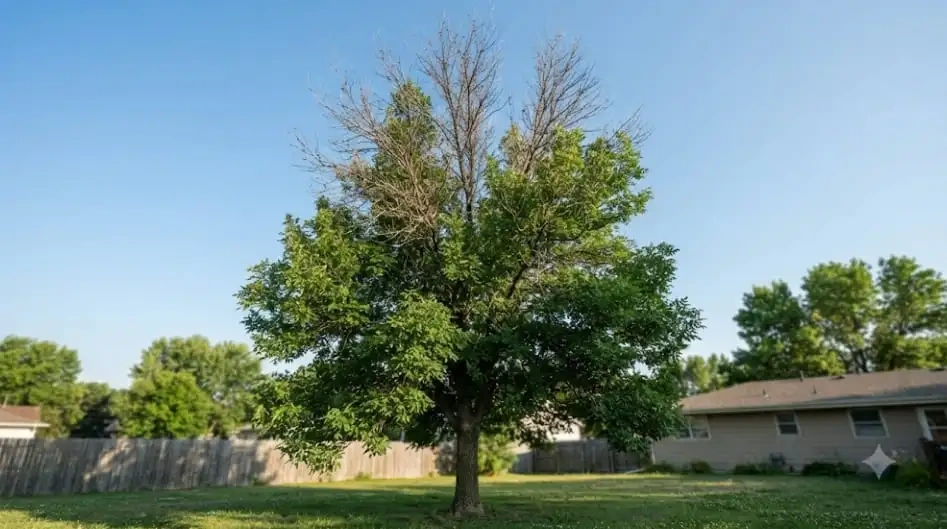
Emamectin benzoate has been demonstrated to provide effective “rescue treatment” of ash trees that have sustained enough injury over the years that there is a reduction in the thickness of the leaf canopy due to accumulated EAB injuries. This insecticide has been shown able to allow tree recovery when trees have sustained some EAB injury but not extensive enough to have produced more than a 30% thinning of the tree canopy.
Peer-reviewed USDA Forest Service research confirms this threshold from the other direction: initially healthy and moderately EAB impacted trees treated with insecticide either maintained or improved their canopy condition, while initially heavily EAB impacted trees stabilized, declined slightly, or died.
What this means in plain terms: if your ash tree has lost less than 30% of its normal canopy fullness, treatment is likely to succeed and the tree can be preserved. If your tree has already lost more than 30% of its canopy, treatment outcomes become significantly less predictable and removal may be the more cost-effective and responsible path.
This is why timing matters so much. A tree that is 20% thinned today may cross 30% by next season, moving from “treatable and likely to respond well” to “treatable but uncertain outcome.” Acting before the threshold is crossed produces the best results and the clearest return on investment.
Your Treatment Options: Four Methods Compared
There are four primary insecticide treatment approaches for EAB management. They differ in active ingredient, application method, timing, efficacy, and which trees they are best suited for. Each requires a South Dakota SDDANR Commercial Pesticide Applicator certification for professional application.
1. Trunk Injection of Emamectin Benzoate
This is the gold standard treatment method for Sioux Falls ash trees, as confirmed by local arborists and peer-reviewed research.
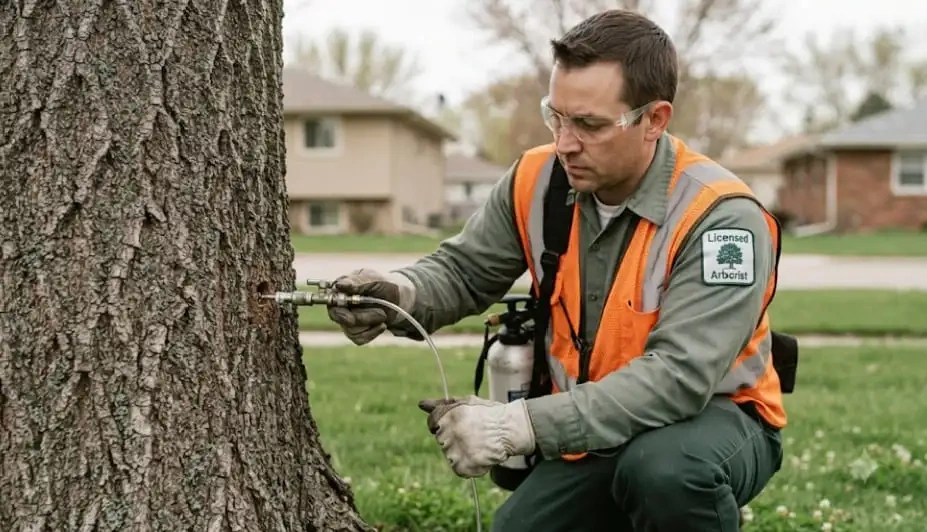
Emamectin benzoate consistently provides at least two years of EAB control with a single application, even in large and very large trees under intense pest pressure. It also provided a higher level of control than other products in side-by-side studies.
The treatment involves drilling small injection ports into the trunk and delivering a precise dose of the active ingredient directly into the xylem, the water-conducting tissue of the tree. The chemical is then transported throughout the tree’s vascular system, killing larvae that feed on treated tissue.
All untreated trees died over the course of the four-year experiment, while on average treated trees did not exhibit a significant decline. Furthermore, initially healthy and moderately EAB impacted trees treated with insecticide either maintained or improved their canopy condition.
Timing: Mid to late spring after the tree has fully leafed out is optimal for emamectin benzoate injection in the Sioux Falls climate. Active water flow through the xylem enhances distribution throughout the crown.
Frequency: Every two years for ongoing protection.
Best for: Trees with less than 30% canopy decline, trees of any size including large mature trees, high-value specimen trees, trees in locations where removal would be costly or disruptive.
2. Soil Drench or Soil Injection of Imidacloprid
Imidacloprid is a neonicotinoid systemic insecticide applied around the base of the tree as a soil drench or soil injection. The chemical is absorbed through the roots and distributed throughout the tree’s vascular system.
University research indicates that soil drenches or injections of imidacloprid provide excellent EAB protection for small ash trees (less than six inches diameter at breast height) in the first year following treatment. Larger trees may require two consecutive years of treatment before they are effectively protected. Thus, treatment of large trees should begin before the trees become infested.
Spring applications have been more effective at controlling EAB and protecting canopy health than fall applications. Most insecticide treatments must be repeated each year. Products containing emamectin benzoate are labeled to provide two years of protection.
Timing: Spring application before or at early bud break for best efficacy. Fall applications are permitted but less effective.
Frequency: Annually.
Best for: Small ash trees (under 6 inches DBH) as preventive treatment. Less effective than emamectin benzoate for large trees or trees already under infestation pressure.
3. Bark Spray of Dinotefuran
Dinotefuran is the most water-soluble of the systemic EAB insecticides and has a distinctive application method.
Dinotefuran is highly water soluble and moves rapidly in plants. It is the only emerald ash borer insecticide that can be applied as a spray on the bark, which can then move into the plant and move systemically.
The product is sprayed onto the bark of the lower trunk, where its water solubility allows it to penetrate bark tissue and enter the tree’s vascular system without drilling. It offers faster initial uptake than soil-applied imidacloprid.
Frequency: Annually.
Best for: Situations where trunk drilling is not desired, smaller trees needing fast initial protection, as a supplemental treatment alongside other methods.
4. Soil Application of Dinotefuran or Other Neonicotinoids
Some homeowner-labeled products containing dinotefuran or imidacloprid are available for direct consumer application via soil drench, without requiring a licensed pesticide applicator. These products have lower concentrations than professional formulations and are generally less effective for larger trees.
Important: For trees of meaningful size or value, professional-grade treatment by a licensed applicator produces significantly more reliable results than homeowner-applied products. The active ingredient concentration and precise dosing in professional trunk injections are what drive the 99%+ efficacy rates cited in research.
Treatment Method Comparison Table
| Factor | Emamectin Benzoate (Injection) | Imidacloprid (Soil) | Dinotefuran (Bark Spray) |
| Application method | Trunk injection | Soil drench or injection | Bark surface spray |
| Efficacy against EAB | Highest (near 99% in research) | High for small trees | Moderate to high |
| Protection duration | 2 years per treatment | 1 year per treatment | 1 year per treatment |
| Best tree size | All sizes including large | Best under 6″ DBH | Smaller trees |
| Rescue treatment capable | Yes, up to 30% canopy loss | Limited rescue capability | Limited rescue capability |
| Requires licensed applicator | Yes | Yes (professional grade) | Homeowner labels available |
| Optimal application timing | Mid to late spring | Spring preferred | Spring preferred |
Treat or Remove? A Decision Framework for Sioux Falls Homeowners
This is the question most homeowners need help answering. The right answer depends on your specific tree’s condition, location, and your long-term property goals.
When Treatment Is the Right Choice
Treatment is worth pursuing when:
- The tree has healthy or only mildly thinned canopy, under 30% loss
- The tree is structurally sound with no major co-dominant stems or pre-existing structural problems
- The tree provides significant shade, privacy, or aesthetic value that would be costly to replace
- The tree is not in a location where removal would be straightforward and inexpensive
- You have a long-term commitment to maintaining the treatment schedule
- The tree has been assessed by a qualified arborist as a good treatment candidate
- The estimated 10-year cost of treatment is lower than the cost of removal plus replacement planting
When Removal Is the Right Choice
Removal becomes the more responsible option when:
- The tree has lost more than 30% of its canopy from EAB damage
- Large dead branches are visible in the upper canopy, creating a drop hazard
- The tree has structural problems independent of EAB (co-dominant stems, root damage, prior disease)
- The tree’s location makes removal straightforward and relatively low cost
- The tree is already dead or nearly dead, with no recoverable canopy
- Treatment costs over 10 years would exceed the realistic value of the tree to the property
- The tree is a small, young ash not yet providing significant canopy benefit
A specific safety warning for Sioux Falls homeowners with declining ash trees:
Local arborists note that the wood of EAB-killed ash trees becomes extremely brittle. It has been described as similar to rotten styrofoam. Unlike when other trees die and might stand for a while or actually get harder, EAB-killed ash trees are uniquely hazardous.
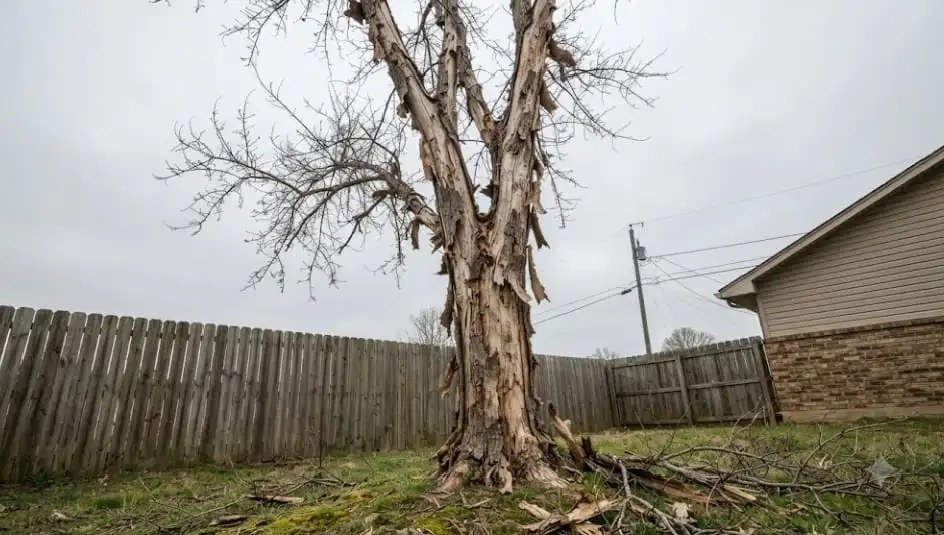
A dead or heavily declining ash tree does not behave like other dead trees. Its structural failure is unpredictable, rapid, and can occur even in calm conditions. Dead ash trees adjacent to structures, vehicles, pedestrian areas, or neighboring properties should be treated as urgent removal priorities.
The 10-Year Cost Comparison
For a medium-sized ash tree (approximately 15-inch diameter), the rough financial comparison looks like this:
| Scenario | Estimated 10-Year Cost |
| Emamectin benzoate injection every 2 years ($250/treatment) | $1,250 (5 treatments) |
| Imidacloprid soil drench annually ($150/treatment) | $1,500 (10 treatments) |
| Remove now ($800 to $1,500) + new tree ($200 to $500 planted) | $1,000 to $2,000 total, no ongoing cost |
| Wait until tree dies, emergency removal | $1,500 to $3,000+ emergency removal |
For a tree with significant property value, shade function, or replacement difficulty, treatment at $1,250 to $1,500 over ten years is often the better financial choice. For a tree in marginal health or a location with easy access for removal, the math often favors removal and replacement now.
EAB Treatment and Removal Cost Breakdown
Treatment costs in the Sioux Falls area:
Treatments typically cost $150 to $350 per tree and need to be repeated every two years. After the primary infestation is over and most of the ash within the area are dead, you can treat every four years.
The per-treatment cost varies based on tree diameter (which determines the volume of product required), tree height, and site access. Larger trees cost more per treatment. The emamectin benzoate trunk injection method, which is the most effective option, is also typically priced at the higher end of the range for larger trees.
Removal costs for EAB-affected ash trees:
Ash trees in various stages of EAB decline follow the same general removal pricing as other trees of their size, but with an important caveat: severely declined or dead ash trees may carry a hazard surcharge due to their unpredictable brittleness. Expect:
- Small ash trees (under 25 feet): $300 to $700 for removal
- Medium ash trees (25 to 50 feet): $700 to $1,500
- Large ash trees (50 to 75 feet): $1,500 to $3,000
- Very large ash trees near structures: $3,000+
- Emergency removal after structural failure: $1,500 to $5,000+
For detailed removal pricing specific to the Sioux Falls market, see our full tree removal cost guide.
Stump grinding after ash removal:
After removing an EAB-killed or declining ash tree, stump grinding adds $75 to $300 depending on stump diameter. This cost is separate from the removal quote in most cases.
What Sioux Falls City Guidelines Require of Homeowners
The City of Sioux Falls has taken an active position on EAB management that directly affects private property owners.
The City of Sioux Falls reminds homeowners that if you are not performing treatment on your ash trees for EAB, you will be required to remove them.
This is a meaningful requirement. The city’s position is not advisory. Homeowners with ash trees in Sioux Falls face a binary choice: commit to an ongoing treatment program to keep the tree alive and compliant, or remove the tree. Leaving an untreated, declining ash tree on private property without a plan is not a permissible middle ground under city guidelines.
Additionally, the City of Sioux Falls Code of Ordinances Chapter 94 prohibits the planting of new ash trees within city limits (§94.019). This prohibition was established in anticipation of the EAB threat and applies regardless of whether a homeowner is replacing a removed ash. When you remove an ash tree, your replacement planting must be a different species.
For street trees, only contractors on the city’s annual Licensed Arborist List are authorized to perform work. For private property trees, the city does not require using a specific licensed arborist, but using a contractor with an ISA Certified Arborist and the required SDDANR Commercial Pesticide Applicator license is strongly advisable.
South Dakota Quarantine: What You Cannot Move
As of June 2025, the South Dakota DANR expanded a plant pest quarantine to an additional county. This law makes it illegal to transport commercial and personal hardwood-based firewood outside of the designated counties, as well as any other ash materials. The quarantine counties include Brookings, Grant, Lincoln, Minnehaha, Turner, and Union counties.
What this means practically for Sioux Falls homeowners:
- Do not transport firewood from ash or any other hardwood species out of Minnehaha County
- Do not transport ash wood, ash chips, ash logs, or ash nursery stock out of the quarantine zone
- Ash wood debris from removal or trimming should be processed (chipped, burned, or buried) locally rather than transported
- These same restrictions are in place in neighboring states on South Dakota’s eastern border
Violations of the quarantine carry legal penalties under SDCL §38-21. If you have ash wood removed from your property, ask your contractor how they will handle disposal and confirm it complies with quarantine requirements.
When Is It Too Late to Save an Ash Tree?
This is the most important practical question for homeowners who have delayed evaluation.
The answer depends on canopy condition. The scientifically established threshold is 30% canopy loss. Trees below this threshold respond well to emamectin benzoate treatment and can maintain or recover canopy condition. Trees above this threshold have significantly lower treatment success rates.
However, 30% is not a cliff. Some trees with 35% to 40% canopy loss still respond to treatment, particularly if the loss is recent and not compounded by other stress factors. Some trees at or near 30% loss are in such overall poor health, with root damage, soil compaction, or prior disease, that treatment is not likely to succeed even at lower infestation levels.
The honest answer is that 30% canopy loss is the point at which treatment moves from “likely to work” to “uncertain outcome.” If your tree is past that threshold, a consultation with an ISA Certified Arborist is the best next step, specifically one who can assess the full picture of the tree’s condition, not just the EAB infestation level.
Any tree with no living canopy remaining should not be treated. At that point, the tree is dead and removal is the only option.
Tree Replacement Planning: What to Plant Instead
Because the Sioux Falls city ordinance prohibits replanting ash trees, replacement requires a different species. The following species have been identified as performing well in South Dakota’s climate and urban conditions, and are recommended by South Dakota State University Extension and similar regional authorities.
Recommended replacement species for Sioux Falls:
- Bur oak (Quercus macrocarpa): The most climate-appropriate large tree for the region. Deep-rooted, extremely drought tolerant, long-lived, and resistant to most major pests and diseases. Slower growing than ash but incomparably more durable over the long term.
- Hackberry (Celtis occidentalis): Native to the Plains, extremely adaptable to the harsh Sioux Falls climate including wind, drought, and clay soils. Good shade tree with similar canopy character to ash.
- Kentucky coffeetree (Gymnocladus dioicus): Native to the region, excellent urban tolerance, no significant pest or disease pressures, unusual and attractive structure.
- Swamp white oak (Quercus bicolor): Adapts well to the variable moisture conditions common in Sioux Falls yards. Medium to large size with excellent fall color.
- American linden (Tilia americana): Excellent shade tree with fragrant flowers, good performance in SD urban conditions.
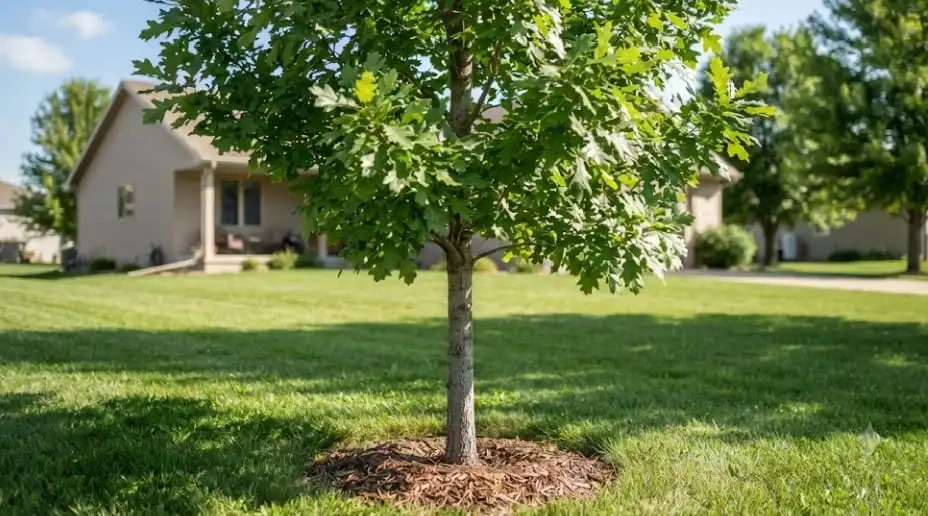
When selecting a replacement tree, prioritize diversity. If your neighbor also has an ash tree and you both replace with the same species, you are recreating the monoculture vulnerability that made the ash borer crisis so severe in the first place.
Common Mistakes Sioux Falls Homeowners Make with EAB
Waiting too long to evaluate. EAB operates beneath the bark for the first one to two years of infestation before symptoms become obvious. By the time canopy thinning is clearly visible, infestation has been building for some time. Annual visual monitoring of ash trees in the growing season, specifically looking for woodpecker activity and upper canopy thinning, is the best early-detection practice.
Assuming the tree looks fine, so it is fine. Early EAB infestation is nearly invisible from the ground. A tree that appears healthy may have one or two years of larval activity already under its bark. In the Sioux Falls area, where EAB is confirmed, the question is not whether your ash tree will be challenged. It is whether it has been treated preventively.
Choosing the cheapest treatment without verifying credentials. EAB treatment requires a SDDANR Commercial Pesticide Applicator license in South Dakota. A contractor offering injection treatments without this credential is either applying pesticides illegally or misrepresenting the service. Treatment done incorrectly with wrong concentrations, wrong timing, or improper injection technique will not protect the tree.
Removing the tree before the city or insurance documentation is complete. After storm-related ash tree failures, removing the tree before documenting damage for insurance purposes can complicate claims. Photograph everything before removal.
Not budgeting for stump grinding. Ash stump grinding is almost always a separate cost from removal. The stump of a large ash tree can be 24 inches or more in diameter, placing it in the higher cost range for grinding.
Assuming treatment is a one-time fix. EAB treatment requires commitment. Emamectin benzoate requires reapplication every two years for the life of the tree. Imidacloprid requires annual application. Stopping treatment leaves the tree unprotected in a quarantine zone where ongoing pressure from nearby infestations will persist for decades.
Frequently Asked Questions
1. Has EAB been confirmed in Sioux Falls?
Yes. EAB has been confirmed in Sioux Falls as well as the surrounding communities of Brandon, Tea, Lennox, Baltic, Worthing, Canton, Hartford, Crooks, and Humboldt. The South Dakota quarantine covers Minnehaha and Lincoln Counties, both of which include Sioux Falls and its surrounding suburban areas. If you have ash trees in the metro area, they are in a confirmed EAB zone.
2. What species of ash trees are in Sioux Falls yards?
Green ash (Fraxinus pennsylvanica) is by far the most common ash species in Sioux Falls residential landscapes. It was widely planted throughout the city’s residential expansion from the 1980s through the 2000s. White ash (Fraxinus americana) is less common in the area but equally susceptible to EAB. Both species are affected identically by EAB.
3. Does the City of Sioux Falls require me to do something about my ash trees?
Yes. The city’s position is that homeowners must either treat their ash trees with an ongoing treatment program or remove them. Untreated ash trees left to decline without a plan are not acceptable under city guidelines. Additionally, the city prohibits planting new ash trees, so any ash removed must be replaced with a different species.
4. Can I treat my ash tree myself without hiring a professional?
Some lower-concentration homeowner-labeled products are available without a pesticide license, but they are significantly less effective than professional-grade formulations, particularly for trees over six inches in diameter. Professional trunk injection of emamectin benzoate, which is the most effective treatment available, must be performed by a licensed pesticide applicator under South Dakota law. For a valuable mature ash tree, professional treatment is strongly recommended.
5. How do I find a qualified EAB treatment provider in Sioux Falls?
Look for a contractor who holds a current SDDANR Commercial Pesticide Applicator license, preferably also has an ISA Certified Arborist on staff, and can provide references for EAB treatment work. Ask specifically which active ingredient they use and what equipment they use for trunk injection. A licensed provider will answer these questions directly and in detail.
6. Can EAB spread from my neighbor’s tree to mine?
Yes. Adult EAB beetles can fly up to several miles. If a neighbor’s ash tree is infested, your ash tree is at risk from airborne adult beetles. This is why individual property-based treatment is insufficient for area management. The city of Sioux Falls and South Dakota DANR support community-level management approaches, but individual property treatment is each homeowner’s responsibility.
7. Is it illegal to transport ash wood from Sioux Falls to another county?
Yes, within the quarantine framework. The SD DANR quarantine prohibits transport of hardwood firewood or ash materials out of Minnehaha, Lincoln, Brookings, Grant, Turner, and Union counties. This applies to both commercial and personal transport. Ask your tree removal contractor how they plan to handle wood disposal to ensure compliance.
8. How long does emamectin benzoate treatment last?
A single trunk injection of emamectin benzoate provides two years of protection. Research confirms this two-year efficacy even in large trees under significant EAB pressure. Reapplication every two years is required for ongoing protection.
9. My ash tree looks healthy. Should I still treat it?
Yes, especially in Sioux Falls. EAB operates beneath the bark for one to two years before visible symptoms appear. Industry guidelines recommend beginning preventive treatment for any ash tree within 15 miles of a confirmed EAB detection. Sioux Falls is well within that radius of numerous confirmed finds. Preventive treatment of a healthy tree is more effective and less expensive per year than treating a declining tree.
10. What are the warning signs that my ash tree is about to fail structurally?
Ash trees killed by EAB develop uniquely brittle wood that can fail suddenly. Warning signs of imminent structural risk include very large dead branches in the upper crown, bark sloughing off in large sections, complete crown dieback with no remaining live growth, and epicormic shoots representing the only living portion of the tree. Any ash tree exhibiting these signs near a structure, vehicle, or pedestrian area should be evaluated as an urgent removal priority.
11. How much canopy loss is too much for treatment?
The research-established threshold is 30% canopy loss. Trees with less than 30% canopy thinning can respond well to treatment and maintain or recover canopy condition. Trees with more than 30% canopy loss have lower and less predictable treatment outcomes. Some trees just above this threshold may still benefit from treatment, particularly if the decline is recent and the tree is otherwise healthy, but the decision requires a professional assessment.
12. Does removing my ash tree now save money compared to waiting?
For many homeowners, yes. A tree in moderate decline removed now costs $700 to $2,000 in most cases. The same tree after complete structural failure creates an emergency removal costing $1,500 to $5,000 or more, with potential property damage. The narrow window between “treatable” and “hazardous dead tree” in ash trees affected by EAB moves faster than with other species.
13. What should I plant to replace a removed ash tree?
The City of Sioux Falls prohibits replanting ash. Recommended alternatives for the SD climate include bur oak, hackberry, Kentucky coffeetree, swamp white oak, and American linden. Prioritize species diversity: if other trees in your yard or neighborhood are already heavily planted, choose a different species to spread the risk across multiple types.
14. Are ash trees on the street or boulevard my responsibility?
Street trees in Sioux Falls are generally maintained by the city, but the line of responsibility can be complicated. Check with the City of Sioux Falls Parks and Recreation or Planning and Development departments for guidance on specific street trees adjacent to your property. Work on street trees requires a contractor from the city’s Licensed Arborist List.
15. What is the best time of year to treat ash trees in Sioux Falls?
Spring is the optimal treatment season. For emamectin benzoate trunk injection, mid to late spring after the tree has fully leafed out provides the best distribution through the xylem. For soil-applied imidacloprid, spring application before or at early bud break is more effective than fall application. Fall treatments are permitted on certain product labels but have lower efficacy than spring applications in research studies.
Local Conditions Across the Area
Timelines differ significantly between communities. Crooks was first, in May 2022. Brandon followed in July 2022, and the city there removes boulevard ash at no cost to the property owner. Lennox was last, in April 2024. Dell Rapids has ash concentrated along the river where flooding has already weakened it.