Emerald ash borer is confirmed in Sioux Falls, Brandon, Tea, Lennox, Harrisburg, and throughout Minnehaha and Lincoln Counties. If you have ash trees on your property, the question is no longer whether your trees will face EAB pressure. The question is how far along the infestation is and whether you still have a treatment window.
The challenge is that EAB is genuinely difficult to detect in its early stages. EAB is difficult to detect early when pest populations are small because damage to the trees is hidden under the bark and tree decline is gradual. By the time the clearest symptoms become visible, the infestation has typically been building for one to two years.
This guide walks you through all seven scientifically verified warning signs, what each one looks like, when each one appears, and what you should do when you find them.
Why Early Detection Is Critical in Sioux Falls
The treatment window for an EAB-infested ash tree closes at approximately 30% canopy loss. Trees below that threshold respond well to trunk injection treatment. Trees above it have significantly lower treatment success rates.
The progression from healthy tree to dead tree under EAB pressure takes three to five years in most cases. The first one to two years of that timeline often produce no obvious visual symptoms at all. By the time symptoms are clearly visible to an untrained observer, the tree may already be approaching or past the point where treatment is most effective.
This is why annual monitoring of ash trees in Sioux Falls, using the specific signs in this guide, is the most effective way to protect your trees. Finding these signs early, when the tree is still largely healthy, is the difference between a treatable situation and a removal decision.
First: Confirm You Have an Ash Tree
EAB attacks only true ash trees in the genus Fraxinus. Before investigating any warning signs, confirm the tree is actually an ash. EAB has no effect on other species.
Four ways to identify an ash tree:
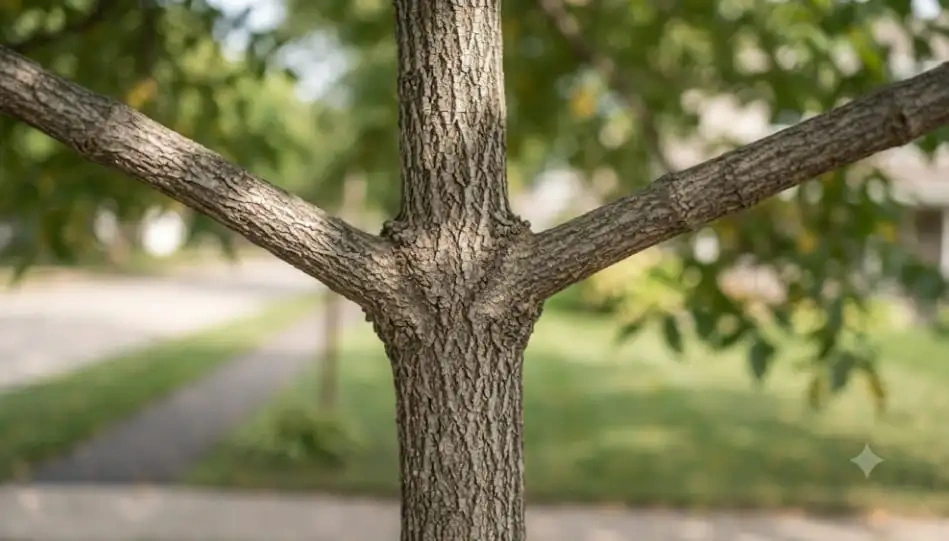
Opposite compound leaves. Ash leaves are compound, meaning each leaf is made up of five to nine smaller leaflets arranged in pairs along a central stem, with one leaflet at the tip. The leaves are arranged on branches in an opposite pattern, meaning directly across from each other rather than alternating.
Opposite branching. Ash branches grow in directly opposing pairs. From a distance, this gives mature ash trees a noticeably symmetrical branching structure. This is visible even in winter.
Diamond-pattern bark on mature trees. Mature green ash trees develop a distinctive interlocking ridge pattern in their bark that forms rough diamond or X shapes. Young ash trees have relatively smooth gray bark that has not yet developed this pattern.
Winged seeds (samaras). Green ash produces clusters of narrow, oar-shaped winged seeds that persist on the tree into late fall and winter. These are an easy winter identification feature.
One important clarification: Mountain-ash trees, which are common ornamentals in Sioux Falls yards and produce clusters of red-orange berries in fall, are not true ash trees. They belong to the genus Sorbus, not Fraxinus, and are not susceptible to EAB. If your tree has berries rather than winged seeds, it is not an ash tree.
The 7 Warning Signs of Emerald Ash Borer
Sign 1: Dead Branches Starting at the Top of the Tree
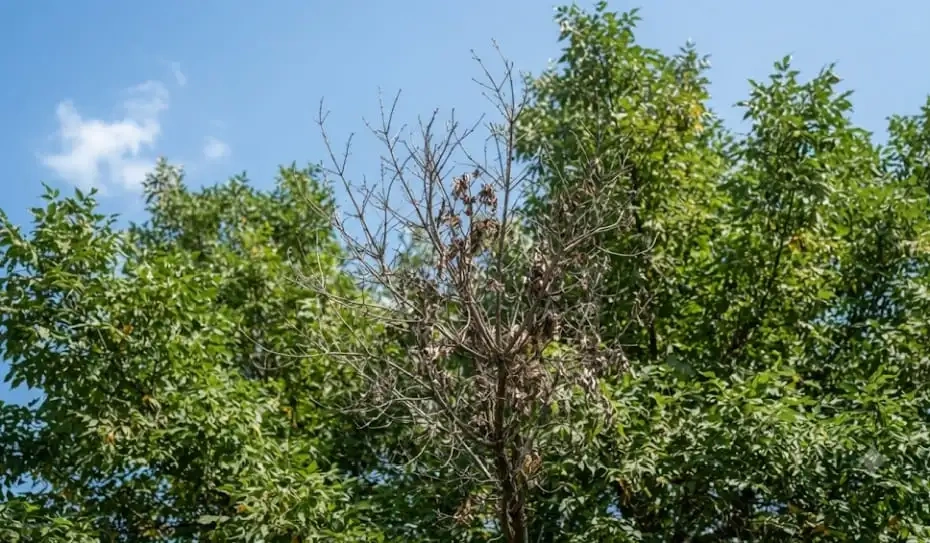
What it looks like: A section or cluster of branches in the upper canopy that have died. The dead branches have no leaves during the growing season and the smaller twigs are brittle and snap easily. The dieback typically begins in isolated sections of the upper crown and spreads progressively downward and outward over subsequent seasons.
Why it happens: EAB larvae feed in the phloem layer directly beneath the bark. The phloem is the tree’s nutrient transport system, responsible for moving sugars produced by photosynthesis downward from the leaves to the roots. As larvae create winding feeding galleries through the phloem, they disrupt this transport system progressively. The upper canopy, which is furthest from the root system and dependent on effective phloem transport, is the first part of the tree to show symptoms when that transport is compromised.
When it appears: Trees typically show thinning of leaves at the top of the tree within one to three years of infestation, followed by individual branch and tree death. For a Sioux Falls homeowner, a tree that appeared perfectly healthy two summers ago and now has a noticeably dead upper section may have been infested for one to three years already.
How serious it is: If dead branch tips are scattered through the upper crown but the tree still has most of its canopy, the infestation may still be in a treatable range. If entire upper scaffold branches are dead and the dieback is progressing visibly downward from season to season, the tree is approaching or may have crossed the 30% canopy loss treatment threshold.
What to do: Look from a distance to assess what percentage of the total canopy appears dead. If you estimate less than 30% of the canopy is gone, contact a licensed arborist for a treatment evaluation promptly. If you estimate more than 30%, seek a professional assessment for both treatment candidacy and removal planning.
Sign 2: Thinning Leaves and Canopy Dieback
What it looks like: Before branches die entirely, they often produce fewer or smaller leaves than in previous seasons. The canopy looks less dense or full than it has in past summers. Sections of the crown that used to cast dense shade now allow more light through. Leaves may be noticeably smaller, yellowed at the edges, or sparse on specific branches.
Why it happens: The same mechanism as crown dieback, but at an earlier stage. Partial phloem disruption means the tree can still move some nutrients but not enough to support full normal leaf production on all branches. The tree essentially begins rationing, producing fewer leaves in the areas where phloem damage has accumulated.
When it appears: Canopy thinning is typically visible in the growing season one to three years after initial infestation. It is easy to dismiss in a single season as normal annual variation, drought stress, or heat stress, which is one reason EAB detection is often delayed.
How serious it is: Subtle thinning with no dead branches is a relatively early signal. It becomes more serious when the thinning is localized to specific sections of the crown or is noticeably progressive year over year.
What to do: Take a photograph of the tree from the same angle at the start of each growing season. Comparing photos from successive years is the most reliable way to detect progressive canopy thinning that might otherwise be dismissed in a single observation.
Sign 3: D-Shaped Exit Holes in the Bark
What it looks like: Small holes in the bark of the trunk or larger branches, each roughly 1/8 inch (3 to 4 millimeters) wide. The holes are distinctively D-shaped, with one flat side and one curved side, rather than perfectly round. The flat side of the D can be oriented in any direction. The holes may be scattered singly or in small clusters.
Why it happens: After larvae complete their development beneath the bark, they pupate and transform into adult beetles. Adult beetles bore exit tunnels directly through the bark to emerge in late spring and early summer. Their body shape, which is somewhat elongated and flat on one side, creates the characteristic D-shaped profile as they exit.
EAB emergence holes are found a year or more after initial attack when adults emerge from the tree by boring through the bark. The emergence holes are an obvious D-shape and 3.5 to 4 mm wide. At early stages of infestation, binoculars or a spotting scope may be needed.
When it appears: Exit holes first appear at least one year after initial infestation, when the first generation of larvae has completed development and adults emerge. In Sioux Falls, adult emergence primarily occurs from late May through July.
How serious it is: Finding D-shaped exit holes is strong evidence of EAB and should be treated as confirmation of an active or recent infestation. The number of exit holes per unit of bark area gives a rough indication of infestation intensity.
Critical identification detail: Exit holes of native borers will be round or oval and can vary in size. The D-shaped hole is the distinctive EAB feature. If you see round holes, those are more likely native wood-boring beetles, which typically only attack already-stressed trees. D-shaped holes specifically, approximately 1/8 inch wide, are the diagnostic EAB indicator.
What to do: Use a ruler or a standard penny (approximately 3/4 inch in diameter) to estimate the hole size. A hole narrower than a pencil eraser and clearly D-shaped warrants immediate professional assessment. Document with photographs.
Sign 4: S-Shaped Tunnels Beneath the Bark
What it looks like: Winding, serpentine channels carved through the wood just beneath the bark surface, packed with fine, sawdust-like frass (a mix of excrement and chewed wood fiber). The galleries form an S or sinuous pattern rather than a straight line, following the larva’s path as it feeds back and forth across the phloem.
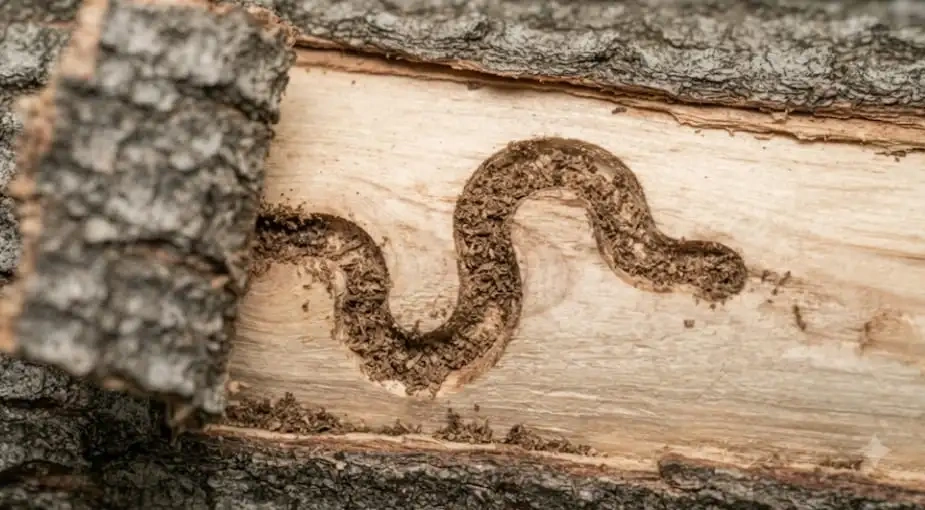
Why it happens: EAB larvae do not bore straight into the wood. They feed horizontally through the phloem and outer sapwood in a back-and-forth pattern, carving widening galleries as they grow. The S-shape reflects the larva’s feeding behavior as it systematically destroys the vascular tissue in its path.
When it appears: Galleries are present from the time larvae begin feeding, which is typically in the first summer after egg hatch. However, they are only visible when bark is physically removed.
How to find them: Look at areas where bark has already split or where large patches have separated from the trunk. Galleries are often visible without tools at these locations. If you want to actively investigate, use a pocket knife or flathead screwdriver to carefully pry up a small section of loose or cracked bark in a suspect area, ideally in the mid-trunk zone.
How serious it is: Finding S-shaped galleries beneath the bark is diagnostic confirmation of EAB. There is no other insect in the Sioux Falls area that produces this specific gallery pattern in ash trees.
What to do: Photograph the galleries clearly before closing the bark. This documentation is useful for an arborist assessment and confirms the identification before pursuing treatment or removal.
Sign 5: Increased Woodpecker Activity and Bark Blonding
What it looks like: Two related visual indicators appear together. First, you may notice a significant increase in the presence of woodpeckers, particularly downy woodpeckers, hairy woodpeckers, or northern flickers, pecking repeatedly at the trunk and larger branches of a specific ash tree. Second, the bark develops pale yellow or light-colored patches where the woodpeckers have stripped away the outer bark surface in search of larvae. This pale patching is referred to as “bark blonding” or “woodpecker flecking.”
Woodpeckers peel layers of bark off of the tree when foraging for EAB larvae. The trunk appears light-colored where the bark has been stripped.
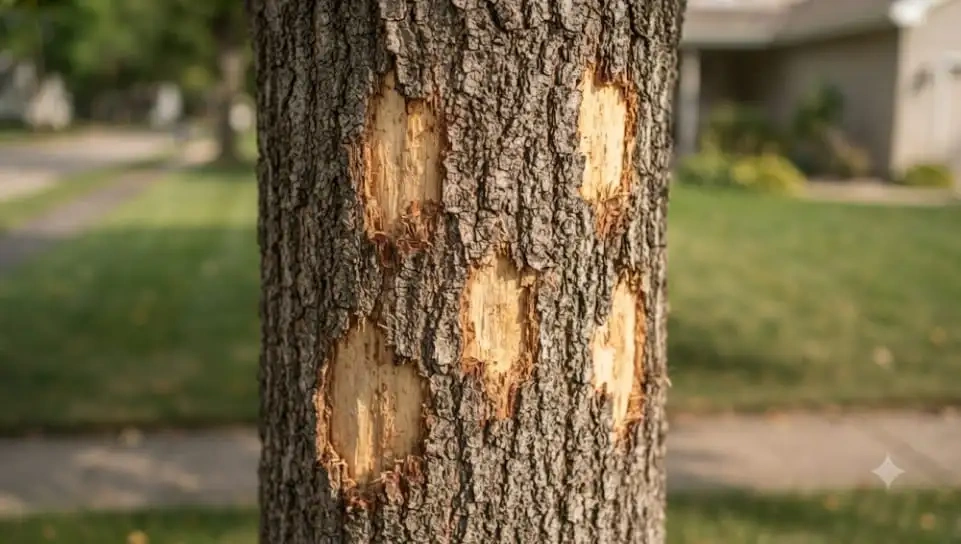
Why it happens: Woodpeckers are highly effective at detecting insect larvae through bark using both sound (tapping and listening) and vibration sensing. EAB larvae feeding beneath the bark are detectable to woodpeckers even when not visible to humans. A woodpecker that has located a productive foraging site on an ash tree will return repeatedly and may recruit other woodpeckers.
When it appears: Woodpecker damage usually becomes apparent in the second year of infestation and becomes more pronounced by the third year. This timing is actually useful as an infestation staging indicator. Significant woodpecker activity suggests the tree has been infested for at least one to two years.
How serious it is: Woodpecker activity alone does not exclusively confirm EAB, as woodpeckers will also feed on other insect larvae in trees. However, woodpecker activity simply indicates insect activity within the trunk of the tree. Other ash-boring insects usually only attack already stressed trees, so if the tree was previously healthy, EAB should be suspected.
What to do: Observe over several days to confirm the activity is persistent and concentrated on the ash tree specifically. Note whether the blonding patches are on the trunk, larger branches, or both. Extensive blonding with persistent woodpecker activity on a previously healthy ash tree in the Sioux Falls area warrants a professional assessment.
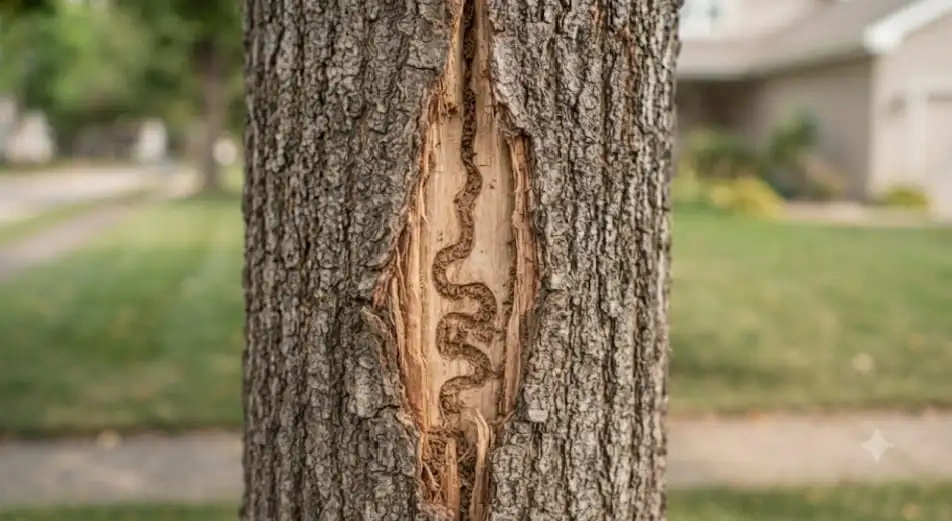
Sign 6: Vertical Bark Splits
What it looks like: Vertical cracks running along the trunk or larger branches. The cracks may be short (five to ten centimeters) in earlier infestations or longer in more advanced cases. When you look into the crack, you may be able to see the S-shaped galleries or frass of EAB larvae in the wood beneath.
Why it happens: When EAB larvae feed through the phloem, the tree responds by attempting to form callus tissue around the damaged area, the same healing mechanism it uses around pruning cuts and physical wounds. As trees attempt to create callus tissue around larval galleries, the bark can split vertically. The S-shaped galleries and larvae can often be seen beneath split bark. The pressure from this callus tissue growth beneath the bark causes it to crack and separate.
When it appears: Bark splits tend to appear in the mid-to-later stages of infestation. At early stages of infestation, splitting is more likely to be found in the top part of the tree. As the infestation intensifies and galleries multiply across the trunk, splits become more widespread.
Critical distinction: Bark splitting is not unique to EAB. Winter frost cracking, lightning strikes, and mechanical injury all produce bark splits. The distinguishing factor for EAB is what is visible beneath the split. If the wood beneath the crack shows S-shaped galleries packed with frass, EAB is the cause. If the wood beneath is smooth, clean, and undamaged, a different cause is more likely.
What to do: When you find a vertical bark split, use a flashlight to look into the crack. If S-shaped galleries or frass are visible, treat this as a high-confidence EAB indicator and seek professional assessment promptly.
Sign 7: Sprouts Growing from the Trunk or Root Flare
What it looks like: Small leafy shoots emerging directly from the trunk, often at mid-height, or from the root flare at the base of the tree. These epicormic sprouts have full leaves and grow vigorously compared to the declining canopy above them. In advanced infestations, a dense cluster of these sprouts may appear near the base of an otherwise largely dead trunk.
Why it happens: When trees are stressed or sick, they will try to grow new branches and leaves wherever they still can. Trees may have new growth at the base of the tree and on the trunk, often just below where the larvae are feeding. This is the tree’s attempt to keep photosynthesis happening by positioning leaves as close as possible to root tissue that can still receive nutrients. It is a survival response, not a recovery response.
Location matters: Epicormic sprouts appearing on the lower trunk below areas of significant damage indicate a more advanced infestation. Sprouts appearing only at the base (from the root flare or roots) suggest the phloem disruption is severe throughout the trunk and the tree is attempting to maintain function from the ground up.
When it appears: Epicormic sprouting becomes visible in moderate to advanced infestations. It typically appears in the second to third year of infestation as phloem disruption accumulates.
Important nuance: Epicormic sprouting alone does not confirm EAB. Other stressors including drought, physical damage, root disturbance, and disease can also trigger this response. However, epicormic sprouting on an ash tree in a confirmed EAB zone, especially when combined with any of the other six warning signs, should be treated as a significant indicator.
What to do: Note the location of the sprouts relative to the tree’s crown. Sprouts on the lower trunk with a declining upper canopy indicate a tree under serious duress. This pattern warrants immediate professional evaluation to determine whether the tree is still within the treatment window.
How Symptoms Progress: A Year-by-Year Timeline
| Year of Infestation | What You Are Likely to See |
| Year 1 | Likely nothing visible. Larvae feeding beneath bark. No exit holes yet. |
| Year 2 | Subtle canopy thinning beginning at crown tips. First D-shaped exit holes may appear. Woodpecker activity increases. |
| Year 3 | Visible crown dieback in upper canopy. More exit holes. Woodpecker blonding evident. Possible bark splits. First epicormic shoots may appear. |
| Year 4 | Significant crown dieback exceeding 30%+. Bark sloughing in sections. Dense epicormic growth near base. Structural failure of dead upper branches begins. |
| Year 5+ | Tree fully dead or nearly dead. Bark separating from trunk. Brittle wood creating structural hazard. |
This timeline assumes a typical infestation progression. Trees that are already stressed from drought, root damage, or prior disease may progress faster. Trees in optimal health with low infestation pressure may progress more slowly.
Homeowner Inspection Guide: How to Check Your Ash Tree
Tools needed for inspection:
- Binoculars (useful for viewing upper canopy and high trunk areas)
- A flashlight or headlamp
- A pocket knife or flathead screwdriver for gently prying loose bark sections
- A ruler or tape measure
- A smartphone for photographs
- Protective gloves
Best time of year to inspect in Sioux Falls:
The most productive inspection windows are late May through early July (when adult beetles are active and exit holes are fresh) and late August through early September (when canopy symptoms are at maximum visibility for the growing season). For woodpecker activity, mid-spring through early summer is the most active observation period.
Where to look, in order:
- Begin at a distance of 20 to 30 feet and look at the entire canopy. Note whether dieback appears in any specific section of the upper crown, and estimate roughly what percentage of the canopy appears dead or significantly thinned.
- Move to within 10 feet of the trunk and work your way slowly around it at eye level, looking carefully at the bark surface for D-shaped holes. Use binoculars to examine the upper trunk and major branches that you cannot examine closely from the ground.
- Check any areas where bark appears cracked, lifted, or separated. Use a flashlight to look into cracks for S-shaped galleries or frass.
- At the base of the tree, look for epicormic shoots emerging from the root flare or lower trunk.
- Step back and observe whether woodpeckers have been active. Look for pale blonding patches on the bark indicating where they have stripped the surface.
What findings require immediate professional attention:
- Any confirmed D-shaped exit holes approximately 1/8 inch wide
- S-shaped galleries visible beneath bark
- Crown dieback estimated at 20% or more
- Extensive bark blonding over large trunk areas
- Dense epicormic sprouting combined with crown dieback
Safety note: Never attempt to climb an ash tree showing significant EAB symptoms. EAB-killed ash wood becomes brittle very quickly. Even limbs on trees that appear alive can be compromised. Assess from the ground only.
Problems That Can Look Like Emerald Ash Borer
Several other conditions produce symptoms that overlap with EAB. Identifying these distinctions prevents both false positives (expensive treatment for a tree that does not need it) and false negatives (dismissing real EAB symptoms as something else).
| Condition | Overlapping Symptoms | How to Distinguish |
| Ash yellows (phytoplasma) | Crown thinning, dieback, epicormic sprouting | No exit holes, no galleries, foliage may have purple or yellow discoloration, decline often more gradual |
| Drought stress | Wilting, leaf scorch, crown thinning | No exit holes, symptoms often reverse after adequate rain, affects multiple species simultaneously |
| Winter injury / frost damage | Crown dieback, branch death | Damage often appears suddenly after a severe frost, typically affects specific exposed sides of canopy, no exit holes or galleries |
| Native ash borers (roundheaded, flatheaded) | Bore holes in bark, some gallery formation | Exit holes are round or oval, not D-shaped. Native borers typically attack only already-stressed trees. Galleries may be present but are shaped differently. |
| Natural aging and senescence | Gradual crown thinning, dead branches | Occurs uniformly across the canopy, no exit holes, no galleries, no woodpecker concentration |
| Fungal cankers | Bark discoloration, sunken areas, branch dieback | Discolored or sunken bark patches rather than vertical splits from below, fungal fruiting bodies may be visible, no D-shaped exit holes |
| Verticillium wilt | Crown dieback, branch death | Affects many tree species, streaking of wood tissue when branch is cut, no exit holes or galleries |
The most reliable distinguishing test: If you suspect EAB, look for D-shaped exit holes and S-shaped galleries beneath the bark. No other condition affecting ash trees in Sioux Falls produces both of these specific signs. Finding even one confirmed D-shaped exit hole on an ash tree in the Sioux Falls metro area is grounds for immediate professional assessment.
What to Do After You Identify These Signs
Step 1: Document thoroughly. Photograph every symptom you observe before anything is moved, disturbed, or treated. Photograph the canopy from a distance, close-ups of any exit holes (with a coin or ruler for scale), bark splits, galleries beneath the bark, and epicormic shoots. Good documentation helps a professional arborist assess the situation accurately and supports any insurance-related questions.
Step 2: Estimate your canopy condition. Stand at a distance and try to estimate, as honestly as possible, what percentage of the tree’s normal canopy volume appears dead, absent, or significantly thinned. This single number has more bearing on your treatment decision than almost any other factor.
Step 3: Choose your next action based on what you found:
- No symptoms found, Sioux Falls location: Your tree is in a confirmed EAB zone. Annual inspection is essential. Consider preventive treatment with a licensed arborist if the tree has significant value.
- Subtle symptoms, under 20% estimated canopy loss: Contact a licensed arborist with a SDDANR pesticide applicator certification for a treatment evaluation promptly. Treatment at this stage has the best outcomes.
- Moderate symptoms, 20 to 30% canopy loss: Seek professional assessment urgently. You may be approaching or near the treatment window boundary.
- Advanced symptoms, over 30% canopy loss or significant dead branch sections: Seek a professional assessment for both treatment candidacy and removal planning. See our full EAB treatment and removal guide for Sioux Falls for detailed guidance.
- D-shaped exit holes or S-shaped galleries confirmed: Treat as a confirmed EAB infestation. Contact a licensed arborist immediately. Do not delay.
Frequently Asked Questions
1. Can I see the actual EAB beetle on my tree?
The beetle is well-suited to our climate, is a good flyer, and moves naturally. Adult beetles are small (roughly 3/8 to 5/8 inch long) and metallic green. They are active during warm, sunny periods from late May through July. Seeing an adult beetle is possible but unlikely, as they are small and spend most of their time high in the canopy or beneath the bark as larvae. The signs of their presence, exit holes, galleries, and the resulting tree decline, are far more reliable indicators than spotting an adult.
2. How long does it take for EAB to kill an ash tree after infestation?
Untreated ash trees typically die within three to five years of initial EAB infestation. The first one to two years usually produce no obvious visible symptoms. Visible canopy decline typically begins in year two to three. By year four or five, trees that have not been treated are often dead or structurally dangerous.
3. Can EAB spread to trees other than ash?
No. EAB attacks only true ash trees in the genus Fraxinus. It does not infest maple, oak, cottonwood, bur oak, hackberry, or any other common Sioux Falls tree species. Mountain-ash (Sorbus spp.) is not a true ash and is not susceptible.
4. What is the best time of year to inspect ash trees in Sioux Falls?
Late May through early July is optimal for spotting fresh adult emergence holes and observing peak woodpecker activity. Late August through September provides maximum canopy symptom visibility. Inspections at both windows each year give the most complete picture of a tree’s EAB status.
5. Are D-shaped holes the same as the holes woodpeckers make?
No. Woodpecker holes are round or oblong and are made by the bird’s bill entering from outside the bark. D-shaped exit holes are made by adult EAB beetles boring outward from within the tree. Both may be visible on heavily infested trees but are distinctly different in shape and size.
6. I see holes in my ash tree’s bark but they are round, not D-shaped. Does that mean it is not EAB?
Round holes suggest native wood-boring insects rather than EAB. Native borers, including roundheaded ash borers, typically attack trees that are already stressed or declining. Their holes are round or oval and vary more in size than the consistent 1/8-inch D-shaped EAB exit hole. Finding only round holes does not rule out EAB entirely but makes native borers the more likely cause. A professional arborist assessment is still advisable.
7. My ash tree has sprouts growing out of the base and lower trunk. Is that always EAB?
Epicormic sprouting has multiple causes including root disturbance, drought, physical injury, and disease. In a confirmed EAB zone like Sioux Falls, trunk sprouting combined with any crown dieback or woodpecker activity should be treated as a significant warning sign. Sprouting alone is not confirmation but warrants investigation for the other six warning signs.
8. What does EAB bark splitting look like compared to winter frost cracks?
Winter frost cracks typically appear on one side of the tree, often the southwest face, after a severe cold event, and the wood beneath is smooth and undamaged. EAB bark splits appear because of callus tissue growth around larval galleries beneath the bark. The key distinction is what is visible beneath the split. EAB-caused splits will reveal S-shaped galleries packed with frass when you look into the crack. Frost cracks will not.
9. How much of the canopy can be dead before it is too late to treat?
The research-established threshold is approximately 30% canopy loss. Trees below this threshold have good treatment success rates with emamectin benzoate trunk injection. Trees above 30% canopy loss have significantly lower success rates. If you cannot estimate the canopy loss accurately yourself, a professional arborist assessment is the next step.
10. Is EAB present in my Sioux Falls neighborhood?
EAB has been confirmed in Sioux Falls and throughout Minnehaha and Lincoln Counties. All ash trees in the Sioux Falls metro area should be considered at risk. The SD DANR quarantine covering these counties reflects the confirmed presence of EAB in the region.
11. Do all ash trees need to be treated in Sioux Falls, or only infested ones?
Industry guidelines recommend preventive treatment for any ash tree within 15 miles of a confirmed EAB detection. Since the entire Sioux Falls metro area is within a confirmed zone, preventive treatment is appropriate for all ash trees that are worth preserving. The City of Sioux Falls requires homeowners to either treat ash trees or remove them.
12. Can I treat my ash tree myself?
Lower-concentration homeowner products (imidacloprid soil drench) are available without a pesticide license, but they are significantly less effective than professional-grade formulations, particularly for trees over six inches in trunk diameter. Emamectin benzoate trunk injection, the most effective treatment available, requires a licensed pesticide applicator under South Dakota law. For valuable mature trees, professional treatment is strongly recommended.
13. How do I report a suspected new EAB infestation in South Dakota?
Report suspected new EAB infestations to the South Dakota Department of Agriculture and Natural Resources at emeraldashborerinsouthdakota.sd.gov or by contacting SDDA directly. Reporting helps the state track the spread and supports community management efforts.
14. What happens structurally to an ash tree after EAB kills it?
EAB-killed ash trees develop uniquely brittle wood. Unlike many other dead trees that harden over time, dead ash trees become structurally unstable quickly. Large branches and sections can fall without warning even in calm conditions. A dead or heavily declining ash tree near a structure, vehicle, or pedestrian area is an urgent removal priority.
15. Should I remove my ash tree now even if I only see early symptoms?
Not necessarily. Early symptoms within the treatment window are the ideal time to begin treatment, not removal. Removal is more appropriate when the tree has exceeded the treatment threshold (over 30% canopy loss), has significant structural problems independent of EAB, or is in a location where removal is straightforward and cost-effective. For guidance specific to your tree, see our EAB treatment and removal guide for Sioux Falls homeowners.
What to Do Once You Have Spotted the Signs
The right next step varies by town. In Crooks, where EAB has been confirmed since 2022, many trees showing these symptoms are already past treating. In Lennox, confirmed in 2024, the same symptoms usually still leave a treatment window open. Brandon requires city registration and tagging if you do decide to treat.