Choosing a tree service company feels straightforward until something goes wrong. A worker gets injured with no workers’ compensation coverage and you face a lawsuit. A crew damages your fence or siding with no liability insurance to cover it. A contractor takes a deposit after a storm and disappears. These are not hypothetical scenarios. They happen to homeowners in Sioux Falls and throughout South Dakota every year, particularly in the weeks following significant storm events.
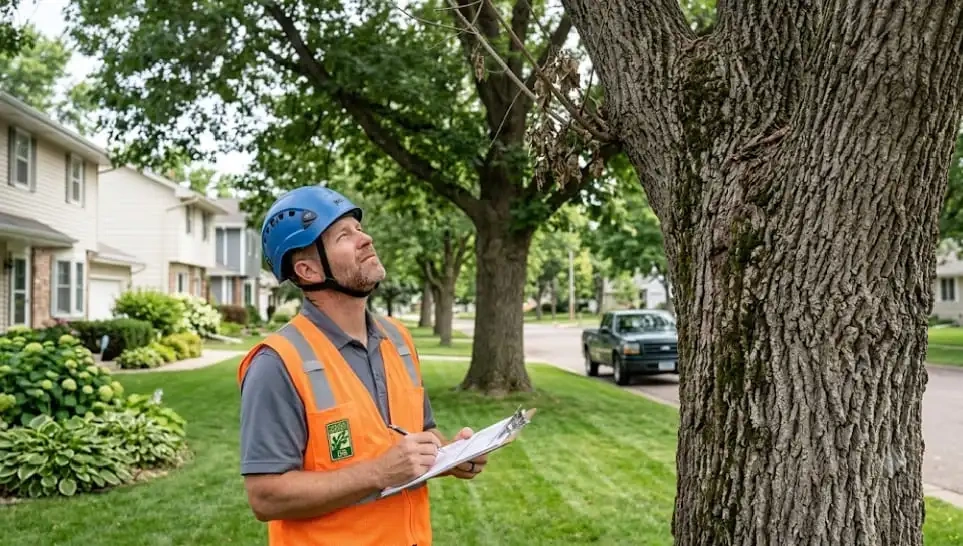
This guide gives you a practical, research-driven framework for finding a trustworthy tree service company, verifying their credentials, comparing quotes intelligently, and protecting yourself from the contractors who should never have access to your property.
Why Hiring the Wrong Tree Company Is a Real Risk
Tree work is one of the most hazardous occupations in the country according to Bureau of Labor Statistics data, with fatality rates consistently higher than most construction trades. That danger is relevant to you as a homeowner in a specific way: if an uninsured or underinsured worker is injured on your property, you may bear financial responsibility for their medical bills and lost wages.
Beyond injury risk, property damage is common in tree work. A chainsaw-cut limb that lands on your roof, a boom truck that cracks your driveway apron, a stump grinder that severs an irrigation line, these situations happen even with experienced crews. The question is not whether accidents happen. The question is whether the company you hired is insured to cover them.
The South Dakota Attorney General’s office has issued warnings to consumers about transient vendors and storm-repair contractors who appear after severe weather events. The pattern is consistent across the country: unqualified operators enter a market after a storm, collect deposits or full payments, then disappear or deliver substandard work. A Minnesota case from late 2025 involved a tree contractor who defrauded 13 homeowners across the Twin Cities metro out of more than $17,000 by collecting deposits through Venmo and CashApp before vanishing. That market is one state away from Sioux Falls, and Sioux Falls experiences the same post-derecho demand spikes that create the same opportunities for fraud.
Knowing how to evaluate a tree company before they set foot on your property is not optional due diligence. It is basic financial self-protection.
The Three Insurance Policies Every Tree Company Must Have
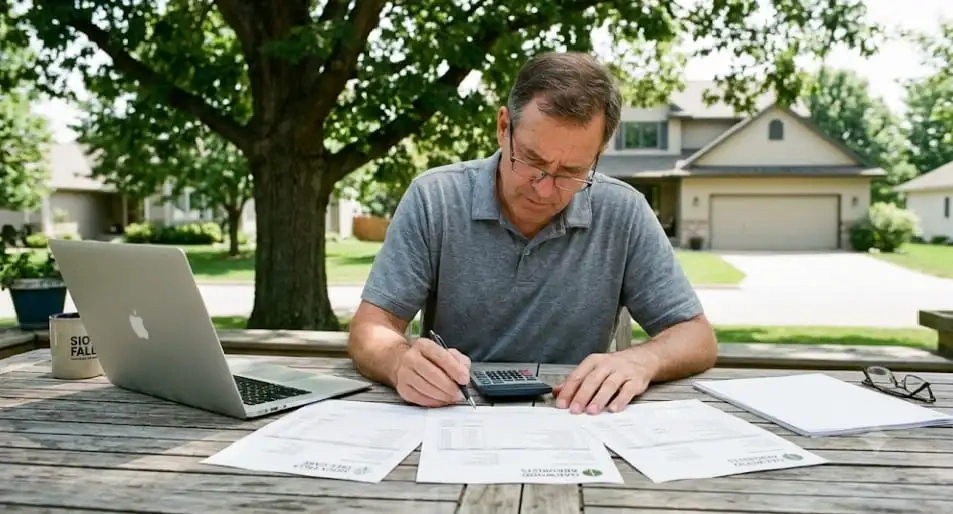
When a tree company tells you they are “fully insured,” that phrase is meaningless without specifics. There are three distinct types of coverage that every professional tree service operating in Sioux Falls should carry, and each protects you from a different type of loss.
1. General Liability Insurance
General liability covers property damage and bodily injury caused by the company’s operations on your property. If a crew member drops a limb onto your roof, chips brick off your house, or a bystander is injured by debris, general liability is what pays. For residential tree work, a minimum of $1 million per occurrence is the industry-standard threshold. Ask for the specific per-occurrence limit, not just confirmation that a policy exists.
2. Workers’ Compensation Insurance
Workers’ compensation covers crew members who are injured while working on your property. Without it, an injured worker may have legal standing to pursue a claim against your homeowner’s insurance or pursue you directly. This is the insurance most frequently omitted by low-budget or fly-by-night operators because it is expensive. It is also the most important one for you as a homeowner. South Dakota requires workers’ compensation for employers with employees. If a contractor claims their workers are all independent contractors or 1099 workers, that is a significant red flag, because it may mean no workers’ comp coverage exists for anyone working on your property.
3. Commercial Auto Insurance
Tree service trucks are heavy commercial vehicles. A chip truck can weigh 30,000 pounds or more. A boom truck or log truck is heavier still. These vehicles operate on your street, in your driveway, and sometimes on your lawn. A standard personal auto policy does not cover commercial vehicle use. Commercial auto coverage is what applies when a chip truck backs into your mailbox, cracks your driveway, or leaves deep ruts in your yard during wet conditions.
ISA Certification and Professional Credentials
The International Society of Arboriculture (ISA) offers a Certified Arborist credential that requires passing an exam, demonstrating practical field knowledge, and completing ongoing education requirements to maintain. An ISA Certified Arborist on staff is a meaningful signal of professional competence because the credential requires demonstrated knowledge of tree biology, pruning standards, hazard assessment, and safe work practices.
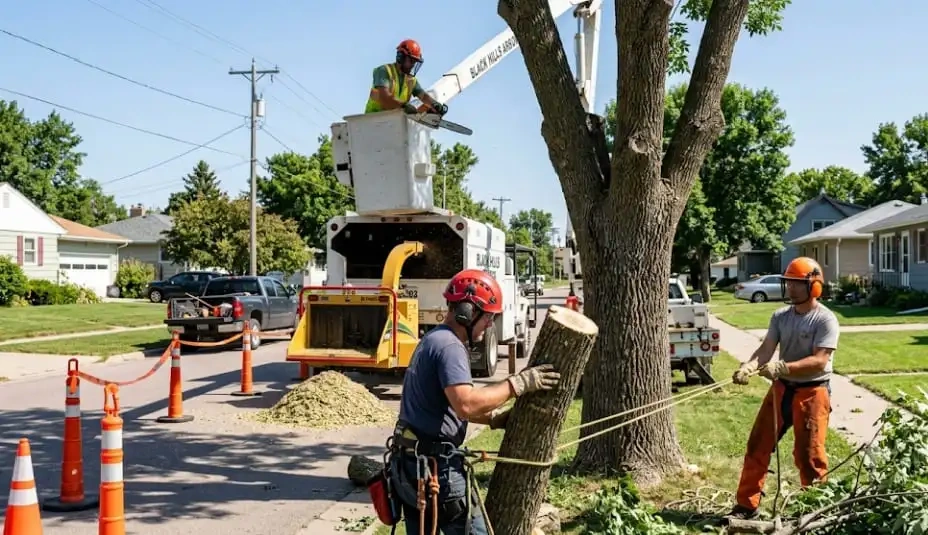
The Tree Care Industry Association (TCIA) offers an Accreditation program for tree service companies as organizations, requiring proof of insurance compliance, safety programs, and business practices that meet industry standards.
Neither credential is legally required in South Dakota, which has no statewide licensing requirement for tree removal companies. This makes credentialing more important, not less. In the absence of a license requirement, ISA certification and TCIA accreditation are the clearest voluntary signals that a company operates to professional standards.
For emerald ash borer treatment specifically, which involves applying pesticides to living trees, a pesticide applicator license is required in South Dakota. If you need EAB treatment and not just removal, ask for proof of pesticide licensing separately.
You can verify ISA certification by searching the ISA’s online public directory at isa-arbor official website, where you can search by company or individual arborist name.
Warning Signs of an Untrustworthy Tree Service Company
These red flags have been documented by consumer protection agencies, the Better Business Bureau, and law enforcement in cases involving tree service fraud.
No insurance documentation provided. Any company that cannot or will not produce a Certificate of Insurance within 24 hours of your request should not work on your property.
Cash-only payment demands. Legitimate businesses accept checks or credit cards. A cash-only requirement limits your recourse if the work is not completed or is done poorly.
High-pressure sales tactics. Urgency pressure (“I can do it today only at this price”) is a manipulation tactic, not a business practice. Take the time you need to verify credentials and compare quotes.
Door-to-door solicitation after storms. Professional tree companies do not need to knock on doors to find work after a derecho hits Sioux Falls. Contractors who appear unsolicited at your door immediately after a storm event are overwhelmingly more likely to be unqualified storm chasers than established local professionals.
No written estimate. Refusing to provide a written quote is a clear indicator that the company plans to present a different number later, after the work has already started.
Dramatically low pricing. A bid that is 40% to 50% lower than every other quote you receive is not a bargain. It is almost always explained by missing insurance coverage, inadequate equipment, unqualified labor, or intent to abandon the job after collecting a deposit.
Requests to sign over insurance rights. Some fraudulent contractors ask homeowners to sign a document authorizing them to communicate directly with your insurance company or to assign your insurance benefits to them. Do not sign any such document without consulting your insurer first.
No verifiable business history. A search for the company name on Google, the BBB, and the South Dakota Secretary of State business registry should return some results. A company with no traceable history, no reviews, and no verifiable business registration is operating in the shadows for a reason.
Vague or verbal-only scope of work. Contracts with blank spaces, unsigned sections, or undefined terms protect the contractor, not you. Never sign an incomplete document.
The Storm-Chaser Problem in Sioux Falls
Sioux Falls experiences one of the highest concentrations of post-storm contractor fraud risk in the region because of its storm profile. After documented derecho events like those in 2022 and July 2025, the city generates thousands of simultaneous tree service calls within hours. Local, established contractors are immediately overbooked. This creates the window that fraudulent operators exploit.
Storm chasers are contractors who travel from region to region following severe weather events, targeting areas with widespread damage and homeowners desperate for fast help. They frequently have no established local presence, no local references, and no accountability if things go wrong. Because they are transient, filing a complaint or pursuing civil remedies becomes difficult after they leave the area.
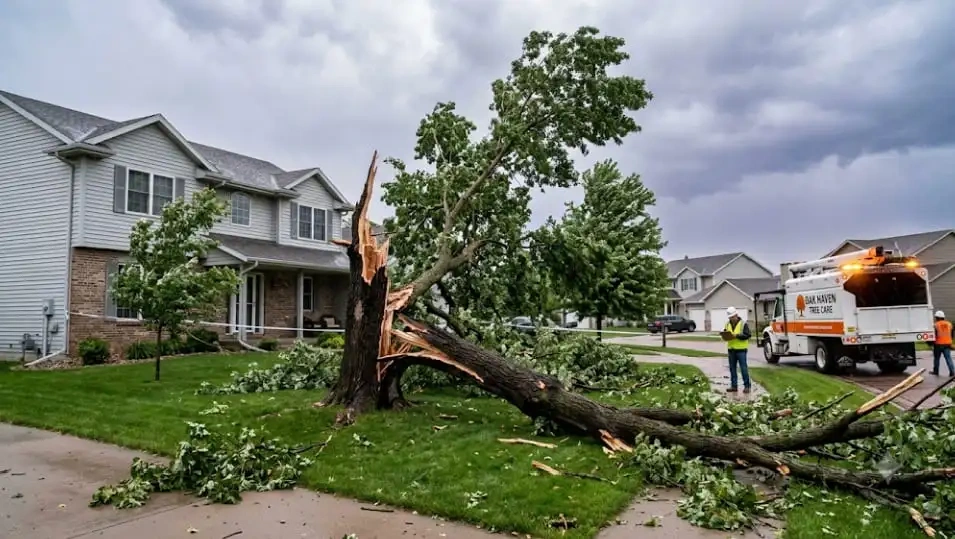
The South Dakota Attorney General has specifically warned consumers about transient vendors who emerge after severe weather, noting that high-pressure sales pitches and rushed decisions are how these operators convert desperate homeowners into victims.
Protecting yourself specifically from storm chasers:
Verify the company has a local physical address that predates the storm. A contractor who registered their business address in Sioux Falls two weeks after a major weather event is a signal worth investigating. Check Google Maps, and the South Dakota Secretary of State business search to establish a real operating history. Established local companies can provide local references from jobs completed months or years before the storm. Storm chasers cannot.
How to Compare Quotes the Right Way
Getting multiple quotes is standard advice that most homeowners follow. What is less understood is how to compare those quotes accurately.
Get a minimum of three written, itemized quotes. Three quotes give you a realistic range and immediately identify outliers in both directions. Verbal estimates from different companies are not comparable because each may be imagining a different scope of work.
Compare scope, not just price. A quote that includes stump grinding, debris hauling, and site cleanup is not comparable to a quote that covers only felling and chipping. Reconstruct each quote to cover identical scope before comparing numbers.
Weight insurance against price. A $200 price difference between an insured and an uninsured contractor is not a $200 savings. It is a $200 transfer of risk to you. The potential liability exposure from an uninsured worker injured on your property vastly exceeds any quote difference.
Ask each company the same questions. Asking identical questions of each company makes the responses directly comparable and makes evasive answers from one company stand out clearly against the transparent answers from another.
Do not assume the most expensive quote is the best. Price reflects equipment, insurance costs, crew experience, and overhead. Extremely high pricing without corresponding explanation of scope warrants the same scrutiny as extremely low pricing.
What Affects Tree Service Pricing in Sioux Falls
Understanding why quotes vary helps you evaluate what you are actually being offered.
Tree size and species. Large trees require more time, larger equipment, and more crew. Dense hardwoods like bur oak take longer to cut and process than softer species. A large cottonwood near a fence is a different project than a small ornamental in an open yard, even if they appear similar in size.
Access and site conditions. A tree in an open backyard with wide gate access is far simpler to work on than one between a house and a privacy fence, or one near overhead lines. Limited access means manual labor replaces machinery, which adds time and cost.
Distance from structures. Trees near the home, garage, or neighboring structures require careful sectional removal rather than felling. This is slower, more skilled work that costs more.
Insurance and overhead. A company carrying three active insurance policies with appropriate coverage limits has real operating costs. Those costs show up in their pricing. A company with no insurance has none of those costs, which is why their price can be dramatically lower.
Stump grinding and debris hauling. These are almost always priced separately and have a meaningful impact on the total cost of a job. Always confirm whether they are included.
For specific pricing ranges by tree size in Sioux Falls, see our complete tree removal cost guide.
Company Comparison Checklist
Use this table when evaluating multiple tree service companies.
| Evaluation Factor | Company A | Company B | Company C |
| General liability insurance (COI provided) | Yes / No | Yes / No | Yes / No |
| Workers’ compensation insurance (COI provided) | Yes / No | Yes / No | Yes / No |
| Commercial auto insurance confirmed | Yes / No | Yes / No | Yes / No |
| ISA Certified Arborist on staff | Yes / No | Yes / No | Yes / No |
| Written, itemized estimate provided | Yes / No | Yes / No | Yes / No |
| Stump grinding included or separately priced | Included / Separate | Included / Separate | Included / Separate |
| Debris hauling included or separate | Included / Separate | Included / Separate | Included / Separate |
| Local references available | Yes / No | Yes / No | Yes / No |
| Payment by check or card accepted | Yes / No | Yes / No | Yes / No |
| Deposit under 30% of total | Yes / No | Yes / No | Yes / No |
| Emergency availability | Yes / No | Yes / No | Yes / No |
| Verifiable local business history | Yes / No | Yes / No | Yes / No |
Frequently Asked Questions
1. Does South Dakota require tree service companies to be licensed?
South Dakota does not have a statewide tree removal contractor license requirement. This makes your own due diligence more important. Verify insurance directly, look for ISA credentials, check BBB standing, and confirm the company has a verifiable local business history. For emerald ash borer or other pesticide treatments, a South Dakota pesticide applicator license is required separately.
2. What happens if an uninsured tree worker is injured on my property?
Without workers’ compensation coverage on the contractor’s policy, an injured worker may have legal standing to pursue a claim against your homeowner’s insurance or pursue you directly for medical expenses and lost income. This is why workers’ compensation verification is non-negotiable before any crew sets foot on your property.
3. Is an ISA Certified Arborist required for tree work?
No, it is not legally required. However, it is one of the most meaningful voluntary indicators of professional competence available to homeowners. An arborist who has passed the ISA exam has demonstrated knowledge of tree biology, proper pruning standards, hazard assessment, and safe removal practices. You can verify ISA credentials at isa-arbor.com.
4. How much of a deposit is reasonable for a tree service job?
A deposit of 10% to 30% of the total project cost is generally considered reasonable for larger jobs. Full payment before work begins is a documented fraud pattern. Cash-only deposits with no written receipt are a significant warning sign. Always get a written receipt for any deposit paid.
5. What should be included in a written tree service estimate?
A proper written estimate should include: the full scope of work, specific trees to be removed or trimmed, whether stump grinding is included or separate, whether debris hauling is included or separate, the total price, the payment schedule, and a timeline for the work. Both parties should sign it.
6. How do I verify a company’s insurance is actually active?
Request a Certificate of Insurance naming you as the certificate holder. Then call the insurance company listed on the certificate directly and confirm the policy is current, active, and has not been canceled. COIs can be produced with expired policies or for coverage that has since lapsed.
7. Can I hire the cheapest company I find?
Extremely low bids usually reflect absent or inadequate insurance coverage, unqualified labor, or intent to not complete the work properly. A bid 40% to 50% below every other quote you receive warrants direct questions about what the difference explains. The cheapest price is only the best deal if the company carries proper insurance and completes the work as specified.
8. What is a storm chaser and how do I identify one?
A storm chaser is a transient contractor who travels to areas hit by severe weather to take advantage of high demand and stressed homeowners. They typically have no established local presence, no verifiable business history predating the storm, and no local references. After major weather events in Sioux Falls, storm chasers from other states frequently appear offering fast cheap service. Verifying a local business address and history before hiring is the primary defense.
9. Should I get a separate assessment before tree removal?
For large, complex, or expensive jobs, a consultation with an ISA Certified Arborist before committing to removal can be valuable. An arborist can assess whether the tree genuinely needs to be removed or whether pruning, cabling, or treatment could preserve it at lower cost. Some arborists charge a consultation fee; others provide free assessments when bidding on work.
10. Does tree trimming require the same level of insurance verification as removal?
Yes. Tree trimming, particularly on large trees or trees near structures, carries the same risks of property damage and worker injury as removal. The same insurance verification steps apply regardless of whether the job is trimming, removal, or stump grinding.
11. What is the risk of hiring a company that uses subcontractors?
Subcontractors may carry different insurance policies, follow different safety protocols, and fall outside the primary company’s coverage. If you hire a company that uses subs, ask specifically whether those subcontractors are separately insured under policies that cover work performed on your property. Get confirmation in writing.
12. What should I do if a tree company damages my property during the job?
Document the damage immediately with photographs before anything is moved or repaired. Notify the company in writing the same day. Contact the insurance company listed on their COI to report the damage. If the company is unresponsive or uninsured, contact the South Dakota Attorney General’s consumer protection division.
13. What questions should I ask about cleanup and debris?
Ask specifically: Will all debris be removed from the property? Are wood sections hauled or left? Is stump grinding included? Is chip disposal included? Will any debris be left on-site, and if so, what and where? These details should be written into your estimate to prevent disputes after the job.
14. How can I check a tree company’s reviews in Sioux Falls?
Google Business Profile reviews, the Better Business Bureau, Yelp, and Angi are the most commonly used platforms for verifying contractor reputation in the Sioux Falls area. Look for consistency across platforms rather than relying on a single source. Also ask the company for references you can contact directly.
15. Are there any Sioux Falls-specific considerations when hiring a tree company?
Yes. The emerald ash borer has established itself in the Sioux Falls area, making pesticide treatment a consideration for many ash trees in residential neighborhoods. Pesticide application requires a South Dakota pesticide applicator license separate from any general tree service credentials. Additionally, Sioux Falls experiences significant post-storm demand spikes after derecho events, which is when storm-chaser fraud risk is highest. Plan tree care before storm season where possible.
The Post-Storm Test Case
After 25 July 2026, when the National Weather Service recorded 92 mph in Tea and 82 mph near Harrisburg, out-of-town crews appeared across the metro almost immediately. Brandon logged tree and fence damage across town. If you are reading this with a damaged tree and someone at the door, every check on this page applies twice over.