Most people only think about their trees when something goes wrong. A branch comes down during a storm. A tree starts leaning toward the house. Roots crack the driveway. By that point, the problem has usually been building for months, sometimes years, and what could have been a routine maintenance call turns into an expensive emergency.
If you own a home in Sioux Falls and you have trees on your property, understanding what professional tree service actually covers, and why it matters specifically here in South Dakota, could save you thousands of dollars and a lot of unnecessary stress.
This guide breaks it all down plainly, without fluff or filler.
What Tree Service Actually Means
Tree service is the professional care, maintenance, and management of trees on residential and commercial properties. It is a broad term that covers everything from routine trimming and pruning to full tree removal, stump grinding, emergency storm response, disease treatment, and structural support systems like cabling and bracing.
What makes tree service different from just grabbing a chainsaw yourself is the trained judgment behind every cut. A certified arborist does not just remove branches. They assess the overall structure and health of a tree, identify problems that are not obvious to the untrained eye, and make decisions that affect how that tree grows and behaves for years to come. One wrong cut on a mature tree can compromise its structural integrity, invite disease, or create a hazard that shows up two seasons later when a storm tests it.
Tree service companies in Sioux Falls handle the following core services:
Tree Trimming and Pruning involves selectively removing branches to improve a tree’s structure, appearance, and long-term health. This is not the same as topping a tree, which is a harmful and outdated practice that weakens trees permanently. Proper pruning follows ANSI A300 standards, targeting dead wood, crossing branches, and overextended limbs that put unnecessary stress on the tree’s framework.
Tree Removal is the complete cutting down and clearing of a tree from a property. It is required when a tree is dead, severely diseased, structurally compromised, too close to a structure, or when roots are causing damage to foundations, sewer lines, or sidewalks. Professional removal involves more than cutting. It requires planning the fall direction, using rigging systems to lower heavy sections safely, and complete debris cleanup afterward.
Stump Grinding is the process of mechanically grinding a remaining stump down below ground level after a tree has been removed. Without this step, stumps attract insects, harbor fungal decay, create tripping hazards, and prevent you from using that area of your yard.
Emergency Tree Service handles situations where a tree or large branch has fallen or is in imminent danger of falling due to storm damage, structural failure, or sudden disease. This cannot wait. A tree leaning against a roofline or power line is an active hazard.
Storm Damage Cleanup focuses on removing broken limbs, downed trees, and scattered debris following major weather events. In South Dakota, this is not a rare occurrence. It is a seasonal reality.
Emerald Ash Borer Treatment is a service that has become critical in Sioux Falls specifically. The invasive beetle has devastated ash trees throughout the region, and treatment through professional trunk injections can save trees if caught early enough.
Why This Matters More in Sioux Falls Than You Might Think
Sioux Falls is not a mild-climate city when it comes to trees. South Dakota’s weather puts trees under year-round stress in ways that homeowners from other states might not anticipate. Summer hailstorms, straight-line winds, spring ice storms that arrive after trees have already leafed out, and the brutal weight of winter snow on branches that have not been thinned, all of these create conditions that turn a neglected tree into a liability fast.
There is also a local legal dimension that most Sioux Falls homeowners are unaware of.
Per Sioux Falls city ordinance, the responsibility for maintaining trees on your property falls on you. This includes trees in the boulevard between the curb and sidewalk in many cases. If an overhanging branch from your tree damages a neighbor’s vehicle, falls on a fence, or injures someone on the public sidewalk, you can be held responsible for that damage.
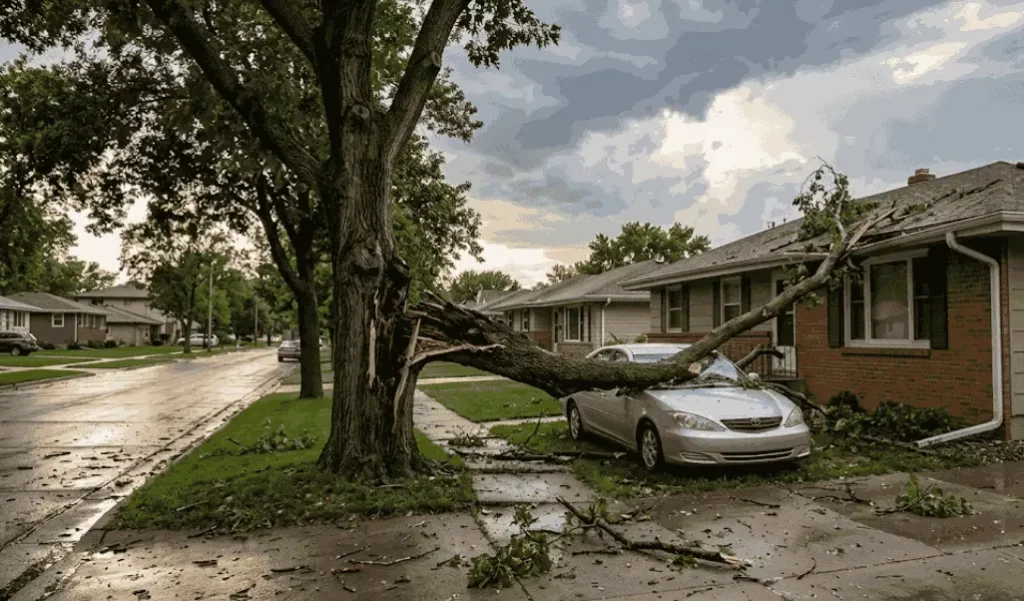
A personal injury attorney based in Sioux Falls has noted publicly that while a perfectly healthy tree that falls during an extreme storm generally does not create liability, a tree that was already in a state of decay or structural weakness is a different matter. If it could be shown that a tree was compromised before the storm and a homeowner did nothing about it, that changes the legal picture considerably.
Routine professional tree maintenance is not just about keeping your yard looking good. It is documentation that you took reasonable care of your property. It is one of the simplest ways to protect yourself from situations that could otherwise become very costly.
The Real Cost of Ignoring Tree Maintenance
There is a tendency to treat tree care as optional, something you will get around to eventually, until a problem forces the issue. The financial reality of that approach is worth understanding clearly.
A routine tree trimming visit in Sioux Falls typically costs between $200 and $700 depending on tree size and access. Emergency tree removal after a storm, when you are dealing with a tree on your roof or blocking your driveway, runs significantly higher, often $847 or more based on local averages, and that figure does not include any structural repairs the fallen tree caused.
Root damage to a foundation, sewer line intrusion by tree roots, or cracked sidewalks from expanding root systems can each cost well into the thousands to repair. All of these are scenarios that develop gradually under trees that received no professional attention.
The other cost people rarely account for is property value. A healthy, well-maintained mature tree adds measurable value to a home. A dead, diseased, or poorly shaped tree does the opposite. Buyers and appraisers notice the difference.
Preventive maintenance is almost always cheaper than reactive emergency response. That is true for your HVAC, your roof, and it is absolutely true for your trees.
What an Arborist Actually Does That You Cannot
There is a meaningful difference between someone who cuts down trees and a trained arborist. Understanding this difference helps you ask better questions when you hire someone.
An ISA Certified Arborist has passed a rigorous examination administered by the International Society of Arboriculture and must maintain their certification through ongoing education every three years. They are trained in the science of tree biology, soil health, structural assessment, disease identification, and safe work practices.
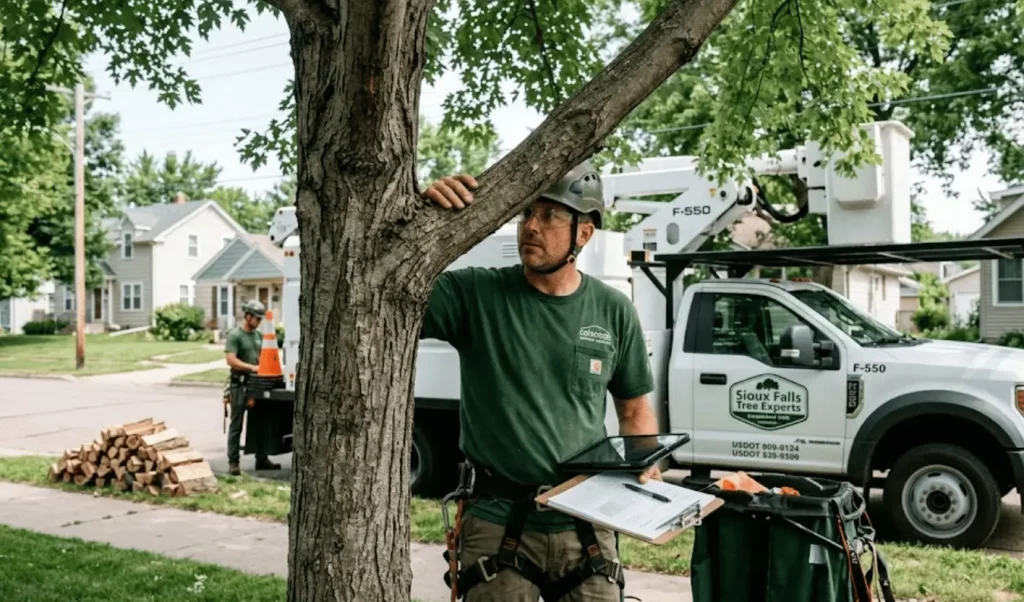
When an arborist looks at a tree, they are evaluating things that are invisible to most homeowners. The angle of branch unions and whether they are structurally sound. Signs of internal decay that appear as subtle bark irregularities before the tree becomes obviously hollow. Root zone compaction that stresses a tree from below the surface. Early stage pest damage, including the characteristic D-shaped exit holes of emerald ash borer, that are easy to miss until the infestation has spread.
In Sioux Falls, where ash trees are facing an existential threat from the emerald ash borer and where the city has been proactively removing infested trees since 2018, having an arborist assess your ash trees early is not just good practice. It is the difference between saving a tree with a biennial treatment injection and paying to have a large, dead ash removed and ground.
Most professional tree companies in the area employ arborists or work alongside ISA-certified professionals. When you are getting quotes, asking whether a certified arborist will be involved in the assessment is a reasonable and important question.
Signs Your Trees in Sioux Falls Need Professional Attention Right Now
You do not need a storm or a visible catastrophe to call a tree service company. Several conditions warrant a professional evaluation before any visible damage occurs.
Dead or hanging branches are one of the most common warnings. A branch that has lost its bark, carries no foliage during growing season, or moves independently from the rest of the canopy in wind is a branch waiting to come down. In Sioux Falls, where wind events are common, hanging dead branches are not just an eyesore. They are a hazard.
A leaning tree that was not always leaning deserves immediate attention. Some trees naturally grow at an angle and are fine. A tree that has recently shifted, or one where you can see soil heaving around the base on the opposite side, may be in the process of uprooting.
Visible decay or fungi at the base of a tree, including shelf mushrooms growing from the bark or ground near the trunk, indicates internal rot. Trees with significant structural decay can fail without much warning, especially under storm conditions.
Branches touching your roofline or power lines create multiple problems. Contact with your roof provides a direct pathway for moisture, insects, and small animals into your home. Branches near power lines are a fire and outage risk and typically fall under utility company or homeowner guidelines that require clearance.
Thinning canopy or dieback from the top in an ash tree is often the first clear sign of emerald ash borer damage. By the time significant canopy dieback is visible, the infestation has usually been present for one to three years. Treatment is still possible in many cases, but the window closes as the damage progresses.
Roots growing toward your home, sidewalk, or sewer lines may not be visible above ground, but signs like cracking pavement, persistently slow drains, or soil movement near a foundation are worth having a professional investigate.
How Tree Service in Sioux Falls Works From Start to Finish
Understanding the process removes the uncertainty from hiring a tree service company, especially for homeowners who have never done it before.
Step one is the estimate. A reputable company will send someone out to physically assess your property before quoting any work. They should walk the site with you, explain what they are seeing, and provide a written quote that clearly outlines what will be done, how long it will take, and what it will cost. Do not accept phone quotes for significant tree work without an in-person look.
Step two is scheduling. For routine work, most companies can schedule within a few days to two weeks depending on the season. Late winter through early spring is typically the best time to schedule pruning for most tree species, and it is also when demand is lower, which can mean better pricing. Emergency situations are handled outside normal scheduling.
Step three is the work itself. A professional crew will arrive with appropriate equipment, which varies based on the job. Smaller pruning work may involve hand tools and a bucket truck. Large tree removal near structures typically involves rigging systems, sectional lowering of heavy wood, and sometimes cranes. The crew should be working safely at all times, with proper personal protective equipment and a clear plan for how pieces are coming down and where.
Step four is cleanup. This is where many less professional crews show their character. A complete tree service job ends with all wood, branches, chips, and debris removed from your property, not piled at the curb and left. Any reputable company in Sioux Falls will include cleanup as a standard part of the job.
Step five is follow-through. For services like emerald ash borer treatment, there is an ongoing schedule of treatments every two years. Your company should advise you clearly on what follow-up is needed and when.
What Separates a Good Tree Company from a Bad One in Sioux Falls
This is where homeowners often get burned. After a storm, the area gets a surge of out-of-town crews who show up with trucks and saws and offer to clear your yard quickly and cheaply. Some of them do fine work. Many do not.
There are specific things to verify before hiring any tree company for work on your property.
Proof of insurance is not optional. Tree work is dangerous. A crew working on your property without liability insurance and workers’ compensation leaves you exposed to financial responsibility if something goes wrong, whether that means property damage from a falling limb or an injury to a crew member. Ask for a certificate of insurance, not just a verbal assurance. A legitimate company will have no hesitation providing documentation.
Local presence matters in ways that go beyond trust. A company that has been working in Sioux Falls for years understands local tree species and how they behave. They know that silver maples in this region have predictable growth habits around power lines. They know the seasonal restrictions around ash tree pruning related to emerald ash borer spread. They know how South Dakota’s freeze and thaw cycles affect root stability. That localized knowledge shapes the quality of the work.
Avoid anyone who recommends topping your trees. Tree topping, the practice of cutting back main branches to stubs, is widely condemned by arboricultural professionals. It causes permanent structural damage, creates entry points for disease and decay, and results in fast-growing but dangerously weakly attached regrowth. Reputable companies in Sioux Falls do not offer it.
A written estimate before any work begins is standard practice for any professional company. If someone shows up and wants to start cutting without a clear agreement on scope and cost, walk away.
Tree Service and Your Homeowner’s Insurance: What You Need to Know
This is a topic that creates a lot of confusion for Sioux Falls homeowners, and the answer is not always simple.
Whether your homeowner’s insurance covers tree-related damage depends heavily on the circumstances. If a healthy tree falls on your home during a covered storm event, your policy will typically cover the damage to the structure, and may contribute toward removal costs. If a tree that was visibly dead or diseased falls and causes damage, the insurance company may question whether the homeowner exercised reasonable care in maintaining the property. This is another reason why documented professional tree maintenance is worth having.
Tree removal in the absence of structural damage to your home, such as a tree that falls in your yard but does not hit anything, is generally not covered by homeowner’s insurance. The cost of removal in that case falls on you.
Your deductible also matters here. Depending on your policy structure, smaller tree-related claims may not be worth filing if the removal cost falls below or close to your deductible amount, since filing claims can affect future premiums.
The safest approach is to talk directly to your insurance agent about tree-specific scenarios before something happens. Knowing where you stand before a storm season helps you make informed decisions about maintenance timing and priorities.
What This Looks Like Where You Live
The basics are the same everywhere, but the local rules are not. Brandon has boulevard permits and a city ash removal programme. Tea has a clearance ordinance that puts pruning on the property owner. Renner has no city ordinance at all. Each town page sets out what actually applies there, and you can see the full list on our areas we serve page.