Most people use “trimming” and “pruning” to mean the same thing. Tree professionals do not. The difference between these two services is not just terminology. It determines the tools used, the time of year the work is done, how much gets cut, and most importantly, what happens to the tree afterward.
Getting this wrong is not a minor inconvenience. Pruning at the wrong time can invite disease. Cutting too much weakens the tree’s structure. Shaping a tree when it actually needs health-based cuts solves nothing. And here in Sioux Falls, where ice storms, emerald ash borer, and temperature swings between -20°F and 100°F+ are facts of life, the margin for error on tree care is smaller than most homeowners realize.
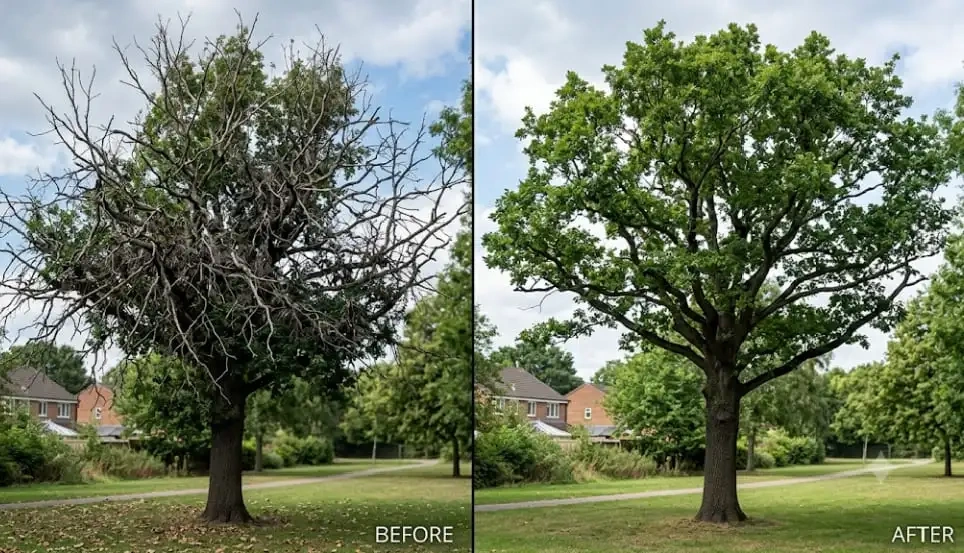
This guide explains the difference clearly, explains when each approach is appropriate for common Sioux Falls tree species, and gives you a practical decision framework so you know exactly what your tree needs.
Quick Answer: The Core Difference
Tree trimming focuses on controlling the shape, size, and appearance of a tree or shrub. It removes overgrown branches to keep the tree looking neat, prevent interference with structures or other plants, and manage growth patterns.
Tree pruning focuses on the long-term health, structure, and safety of the tree. It involves removing dead, diseased, damaged, or structurally problematic branches based on what the tree needs, not just how it looks.
Both involve cutting. The difference lies in why you are cutting and which branches get removed.
What Is Tree Trimming?
Tree trimming is primarily a landscaping practice. The goal is appearance and control, not health intervention. A trimmed tree looks maintained, fits its space in the landscape, and does not encroach on sidewalks, structures, power lines, or neighboring plants.
What Trimming Involves
Trimming typically removes outer portions of a tree’s canopy or specific branches that have grown beyond their desired boundary. Think of it as the maintenance phase of tree care: routine, scheduled, and appearance-driven.
A homeowner trimming a young ornamental maple to maintain its shape is trimming. A tree service cutting branches away from a roofline to keep clearance is trimming. Shaping hedges and shrubs along a fence line is trimming.
When Trimming Is the Right Choice
Trimming makes sense when:
- The tree is visually overgrown but structurally sound
- Branches are growing into utility lines, structures, or blocking sight lines
- Ornamental shrubs or young trees need shaping
- You want to manage the tree’s size as part of routine landscaping maintenance
Most ornamental trees and shrubs benefit from trimming once or twice a year, depending on species and growth rate.
Tools Used for Trimming
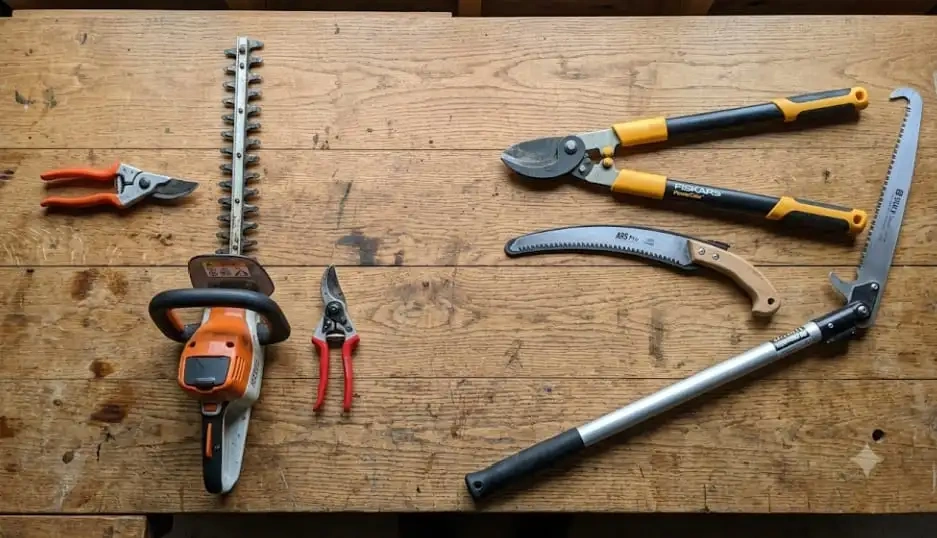
Trimming uses lighter equipment than pruning. Common tools include hand shears, hedge trimmers, and small pruners. For higher branches, a pole pruner or pole saw extends the reach without requiring a ladder. The cuts made during trimming are generally on smaller-diameter branches at the outer canopy.
What Is Tree Pruning?
Tree pruning is a targeted intervention in a tree’s growth and health. Rather than shaping the exterior, pruning works inside the tree’s structure, removing branches based on what the tree needs to survive and thrive over time.
Professional arborists follow the ANSI A300 standard, which is the American National Standards Institute’s published guideline for tree care operations. It defines correct cut placement (at the branch collar, never flush with the trunk), maximum canopy removal limits (no more than 25% of live growth in a single year), and the specific categories of pruning work.
The Four Types of Pruning (per ANSI A300)
These are the industry-standard categories:
Crown Cleaning: Removing dead, dying, diseased, or broken branches throughout the canopy. This is the most common type of pruning and the baseline of responsible tree care.
Crown Thinning: Selectively removing live branches to reduce canopy density. This improves airflow and light penetration through the canopy, reduces wind resistance, and helps prevent fungal issues caused by poor circulation.
Crown Reduction: Reducing the overall size of the canopy by cutting back to lateral branches capable of taking on a terminal role. This is how a professional reduces a tree’s size without damaging it. It is not the same as topping.
Crown Raising: Removing lower branches to raise the base of the canopy. This creates clearance for pedestrians, vehicles, buildings, or sight lines.
When Pruning Is the Right Choice
Pruning is appropriate when:
- Branches are dead, broken, diseased, or dying
- Two branches are rubbing or crossing, causing bark damage
- The tree has co-dominant leaders (two main stems competing at the top)
- There is visible canopy dieback, unusual growth, or signs of pest infestation
- The tree needs structural correction while it is still young enough to respond
- A branch poses a hazard to people or property
Tools Used for Pruning
Pruning uses heavier tools than trimming. Loppers, hand saws, pole saws, and chainsaw rigs handle the thicker cuts required. Because pruning often involves significant branch removal and work at height, the risk profile is much higher than routine trimming.
Trimming vs. Pruning: Side-by-Side Comparison
| Factor | Trimming | Pruning |
| Primary goal | Appearance, shape, size control | Health, structure, safety |
| What gets cut | Outer canopy, overgrown branches | Dead, diseased, damaged, or structurally weak branches |
| Driven by | Aesthetics and landscaping goals | Tree health and condition assessment |
| Frequency | 1–2 times per year (routine) | As needed; often annually or less |
| Best timing | After growth periods; varies by species | Dormant season (late winter) for most species |
| Tools | Hand shears, hedge trimmers, small pruners | Loppers, hand saws, pole saws |
| Skill level | Manageable for homeowners on small trees | Professional-level work for mature trees |
| Risk if done wrong | Aesthetic issues, mild stress | Disease entry, decay, structural failure |
When Should Trees Be Trimmed in Sioux Falls?
Timing for trimming in Sioux Falls is more flexible than pruning because trimming does not create the kind of large open wounds that invite disease or pest pressure. That said, a few practical points apply locally.
For most ornamental trees, late spring and early summer work well. Trees have finished their spring push of growth and their shape is visible and stable. Trimming after the bloom has faded is particularly important for flowering ornamental species so you do not cut off next year’s flower buds.
Summer trimming is common and practical. Growth is obvious and branches that are crossing into problem areas are easy to identify.
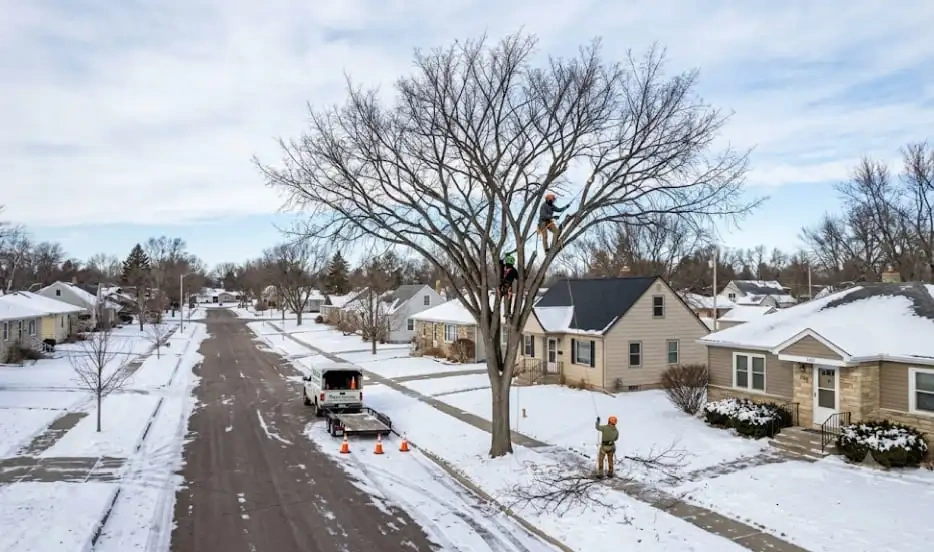
Winter trimming also has advantages in Sioux Falls. Without leaves, the structure of the tree is fully visible and branch access is easier. Sioux Falls winters bring heavy ice storms and significant snowfall. Before these events arrive, trimming out weak or extended branches reduces the weight burden on the tree. The ice storm that struck Sioux Falls in 2013 required the city to launch Operation Timber Strike, a cleanup operation spanning more than two months and costing millions of dollars. Properties with already weakened or overgrown trees suffered the worst damage.
Avoid trimming during active drought stress. When a tree is already struggling to retain moisture, adding the stress of trimming compounds the problem.
When Should Trees Be Pruned in Sioux Falls?
Pruning timing in Sioux Falls is more consequential than trimming timing. The wrong window can expose a tree to disease, invite pest colonization, or prevent the tree from sealing its wounds before the growing season ends.
Late Winter Is the Best Default Window
For most tree species in Sioux Falls, late winter (February through early March) is the preferred pruning window. Trees are dormant, which means:
- Sap flow is minimal, reducing the scent that attracts beetles and other pests
- Fungal spores that cause tree diseases are less active
- The full branch structure is visible without leaves, making assessment more accurate
- The tree channels energy into wound closure as soon as spring growth begins
This aligns with ANSI A300 guidance followed by ISA-certified arborists.
Ash Trees and Emerald Ash Borer Timing
Sioux Falls homeowners with ash trees face a specific challenge. The emerald ash borer was confirmed in Sioux Falls in 2018, and the city estimates it has approximately 84,900 ash trees. EAB adult beetles emerge in spring and actively seek ash trees to colonize. Fresh pruning cuts attract them.
For ash trees specifically, pruning should be completed before EAB adult emergence (typically before late May) or avoided entirely during the active flight period (May through September). Fresh wounds during this window can attract adult EAB and accelerate infestation.
If an ash tree has active EAB damage, consult a professional before pruning, as the work requires coordination with treatment decisions.
The 25% Live Crown Rule
One of the most important principles from the ANSI A300 standard: never remove more than 25% of a tree’s live canopy in a single pruning session. Exceeding this threshold deprives the tree of the photosynthetic capacity it needs to fuel recovery. It causes significant stress, weakens the tree’s immune response, and can trigger aggressive but structurally weak regrowth called water sprouts.
This rule applies regardless of how the tree looks. If a tree needs more than 25% removed to address problems, that work should be spread over multiple growing seasons.
Fall Pruning: Proceed With Caution
Fall is generally not the recommended pruning season for Sioux Falls trees. Trees are preparing to go dormant and their energy is being pulled toward root storage. Wounds created in fall heal more slowly because growth activity is slowing. This leaves cut sites exposed through winter, increasing the risk of frost damage and fungal entry.
There is one exception: dead, broken, or hazardous branches should be removed whenever they are identified, regardless of season. Safety always takes priority over seasonal timing.
How to Know Which Service Your Tree Needs
Use this decision checklist to figure out what you are looking at.
Your tree probably needs trimming if:
- It looks overgrown or messy but leaves and bark appear healthy
- Branches are growing into structures, power lines, or other trees
- You want to maintain or adjust its shape and size
- It is a shrub, hedge, or young ornamental tree
- No branches appear dead, discolored, or structurally compromised
Your tree probably needs pruning if:
- You can see dead branches (brittle, no bark, no leaves in season)
- Branches have discolored, cracked, or oozing bark
- There is obvious dieback in the canopy
- Two main stems are competing at the top of the tree (co-dominant leaders)
- Branches are rubbing against each other and creating raw wounds
- The tree has recently been through storm damage
- You have an ash tree and have not had it assessed since EAB arrived in Sioux Falls
- There are visible signs of woodpecker activity on the trunk (a common indicator of borer damage)
Your tree needs both, sequentially, if:
Both health issues and appearance issues exist. In that case, prune first. Address the health and structural concerns before worrying about shape. Once the tree recovers, appearance maintenance can follow in the next growing season.
Common Mistakes Sioux Falls Homeowners Make
Topping the Tree
Topping means cutting the main scaffold branches or the central leader back to blunt stubs. It is explicitly prohibited under ANSI A300 standards. It is still done regularly by unqualified contractors and DIY homeowners who want to make a tree shorter quickly.
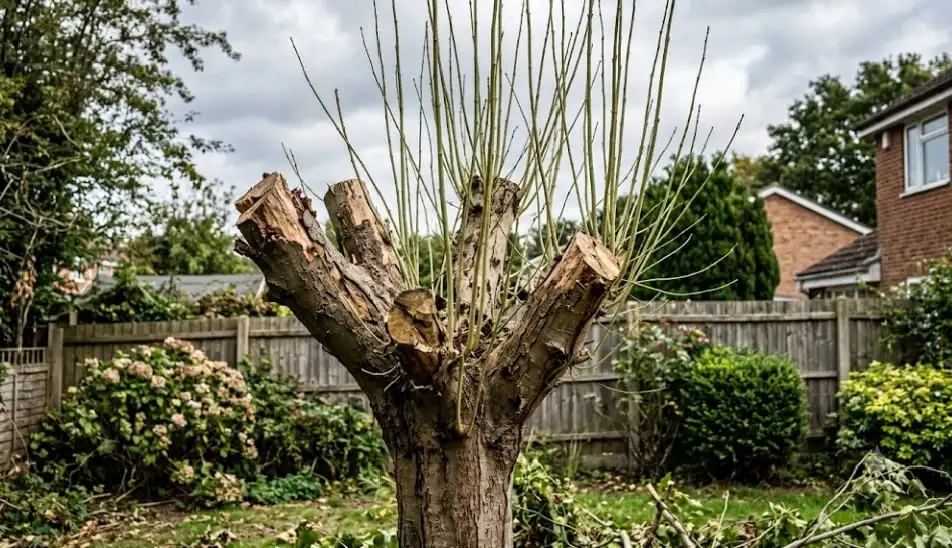
The result is not a shorter tree. Topped trees respond with rapid, vertical regrowth called water sprouts. Within a few years the tree is taller than it was, with weaker branch attachments and an irregular structure. Every stub becomes a decay entry point. Trees that are repeatedly topped decline over years and rarely recover their natural form.
The correct alternative is crown reduction, performed by a qualified arborist, which involves cutting back to lateral branches that can assume a terminal role without leaving stubs.
Pruning Ash Trees During EAB Flight Season
As noted above, fresh wounds on ash trees during May through September attract adult emerald ash borers. This is a mistake that can accelerate the loss of an otherwise healthy tree.
Making Flush Cuts
A flush cut removes the branch collar along with the branch. The branch collar is a zone of specialized cells that the tree uses to compartmentalize decay and seal over wounds. Removing it eliminates the tree’s primary defense mechanism at the cut site. Decay then spreads inward rather than being contained.
Cuts should be made just outside the branch collar, not into it and not leaving a stub.
Over-Pruning
Removing more than 25% of the live canopy in a single session causes significant stress, leaves the tree vulnerable to sunscald on previously shaded bark, and triggers weak water sprout growth. More is not better when it comes to pruning.
Pruning in Fall Without Cause
Routine pruning in September or October in Sioux Falls leaves wounds that will not seal before the tree enters dormancy and faces a Midwest winter. Reserve fall work for genuine hazards.
Warning Signs Your Tree Needs Attention Now
Do not wait for the next scheduled maintenance window if your tree shows any of these:
- Dead branches that remain leafless while the rest of the tree has leafed out
- Cracks or splits running vertically along the trunk or major branches
- Fungal growth such as shelf mushrooms or conks growing from the trunk or at the base
- Visible cavities in the trunk where wood has rotted out
- Canopy die-off on one side of the tree, or progressive die-off from the top down
- Bark “blonding” (lightening or peeling of outer bark) on ash trees, which is associated with EAB damage
- Excessive woodpecker activity concentrated on the trunk or main scaffold branches
- Leaning that has changed from its normal angle, especially after a storm
- Co-dominant leaders or branch unions with included bark visible as a V-shape without visible bark ridges between the stems
Any of these should prompt a professional assessment rather than a wait-and-see approach.
When to Call a Tree Care Professional
Some tree work is manageable for homeowners on small trees and shrubs. Mature trees are a different situation. Consider calling a professional when:
- The tree is more than 15–20 feet tall
- Branches to be removed are larger than 2 inches in diameter
- Work requires a ladder, chainsaw, or climbing
- The tree shows signs of disease or pest damage
- The tree is near a structure, utility line, or vehicle
- You have an ash tree in need of evaluation
- You are unsure whether the tree needs trimming, pruning, or removal
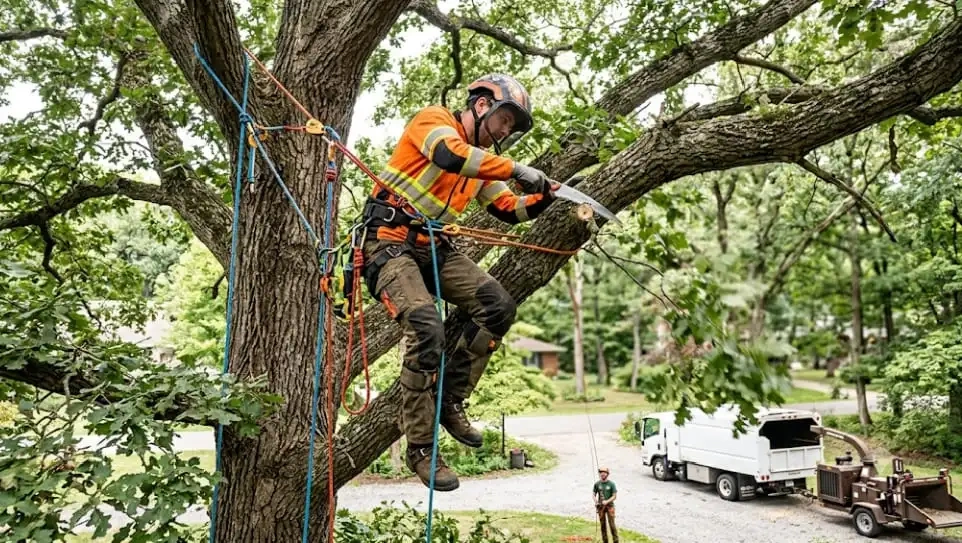
A professional assessment is also worthwhile before Sioux Falls’ ice storm season. A tree that has developed structural weaknesses, co-dominant leaders, or heavy canopy over a structure is a liability when a January ice storm arrives.
Seasonal Tree Care Checklist for Sioux Falls
Late Winter (February–Early March)
- Prime window for dormant pruning on most deciduous trees
- Prune maples, lindens, honeylocusts, and elms before sap flow begins
- Assess ash trees and plan EAB treatment or removal before spring adult emergence
Spring (April–May)
- Avoid pruning oaks if oak wilt is a concern in your area
- Spring-flowering ornamentals should be trimmed after bloom fades
- Inspect trees after winter and ice season for damage
Summer (June–August)
- Routine trimming works well for most ornamentals
- Do not prune ash trees with fresh cuts during peak EAB flight
- Remove dead or broken branches as hazards; avoid elective structural pruning during heat stress
Fall (September–November)
- Avoid elective pruning
- Remove genuinely hazardous branches before snow and ice season
- Consider trimming extended or weak branches before winter weight loads arrive
Frequently Asked Questions
1. What is the main difference between tree trimming and tree pruning?
Trimming focuses on maintaining the shape and appearance of a tree. Pruning focuses on the tree’s health, structure, and safety by removing dead, diseased, damaged, or structurally problematic branches.
2. Can I do tree trimming or pruning myself?
Light trimming on small ornamental trees and shrubs is manageable for most homeowners with the right hand tools. Pruning work on mature trees, especially those requiring a ladder, chainsaw, or work near structures or power lines, is best left to a qualified professional.
3. How often should trees be trimmed?
Most ornamental trees benefit from trimming once or twice per year. The right frequency depends on the species, growth rate, and your landscaping goals.
4. How often should trees be pruned?
There is no fixed schedule for pruning. Most trees benefit from an assessment every year or two, with pruning performed when health or structural issues are identified. Young trees may benefit from annual structural pruning to establish good form.
5. Is it okay to prune trees in the fall in Sioux Falls?
Generally, no. Fall pruning leaves wounds that cannot seal before winter, increasing the risk of frost damage and disease entry. The exception is hazardous or dead branches, which should be removed whenever they are identified.
6. What is the best time to prune trees in South Dakota?
Late winter, from February through early March, is the best window for most deciduous trees. Trees are dormant, pests are inactive, and wounds will seal quickly once spring growth begins.
7. What is crown thinning and do I need it?
Crown thinning is the selective removal of live branches to reduce canopy density, improve airflow, and reduce wind resistance. It is beneficial for trees with overly dense canopies and for reducing risk during high-wind events. It requires professional judgment to perform correctly.
8. What is topping and why is it harmful?
Topping means cutting main branches or the central leader back to stubs. It causes rapid but structurally weak regrowth, creates extensive decay entry points, and permanently damages the tree’s form. It is prohibited under ANSI A300 professional standards and should not be requested or accepted as a tree service.
9. I have ash trees in my yard. When can I prune them?
Ash trees in Sioux Falls should be pruned in late winter before EAB adult beetles emerge in late May, or avoided during the active flight period of May through September. If you have concerns about EAB damage or infestation, get a professional assessment before any pruning work begins.
10. How much does tree pruning cost in Sioux Falls?
Costs vary based on tree size, species, condition, and scope of work. Routine pruning of a single mature tree in Sioux Falls typically ranges from $200 to $700. Large, complex, or hazardous trees cost more. Getting multiple quotes from qualified professionals is advisable.
11. How much of a tree can I safely remove in one pruning session?
Per the ANSI A300 standard, no more than 25% of the live canopy should be removed in a single session. Exceeding this threshold causes significant stress and weakens the tree’s ability to recover.
12. Does trimming hurt a tree?
Routine trimming on healthy branches causes minimal stress. However, heavy or poorly timed trimming can stress a tree, and flush cuts or excessive removal can cause lasting damage. Using clean, sharp tools and avoiding over-removal keeps trimming low-risk.
13. What is the branch collar and why does it matter?
The branch collar is a zone of specialized cells where a branch meets the trunk or parent branch. These cells contain the tree’s wound-sealing response. Pruning cuts made just outside the branch collar (not into it, not leaving a stub) allow the tree to compartmentalize decay and seal over the wound naturally. Cutting into the collar removes this defense.
14. My tree has a lot of dead branches. Does it need removal?
Not necessarily. A tree with a significant amount of deadwood may still be structurally sound and treatable. An arborist can assess the extent of dead wood, identify the likely cause, and determine whether crown cleaning, health treatment, or removal is the appropriate response.
15. Can a tree recover from improper pruning?
It depends on the severity and the health of the tree. A single poor cut on an otherwise healthy tree usually compartmentalizes without serious long-term consequence. Repeated topping, extensive flush cuts, or removal of more than 25% of the canopy can cause damage the tree never fully recovers from. Younger, vigorous trees are more resilient than old or already-stressed specimens.
Some Towns Make Clearance Your Legal Responsibility
In Tea, Ordinance 9.05(c) makes the property owner responsible for keeping branches clear: 10 feet over sidewalks, 12 feet over streets and 14 to 16 feet over truck routes. It also counts shading a street light as a violation, so a tree well inside your garden can still be out of compliance. Younger trees in Harrisburg need structural pruning rather than clearance work, while century-old canopies in Lennox mostly need deadwood removal.