After a tree comes down, the stump it leaves behind becomes the next decision. For most Sioux Falls homeowners, the choice comes down to two options: stump grinding or complete stump removal. Both get rid of the visible problem. Both have very different implications for your yard, your future landscaping plans, and your budget.
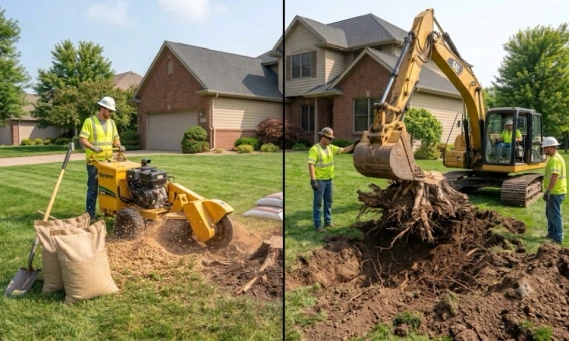
This guide explains exactly what each method involves, what it costs in the local market, how local soil conditions and tree species affect the outcome, and how to choose the right option for your specific situation.
Grinding vs. Removal at a Glance
Stump grinding is faster, less disruptive, and significantly less expensive. It removes the visible stump and grinds it several inches below grade, leaving the root system underground to decompose naturally. It is the right choice for most residential situations.
Complete stump removal extracts the stump and the bulk of the root ball, leaving the ground fully clear. It costs more, takes more time, and disturbs more of the surrounding yard. It is the right choice when you need the ground completely clear for construction, a patio, a new tree, or a deep foundation.
What Is Stump Grinding? Process and What It Leaves Behind
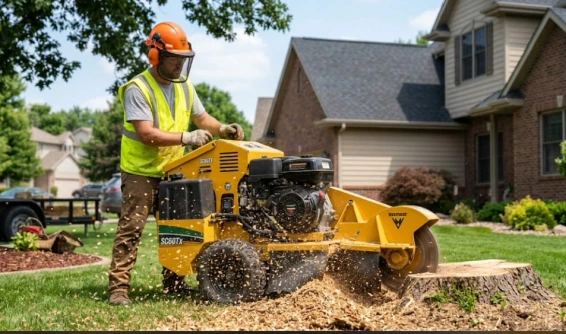
Stump grinding is a mechanical process that uses a machine equipped with a rotating cutting wheel lined with carbide teeth. The operator positions the machine over the stump and works the wheel back and forth, systematically chipping the wood into small fragments. The grinding typically goes six to twelve inches below the existing soil surface, though deeper cuts of up to eighteen inches are possible on request for an additional cost.
The result is a shallow depression filled with wood chips and sawdust where the stump used to be. The visible stump is completely gone. What remains is the root system underground, which stays in place and decomposes naturally over the following years.
What stump grinding does:
- Eliminates the visible stump entirely
- Produces wood chip mulch that can be repurposed or hauled away
- Creates minimal disruption to surrounding lawn, landscaping, and soil
- Completes the job in one to three hours for most residential stumps
- Prevents the stump from becoming a tripping hazard or eyesore
What stump grinding does not do:
- Remove the root system below the grinding depth
- Guarantee against root sucker regrowth in sprouting species
- Allow immediate replanting of a new large tree in the same location
- Clear ground for construction, foundations, or underground utility work
The wood chips left behind are usable as mulch in garden beds. One exception worth knowing: chips from bur oak stumps, which are among the most common large trees in Sioux Falls residential areas, contain compounds that can inhibit the germination of some plant species. Use bur oak chips as a path material or dispose of them rather than spreading them near flower beds or vegetable gardens.
What Is Complete Stump Removal? Process and Trade-Offs
Complete stump removal is a fundamentally different operation. Rather than grinding the wood in place, this method physically extracts the stump and as much of the root ball as possible from the ground.
The process involves digging around the stump perimeter to expose the major structural roots, cutting through those roots with chainsaws or hand tools, and then pulling the entire stump and root mass out using an excavator, backhoe, or hydraulic equipment. The excavation typically extends three to eight feet out from the trunk depending on the tree’s species and age. Smaller, younger stumps with compact root systems are the most practical candidates.
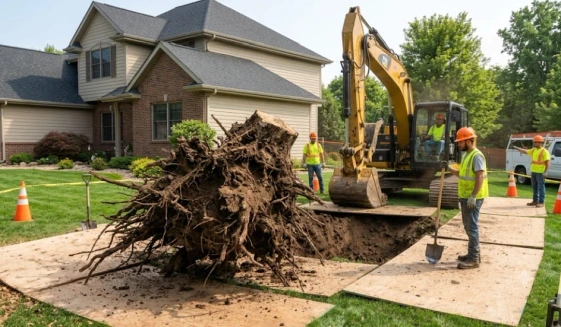
After extraction, the site is left with a significant hole that needs to be backfilled with clean soil, graded, and restored before anything else can be done with the space.
What complete stump removal does:
- Clears the ground entirely of the stump and major root mass
- Creates usable, rootfree ground for construction or deep foundation work
- Allows replanting of a new tree in the same location immediately after restoration
- Eliminates any possibility of root sucker regrowth from the removed root system
What complete stump removal does not do:
- Remove every feeder root (smaller lateral roots remain and decompose naturally)
- Avoid significant disturbance to surrounding lawn and soil
- Complete quickly or inexpensively for large stumps
- Work as efficiently on large, mature stumps in tight residential spaces
Full Comparison Table: Stump Grinding vs. Stump Removal
| Factor | Stump Grinding | Complete Stump Removal |
| Process | Mechanical grinding below grade | Full excavation and extraction |
| Depth | 6 to 18 inches below surface | 3 to 8 feet of excavation radius |
| Roots removed | No, roots remain underground | Yes, major root ball removed |
| Average cost | $75 to $300 per stump | $175 to $500+ per stump |
| Time required | 1 to 3 hours | 3 to 8 hours per stump |
| Lawn disruption | Minimal | Significant |
| Regrowth risk | Low to moderate depending on species | Very low, root mass removed |
| Future planting | Grass and small plants: immediate. New tree: wait 1 to 2 seasons | New tree: possible after soil restoration |
| Construction suitability | Not suitable for foundations or deep work | Suitable after backfill and grading |
| Soil settling risk | Moderate as roots decompose | High initially from backfill settling |
| Wood byproduct | Wood chips usable as mulch | No wood byproduct |
| Best use case | Most residential situations | Construction, replanting, or root-sensitive landscaping |
| Long-term result | Roots decompose over 3 to 15 years depending on species | Ground is fully clear after restoration |
Cost Breakdown: What Sioux Falls Homeowners Actually Pay
Nationally, stump grinding averages around $250 per stump, with smaller stumps and softer wood coming in as low as $30 and large stumps with hardwood species reaching up to $1,600. In the Sioux Falls market, typical residential stump grinding runs between $75 and $300 for most stumps, with the per-diameter-inch pricing model of $2 to $5 per inch being the most common approach contractors use.
Complete stump removal typically costs $100 to $200 more than grinding, making grinding the more budget-friendly option for most situations.
Key cost factors specific to Sioux Falls:
Tree species. Bur oak and hackberry are the densest hardwoods commonly removed in Sioux Falls residential areas. Hardwood stumps like oak, maple, and walnut are denser and cause more wear on equipment, with an additional $50 to $150 per stump for hardwood grinding compared to softer species.
Stump diameter. A 10-inch diameter stump from a young ornamental crabapple is a fundamentally different job than a 36-inch cottonwood stump. Measure the stump at ground level before requesting a quote.
Stump condition. Older, rotten stumps with aged wood are typically far easier to remove with grinding, so labor costs are often lower. A fresh stump from a recently felled healthy tree takes more time and equipment effort.
Site access. A stump in an open backyard with wide gate access is straightforward. A stump between a fence and a foundation, or at the end of a narrow side yard, requires specialized smaller equipment or manual augmentation, both of which add cost.
Stump count. Multiple stumps on one property almost always qualify for a per-unit discount. The mobilization cost is the same whether the crew grinds one stump or five. If you have several stumps, scheduling them together can reduce the cost per stump by 20% to 40%.
Debris hauling. Most quotes do not include hauling the resulting wood chips off the property. Expect to add $50 to $150 for chip removal, or arrange to keep the mulch and spread it yourself.
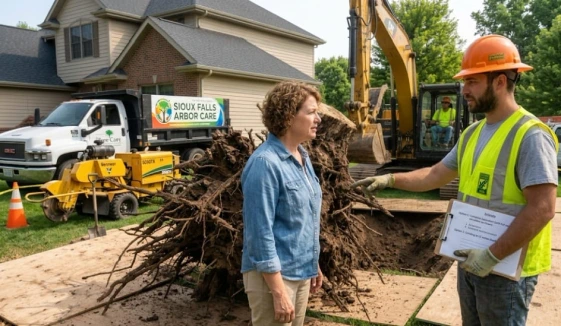
Hidden costs to watch for: Soil backfill after either method, lawn restoration seeding, root removal for deep-reaching species, and permit fees in some cases. Always ask your contractor to confirm what the quote includes and excludes in writing.
Regrowth Risk by Tree Species Common in Sioux Falls
This is one of the most practically important sections of this decision, and it is one that most general articles completely ignore.
Whether or not a tree regrows after stump grinding depends heavily on the species. Fast-sprouting species include willow, poplar, aspen, maple, elm, and sweetgum, which send up shoots within weeks, sometimes forming dense clusters. Conifers like pine, spruce, cedar, and fir rarely sprout from stumps once cut.
The table below focuses specifically on tree species common in Sioux Falls residential yards.
Practical implication: If your stump is a cottonwood, silver maple, or elm, budget for ongoing monitoring after grinding and plan to cut back any sprouts promptly as they emerge. Cutting sprouts consistently over one to two growing seasons exhausts the root system’s energy reserves. If you want to entirely avoid the possibility of regrowth, complete removal is the appropriate choice for these high-sprouting species.
How Sioux Falls Soil and Climate Affect Your Decision
This is a dimension virtually no competitor addresses, and it matters significantly for Sioux Falls homeowners.
Freeze-Thaw Cycles Slow Root Decomposition
Root decomposition after stump grinding is influenced by climate, with warm and wet weather speeding up decomposition while cooler and dry conditions slow it down. Sioux Falls winters are long and cold, with soil temperatures dropping below freezing from November through March most years. Microbial activity, which is what drives root decay, slows dramatically in cold soil. This means that roots left underground after grinding in Sioux Falls will decompose more slowly than the national averages suggest.
Where a national average might suggest a 3 to 5 year decomposition timeline for softwood roots, Sioux Falls homeowners should realistically expect 4 to 7 years for softwood species like cottonwood and green ash, and 10 to 15 years or more for dense hardwoods like bur oak. This extended timeline affects the soil settling question directly.
Soil Settling Is a Real Consideration in Clay-Heavy Sioux Falls Soils
Sioux Falls sits on predominantly clay-rich prairie soils. As roots decompose and leave voids underground, the soil in those areas can settle or sink. This is a natural occurrence. In the clay-heavy soils typical of Sioux Falls residential lots, these voids can be slow to fill naturally and may create soft spots or minor depressions in your lawn over several years after grinding.
This is not a reason to avoid grinding. It is simply a reason to monitor the area after grinding and add topsoil or leveling mix if settling becomes visible.
Uprooted Stumps After Derecho Events
After major wind events in Sioux Falls, including the documented derechos that have affected the metro in recent years, many homeowners are left with large uprooted trees rather than stumps from deliberate felling. An uprooted tree creates a different stump situation. The root ball is already partially exposed and disrupted. In these cases, the distinction between grinding and removal becomes narrower, because excavation has already begun naturally. A contractor can assess whether the upturned root ball can simply be cut back and backfilled, or whether additional grinding or extraction is warranted.
What Happens to Roots After Stump Grinding?
One of the most common questions Sioux Falls homeowners have is whether leaving roots in the ground causes long-term problems. The honest answer is: usually not, but with some important nuances.
The remaining roots decompose naturally, a process that takes three to five years depending on tree species and soil conditions. The decomposing roots actually improve your soil by adding organic matter.
However, three specific concerns are worth understanding:
Soil settling. As large roots decay, they leave voids. In clay soil, these voids may not fill immediately from above, creating soft spots in the lawn years after the stump is gone. Filling the chip-filled depression with good quality topsoil after grinding reduces, but does not eliminate, this risk.
Nutrient competition. Decomposing roots in the soil create a zone of high carbon content relative to nitrogen. If you plan to seed or sod directly over the ground after grinding, add a nitrogen-rich starter fertilizer to compensate, because the decomposing wood chips will initially pull nitrogen from the surrounding soil.
Root sucker emergence. For the sprouting species identified in the table above, roots left underground continue attempting to generate new growth. These suckers appear as small shoots emerging from the soil in the vicinity of the old stump. They are manageable by consistent cutting, but require attention through at least two full growing seasons.
When Stump Grinding Is the Right Choice
Stump grinding is appropriate for the large majority of residential stump situations in Sioux Falls. Choose grinding when:
- You want the stump gone with minimal yard disruption and cost
- Your primary goal is a level, clean lawn surface
- You plan to plant grass, shrubs, or small ornamentals over the area
- The tree was a low-sprouting species such as bur oak, redcedar, or green ash
- You have limited budget and the roots being underground is not a problem
- You are bundling stump grinding with a tree removal already in progress
- The stump is in a location where heavy excavation equipment cannot access safely
When Complete Stump Removal Is the Right Choice
Complete stump removal is appropriate in specific situations that grinding cannot adequately address. Choose full removal when:
- You are planning construction, a patio, a deck, or a structure in the exact location of the stump
- You want to plant a new large tree in the same spot and cannot wait for roots to decompose
- The stump is from a high-sprouting species like cottonwood, silver maple, or elm and you want to eliminate regrowth potential entirely
- The tree was diseased and you are concerned about soilborne pathogens remaining near other plantings
- The root system is interfering with an existing structure, underground utility, or drainage system
- The stump is from a relatively small, young tree with a compact root ball that can be extracted without major excavation
How to Decide: A Homeowner Decision Framework
Use this checklist to determine which option fits your situation.
Choose stump grinding if you answer YES to most of these:
- My primary goal is removing the visible stump and having a level lawn
- I am not planning construction or a large new tree in this exact spot
- The tree species is a low-to-moderate sprouter (bur oak, green ash, redcedar, crabapple)
- Budget is a meaningful consideration and the cost difference matters
- The stump is large, old, or in a location where heavy excavation would be very disruptive
- I am comfortable monitoring the area for root suckers for one to two growing seasons
Choose complete stump removal if you answer YES to any of these:
- I am planning construction, a patio, or any structure in this exact location
- I want to plant a new large tree in the same spot within the next season
- The tree was a cottonwood, silver maple, elm, or other aggressive sprouting species and I want zero regrowth risk
- The stump is from a diseased tree and I want to remove the root system entirely from my soil
- Roots are already causing a known problem with utilities, a foundation, or drainage
Lawn Restoration After Either Method
Both methods leave a void or depression that requires attention before the area looks like part of the lawn again.
After stump grinding: The hole will be filled with wood chips and sawdust from the grinding process. Allow these chips to settle for two to four weeks. Then add several inches of topsoil to bring the area level with the surrounding grade. Seed with a grass mix appropriate for Sioux Falls conditions (tall fescue, Kentucky bluegrass, and perennial ryegrass all perform well in the area) in early fall or early spring for best establishment. Water consistently for four to six weeks until germination is complete.
After complete stump removal: The excavated hole is larger and requires more careful backfilling. Use quality topsoil rather than fill dirt, which compacts poorly and drains inadequately in clay soil conditions. Backfill in layers, tamping each layer to reduce future settling. Grade the surface level or slightly mounded to account for settling. Seed or sod as conditions allow.
In both cases, if the stump location was in a shaded area under the canopy of other trees, choose a shade-tolerant grass seed blend rather than standard full-sun mixes, which will struggle to establish under reduced light.

Common Mistakes Homeowners Make
Skipping the stump entirely after tree removal. A stump left in place is not a neutral decision. It becomes a tripping hazard, a pest habitat, and in sprouting species, the source of multiple new stems within a season. Scheduling stump grinding at the same time as tree removal is almost always more cost-effective than a return visit.
Choosing full removal for a stump that only needs grinding. Complete removal for a large mature tree stump in a non-construction context is often unnecessary, expensive, and significantly more disruptive to the surrounding yard than the situation warrants.
Assuming the wood chips are free mulch for any purpose. Wood chip mulch from freshly ground stumps should not be used directly around edible plants or in areas where you plan to sow seeds immediately. Fresh wood chips tie up nitrogen in the soil as they decompose, inhibiting establishment. They also carry any disease pathogens present in the original tree.
Planting directly over the ground before soil has settled. Both methods create some degree of soil settlement in the weeks following. Allow the area to settle before final seeding or sod installation.
Not asking about debris hauling in the quote. Many grinding quotes do not include chip removal. Confirm this before the job to avoid a surprise surcharge.
Ignoring root sucker emergence. Homeowners who see new shoots appearing around a ground stump often think the stump was not fully processed. In most cases, these are root suckers from the remaining root system, particularly common in cottonwood, maple, and elm. They should be cut back promptly each time they appear. Consistent removal over two growing seasons typically exhausts the root system’s ability to resprout.
Frequently Asked Questions
1. How much does stump grinding cost in Sioux Falls?
Stump grinding in Sioux Falls typically runs $75 to $300 per stump for most residential jobs. The most common pricing model is $2 to $5 per diameter inch, with a minimum charge of $100 common for small stumps. Dense hardwood species like bur oak and hackberry may run toward the higher end of the range. Multiple stumps on one visit typically qualify for per-unit discounts.
2. Is stump grinding included when I hire a tree removal company?
Almost never. Stump grinding is almost universally a separate line item from tree removal. Always ask specifically whether stump grinding is included in your removal quote. Adding it to a tree removal job on the same visit is the most cost-effective approach, since the crew and equipment are already on-site.
3. How deep does stump grinding go?
Standard residential stump grinding typically removes the stump six to twelve inches below the existing ground surface. If you need a deeper grind for replanting or construction purposes, most operators can go deeper for an additional fee, often reaching sixteen to eighteen inches below grade with the right equipment.
4. Will a cottonwood or silver maple stump regrow after grinding?
Both species are known for vigorous root sucker production and have a meaningful regrowth risk after grinding. Suckers can emerge from lateral roots well beyond the stump perimeter. The management approach is consistent cutting of any new growth as it appears over two growing seasons. If you want zero regrowth risk from these species, complete removal is the more reliable option.
5. How long does it take for roots to decompose after stump grinding in Sioux Falls?
In Sioux Falls, with its cold winters and clay-heavy soils, expect a longer decomposition timeline than national averages suggest. Softwood species roots like green ash and cottonwood may take four to seven years. Dense hardwood roots like bur oak can take ten to fifteen years or more. Cold soil significantly slows the microbial activity that drives decomposition.
6. Can I plant grass over a ground stump immediately?
You can plant grass relatively quickly after stump grinding, but the wood chips in the hole should be removed and replaced with topsoil first. Fresh wood chips decompose slowly and tie up nitrogen in the soil as they do, which inhibits grass seed germination. Fill with quality topsoil, allow two to four weeks for settling, then seed.
7. Can I plant a new tree where a stump was ground?
You can plant small trees or shrubs within a season after grinding. Planting a new large tree in the exact same location works best after two to three years have passed, allowing initial root decomposition to clear space and prevent soil nitrogen competition. After complete stump removal and proper soil restoration, replanting is possible more quickly, typically within one season.
8. Is there a risk of soil settling after stump grinding?
Yes. As the roots left underground decompose over years, they leave voids that can cause minor soil settling or soft spots in the lawn above. This is more pronounced in Sioux Falls clay soils, which do not fill voids as readily as looser sandy soils. Adding topsoil after grinding and monitoring the area for a season or two is good practice.
9. What should I do with the wood chips after stump grinding?
Wood chips from the grinding can be used as mulch in garden beds away from vegetable gardens or seed areas. They work well as path material or around ornamental plantings where existing plants are already established. For bur oak chips specifically, spread them as path material rather than in planting beds, as oak wood contains compounds that can inhibit germination of other plants. If you do not want the chips, most contractors will haul them for an additional fee of $50 to $150.
10. Is complete stump removal ever necessary?
Yes, in specific situations. If you are building a structure, patio, driveway, or foundation over the stump location, the roots left by grinding will interfere with the work. If you are planting a new large tree in the exact location immediately, root competition is a problem. If the stump is from a disease-affected tree and you want to remove the root system from the soil entirely, removal is the appropriate choice.
11. Does stump grinding kill the roots?
Grinding itself does not kill the roots below the grinding depth. For species with strong sprouting instincts like cottonwood and silver maple, the roots may continue attempting to produce new growth. The roots themselves die over time as the food supply from photosynthesis is eliminated, but this process can take one to several growing seasons in energetically strong species.
12. Is DIY stump grinding a reasonable option for Sioux Falls homeowners?
Stump grinders can be rented from equipment rental companies, and DIY is theoretically possible for simple, accessible stumps. However, stump grinders are heavy, powerful, and require operator experience to use safely. The risk of equipment damage, injury, and underground utility strikes is real. For stumps near structures, underground lines, or fencing, professional operation is strongly recommended. Dial 811 before any grinding or excavation to have underground utilities marked.
13. Does removing a stump improve property value?
Stump removal, whether by grinding or complete extraction, has a positive impact on property presentation and safety. An active stump in a visible front yard is a mild negative on curb appeal and may be noted in a home inspection. Removing it eliminates a tripping liability, improves lawn aesthetics, and reduces pest attraction, all of which are favorable from a property maintenance standpoint.
14. How long does stump grinding take?
Most residential stumps are ground in one to three hours depending on diameter, wood density, and site access. A crew can grind a standard 20-inch diameter green ash stump in about one hour with commercial equipment. A large 36-inch cottonwood near a fence may take two to three hours. Multiple stumps add proportional time, though mobilization overhead is only counted once.
15. Are there specific Sioux Falls considerations for emerald ash borer-killed ash stumps?
Yes. Green ash and black ash trees in Sioux Falls have been significantly affected by the emerald ash borer. Dead ash stumps have very low regrowth potential, which is one less concern compared to healthy stumps. However, ash wood from EAB-killed trees can remain structurally compromised and may be easier to grind than healthy ash stumps. The wood chips from EAB-affected stumps should not be transported to other properties, as this can spread insect populations. Keep chips on-site as mulch or have them disposed of locally.
Ground Conditions Decide What Is Actually Possible
Grinding depth is not always your choice. In Garretson, Sioux quartzite sits close to the surface, so grinding goes to bedrock rather than to a set depth. In Harrisburg‘s newer additions, irrigation lines and utilities sit shallow and closer to the tree than the plans suggest. In Dell Rapids, flood silt has raised the grade over the years, so the original soil line is lower than it looks.