Tree service is tree service, right? The same chainsaw, the same chipper, the same outcome. That assumption costs property owners in Sioux Falls real money and real liability exposure every year.
Residential tree service and commercial tree service share the same foundational skills, but they differ significantly in scope, scheduling, liability requirements, maintenance structure, equipment scale, and the way pricing and contracts work. A homeowner managing two mature bur oaks in their backyard has fundamentally different needs than a property manager responsible for 140 trees across a mixed-use development near the Sanford Pentagon. Understanding those differences helps you hire the right type of service, set the right expectations, and avoid the mistakes that create either unnecessary expense or serious liability gaps.
The Core Distinction: Scale, Scope, and Accountability
The difference between residential and commercial tree service is not primarily about the type of work being done. Both involve trimming, removal, stump grinding, hazard assessment, and emergency response. The difference is in how that work is planned, executed, documented, and contracted.
Scale is the most visible difference. A residential property might have three to ten trees that require periodic attention. A commercial property in Sioux Falls, whether a retail center on West 41st Street, an apartment complex near the Empire Mall, or a business park on the north side, may have dozens to hundreds of trees requiring systematic management.
Accountability is the less visible but more consequential difference. A residential homeowner is accountable to themselves and their immediate neighbors. A commercial property owner or manager is accountable to tenants, customers, employees, visitors, municipal codes, zoning requirements, insurance carriers, and potentially lenders or investors. A tree failure on a commercial property that injures a visitor is a liability event with legal, financial, and reputational consequences that simply do not exist at the same scale in a residential context.
What Residential Tree Service Looks Like in Sioux Falls
Residential tree service in Sioux Falls is largely reactive and per-job. A homeowner notices a dead limb over the driveway after a wind event, calls a tree service, gets a quote, and schedules the work. The scope is specific: one or two trees, a defined task, a single visit.
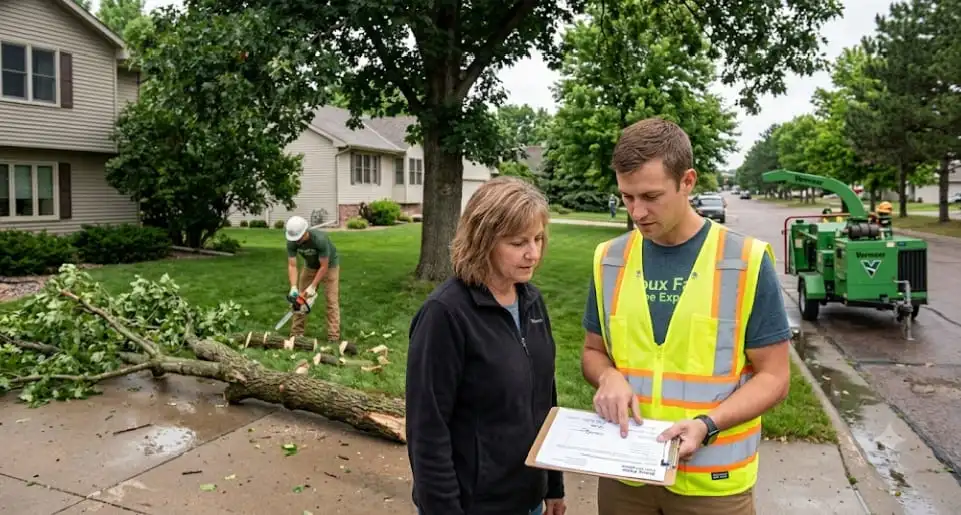
Typical residential tree services include:
- Pruning or trimming of individual trees for clearance, health, or appearance
- Removal of dead, hazardous, or unwanted trees
- Stump grinding after removal
- Storm damage cleanup after a significant weather event
- Emergency removal after a tree falls on a structure or blocks access
- One-time disease or pest treatment for a specific tree
Characteristics of residential work:
- Smaller equipment appropriate for yard access through standard gates
- Work scheduled during business hours at the homeowner’s convenience
- Cleanup and restoration of the immediate work area
- One-time or occasional contracts with no long-term maintenance obligation
- Pricing on a per-job basis with a written estimate for each visit
The residential homeowner’s primary goals are typically appearance, safety, and property value. The relationship with a tree service is transactional and periodic rather than ongoing and contractual.
What Commercial Tree Service Looks Like in Sioux Falls
Commercial tree care involves larger areas like office parks, shopping centers, schools, and municipal properties. Trees serve functional roles such as shade for parking lots, public safety, and meeting zoning requirements. Because these spaces are public or semi-public, careful planning and maintenance are essential to minimize liability and ensure safe access.
In the Sioux Falls market, commercial tree service clients include retail centers, apartment complexes, office parks, medical campuses, educational institutions, industrial properties, HOAs, and municipal properties. What sets these clients apart is not just the number of trees but the nature of the obligation involved.
Typical commercial tree services include:
- Regular scheduled trimming of tree populations across the entire property
- Systematic hazard assessments of all trees by a qualified arborist
- Emergency response with guaranteed response windows for storm events
- After-hours and weekend work to avoid disruption to business operations
- Tree inventory development and ongoing management
- Coordination with property management companies, tenant associations, and municipal officials
- Compliance documentation for insurance carriers and municipal code compliance
- Large-scale storm damage cleanup affecting multiple structures or access points simultaneously
- Lot clearing for new development projects
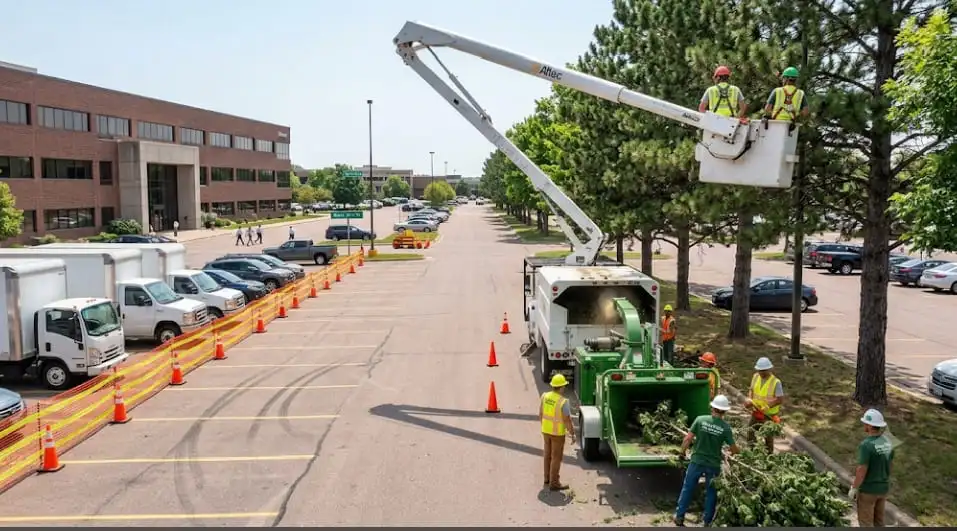
Characteristics of commercial work:
Commercial contracts often include long-term agreements with scheduled maintenance visits and emergency response provisions. Commercial projects require heavy-duty equipment like large cranes, chippers, and aerial lifts to handle bigger trees and spaces. Tree care in commercial zones often happens outside business hours or weekends to minimize disruption to operations.
The commercial property manager’s primary goals are safety compliance, liability reduction, tenant satisfaction, and systematic cost control through planned rather than reactive maintenance.
Full Comparison Table: Residential vs. Commercial Tree Service
| Factor | Residential | Commercial |
| Property size | Single lot, 1 to 10 trees typically | Multiple acres, dozens to hundreds of trees |
| Project scope | Per-job, specific task | Ongoing, systematic, multi-tree |
| Scheduling | Homeowner convenience, business hours | Planned cycles, often after-hours or weekends |
| Maintenance frequency | As needed, reactive | Scheduled quarterly, semi-annual, or annual plans |
| Equipment requirements | Lighter, maneuverable tools | Heavy equipment, aerial lifts, large chippers |
| Primary goal | Appearance, safety, property value | Safety compliance, liability reduction, tenant satisfaction |
| Liability exposure | Homeowner to neighbors | Business to public, tenants, insurers, municipal code |
| Insurance requirements | Standard liability and workers’ comp | Higher limits often required, sometimes additional insured status |
| Budget planning | Per-event cost | Annual or multi-year maintenance budget |
| Tree inventory | Not typically maintained | Essential for large properties |
| Emergency response | Call-and-schedule basis | Guaranteed response windows in contracts |
| Regulatory considerations | Basic local ordinances | Zoning codes, commercial permits, ADA clearances |
| Contract structure | Written estimate per job | Annual or multi-year maintenance contracts |
| Documentation | Quote and invoice | Inspection records, compliance documentation, hazard reports |
| Decision making | Homeowner | Property manager, facility director, HOA board |
Why Liability Is Different for Commercial Properties
This is the dimension most articles on this topic skip entirely, and it is the most important one for business owners and property managers to understand.
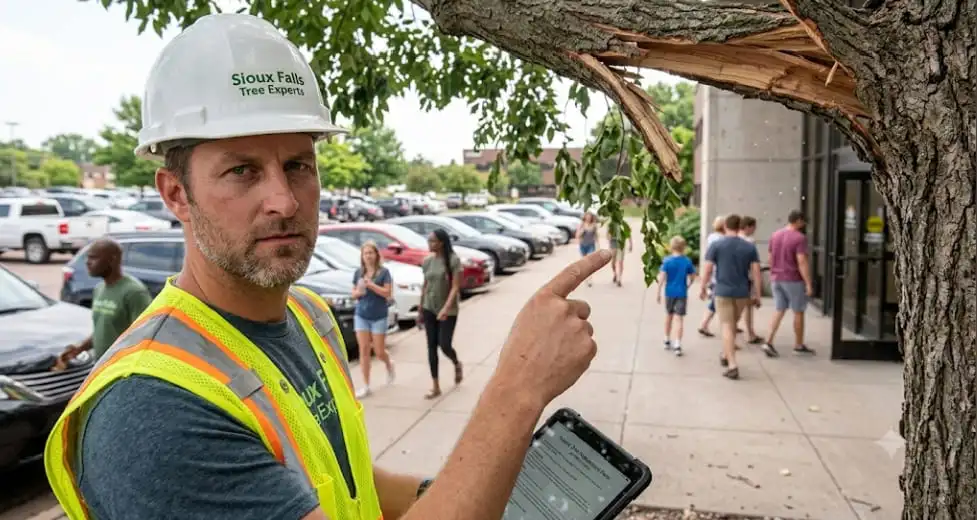
A residential homeowner’s liability exposure from a tree is real but relatively contained. If a neighbor’s car is damaged by a falling limb, the homeowner’s liability coverage through their homeowner’s insurance policy is the primary financial mechanism. The dollar amounts are meaningful but bounded.
A commercial property has a fundamentally different exposure profile. A tree limb that falls in a retail parking lot during business hours may injure a customer. A tree that fails adjacent to a business entrance creates both the immediate safety hazard and a documented negligence risk if prior warning signs were observable. A tree blocking emergency vehicle access to an apartment complex after a storm creates potential liability extending well beyond property damage.
Commercial properties must comply with strict regulations regarding tree safety, particularly in public spaces. Business owners and site managers have a duty of care to prevent tree-related risks, which is why regular inspections and professional tree maintenance are essential.
This duty of care obligation changes the entire calculus of tree maintenance for commercial property owners. Reactive, per-job tree service is not an adequate risk management strategy for a commercial property with high public traffic. Documented, regular inspections and proactive maintenance create a defensible record that the property owner exercised appropriate care.
What this means practically for Sioux Falls commercial properties:
A commercial tree service relationship typically involves written inspection reports documenting the condition of trees across the property. These reports become part of the property’s maintenance record and can be produced in the event of an insurance claim or legal action. A property manager who can show that trees were professionally inspected semi-annually and that identified issues were addressed has a substantially different legal position than one who cannot.
Commercial properties often face stricter zoning regulations and must obtain permits for tree removal or significant pruning to comply with municipal codes. In Sioux Falls, any commercial tree work near public right-of-way or involving trees in regulated zones may require coordination with the city before work begins.
Insurance Requirements Are Higher for Commercial Work
Residential tree service requires a contractor to carry general liability and workers’ compensation. Commercial clients, particularly property management companies, REITs, and municipal entities, frequently require higher insurance limits. They may also require the tree service contractor to carry a commercial auto policy for their vehicles, name the property owner as an additional insured on the policy, and provide waivers of subrogation for certain contract types. This is a meaningful difference that homeowners never encounter and that commercial property managers should verify before any vendor begins work.
Maintenance Plans vs. Per-Job Service: Understanding the Difference
Residential tree service operates almost entirely on a per-job basis. A homeowner calls with a specific need, receives a quote, approves the work, and pays when it is done. There is no ongoing obligation on either side.
Effective commercial tree care begins with comprehensive planning, moving beyond reactive responses to a proactive maintenance strategy. This involves an initial consultation and assessment by a qualified arborist to understand the property’s specific tree inventory, potential safety concerns, and overall business goals. Based on this, a customized long-term tree care plan is developed, including regular trimming and pruning schedules tailored to tree type and growth cycle, and plant health care programs focusing on fertilization, disease and insect treatment, and soil improvement.
A commercial maintenance plan typically works on an annual or multi-year contract that includes:
- A defined schedule of inspection visits, usually quarterly or semi-annual
- Specified pruning cycles for different zones of the property
- Prioritization of high-risk trees or high-traffic areas
- Emergency response provisions with defined response windows
- Documentation of work performed and conditions observed at each visit
- Budget predictability through fixed or capped annual pricing
Why maintenance plans save money over time:
Proactive maintenance reduces the frequency of expensive emergency removals, extends tree lifespan, and preserves property values. Regular pruning and health treatments lower the probability of catastrophic failure, which disproportionately drives costs. Investing in inspections and prioritized pruning often prevents larger future removals or liability claims.
Emergency tree removal after a storm costs significantly more than planned removal of the same tree on a scheduled visit. For a commercial property managing dozens of trees, the cumulative cost difference between proactive and reactive approaches over a five-year period can be substantial.
Tree Inventory Management: What Commercial Properties Need
A tree inventory is a documented record of every tree on a property, typically including species, approximate age, size, location, current health status, and identified risks. Homeowners do not need tree inventories. Commercial properties with meaningful tree populations genuinely do.
A well-maintained tree inventory allows a property manager or facility director to:
- Prioritize which trees require attention in what order
- Budget accurately for future removal or maintenance based on known tree ages and conditions
- Track the history of any inspection or work performed on each tree
- Identify patterns such as a species dying from disease across the property
- Demonstrate due diligence in the event of an insurance or liability situation
The program works by combining governance, a detailed tree inventory and risk assessment, scheduled maintenance cycles, vendor procurement, and resident communications to achieve safety and aesthetic goals. The primary benefit is predictable, budgeted care that reduces emergency removals, lowers liability exposure, and sustains landscape value over time.
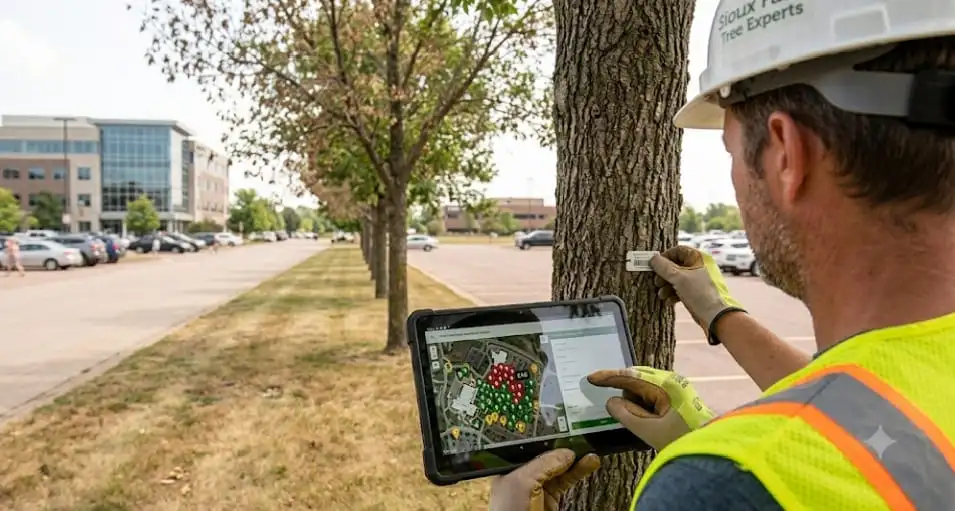
For properties with the emerald ash borer present in Sioux Falls, a tree inventory is particularly valuable. Green ash trees, which are common in Sioux Falls commercial landscaping from developments established in the 1990s and 2000s, may be at various stages of EAB decline across a single property. An inventory makes it possible to identify affected trees systematically and plan replacements before failures occur rather than responding to them one by one.
How Sioux Falls Weather Affects Commercial and Residential Properties Differently
Both residential and commercial properties in Sioux Falls face the same underlying weather risks: derechos, straight-line winds, spring thunderstorm systems, heavy wet snow, and ice events. The difference is in what those risks mean operationally.
Residential Impact
For a residential homeowner, a major storm event means dealing with one or several trees on their own property. The scope of the problem is local and personal. They call a tree service, get on the schedule, and deal with the aftermath.
Commercial Impact
For a commercial property, a widespread storm event like the derechos documented in the Sioux Falls metro in recent years creates a simultaneous, multi-point problem. Trees may be down or damaged across the entire parking lot, blocking entrances and emergency access routes. Business operations cannot resume until clearance is achieved. Tenants are affected. The timeline for resolution directly affects revenue.
This is why commercial tree service contracts almost always include emergency response provisions with defined response times. A retail center that cannot open because of blocked entrances needs a contractor who can commit to a specific response window, not one who will return the call when the volume of post-storm demand allows.
Ice events specifically affect commercial properties differently in Sioux Falls. Winter ice accumulation on trees adjacent to sidewalks, parking areas, and building entrances creates trip and fall liability that is legally significant in a commercial context. A branch that falls on a residential driveway is a nuisance. A branch that falls on a shopper crossing a parking lot is a liability event. Commercial properties in Sioux Falls should include a post-ice-event inspection protocol in their maintenance agreements.
Cost and Budget Planning for Each Property Type
Residential Pricing
Residential tree service is priced on a per-job basis. The variables are tree size, species, location, access, and the specific work being done. Sioux Falls homeowners typically pay $400 to $1,800 for most residential tree removal jobs, with the average around $1,100. Trimming runs considerably less. The cost structure is straightforward: one job, one quote, one invoice.
See our full tree removal cost guide for Sioux Falls for detailed residential pricing by tree size and type.
Commercial Pricing
Commercial pricing works differently for several reasons.
Volume pricing. A commercial property with 40 trees to trim is negotiated as a package, not as 40 individual estimates. The per-unit cost drops as volume increases, because mobilization overhead is absorbed across more work.
Contract pricing. Annual maintenance contracts typically include defined services at a fixed or predictable annual cost. This budget predictability is one of the primary reasons commercial clients prefer contracts over per-job arrangements. A property manager who knows their annual tree care cost by February can budget accordingly rather than absorbing unpredictable event-driven costs.
Equipment scale. Commercial jobs requiring large aerial lifts, crane-assisted removal, or heavy chipper deployment carry higher equipment costs than the lighter machinery typical of residential work. These costs are real and legitimate.
After-hours premiums. Work scheduled outside business hours to avoid disruption to commercial operations carries labor premiums that residential work does not.
Emergency response. Guaranteed emergency response windows built into commercial contracts carry a premium over standard per-call residential emergency rates. That premium buys the certainty of a response time, which is what commercial operators need.
Use multi-year contracts or scheduled maintenance plans to stabilize unit pricing and reduce mobilization fees. These strategies reduce surprise expenditures and enable a comparison between proactive maintenance and the higher cost of emergency removals and liability exposure.
Which Type of Tree Service Do You Need?
You need residential tree service if:
- You own a single-family home with trees on your personal property
- You have a small number of trees with specific, periodic needs
- Your primary concerns are appearance, individual tree health, and property value
- You are comfortable scheduling as-needed and managing on a per-job basis
- Your liability exposure is primarily to your immediate neighbors and property
Residential homeowner checklist:
- Identify trees that need attention and prioritize by urgency
- Get three written quotes for any job over $500
- Verify the contractor carries liability insurance and workers’ compensation
- Schedule stump grinding at the same time as removal to save on mobilization
- Check for warning signs of hazard trees each spring before storm season
You need commercial tree service if:
- You manage a property with significant public access or tenant occupancy
- You have a large tree population requiring systematic attention
- You have regulatory, zoning, or permit considerations
- Your liability exposure extends to the public, tenants, or third parties
- You need scheduled, documented maintenance rather than reactive per-job work
- Your business operations would be disrupted by tree-related events
Commercial and property manager checklist:
- Determine how many trees are on the property and where they are located
- Identify whether any trees are in high-traffic zones adjacent to building entrances, parking areas, or sidewalks
- Verify your current tree service contractor carries appropriate commercial insurance limits
- Establish whether a maintenance contract or per-job arrangement better fits your operational needs
- Ensure your maintenance agreement includes a defined emergency response window
- Create or request a tree inventory or hazard assessment for properties with significant tree populations
- Review insurance policy requirements for contractor coverage before signing any agreement
HOA and Multi-Property Tree Service: A Separate Category
HOAs occupy a middle ground between residential and commercial tree service that warrants specific attention. An HOA is not a single residential property, but it is also not a commercial enterprise in the traditional sense. The combination of shared common areas, individual homeowner lots, and collective governance creates a unique set of responsibilities.
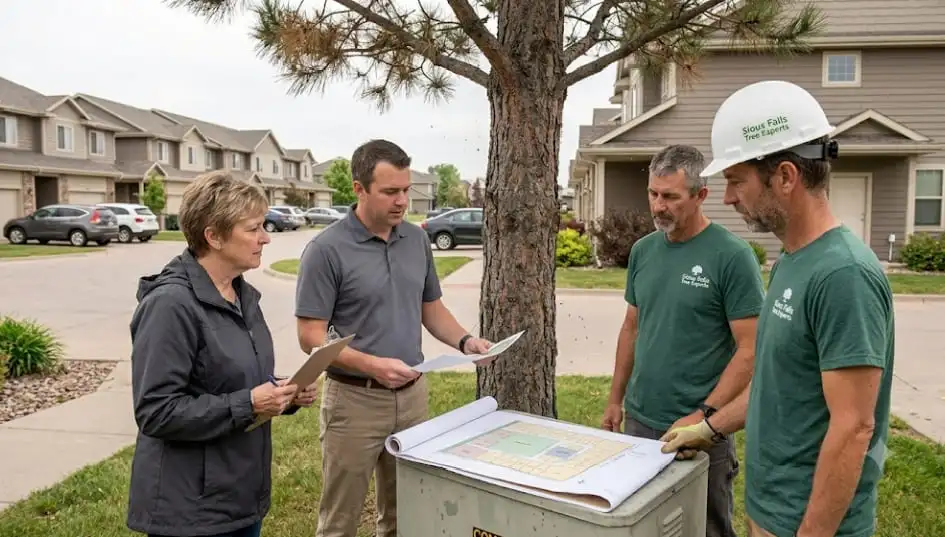
Common area vs. individual lot responsibility is the most frequent source of confusion in HOA tree situations. Most HOA governing documents assign maintenance responsibility for trees in common areas to the association, while trees on individual lots remain the homeowner’s responsibility. The practical boundaries can be unclear when a tree straddles a property line or when roots from a common-area tree affect an individual lot.
HOA programs work by combining governance through governing documents, a detailed tree inventory and risk assessment, scheduled maintenance cycles, vendor procurement, and resident communications to achieve safety and aesthetic goals.
For HOA boards in Sioux Falls, proactive tree management protects both the common-area landscape and the association from liability. An HOA that can demonstrate it had a regular inspection and maintenance program in place is in a substantially better position if a common-area tree causes injury or damage than one that relied solely on resident complaints to identify problems.
Reserve fund planning for HOAs is directly relevant to tree management. Large-scale tree removal, significant pruning programs, or tree replacement initiatives are capital expenses that should appear in the HOA’s reserve study. Trees that are aging, showing signs of decline, or approaching removal age within a ten-year planning window should be identified in the reserve study so the cost of replacement can be planned and funded appropriately.
Common Mistakes Property Owners Make
Applying residential thinking to commercial properties. A per-job, reactive approach that works fine for a homeowner is inadequate for a property with public access and liability exposure. The first time a preventable tree failure causes an injury, the cost of that event typically far exceeds the cost of years of proactive maintenance.
Assuming the same contractor handles both well. Not all tree service companies have the equipment scale, insurance levels, or operational infrastructure for commercial work. Before engaging a contractor for commercial property maintenance, verify that they have experience with commercial accounts, carry the appropriate insurance limits, can provide emergency response guarantees, and have the equipment for the scope of the work.
Skipping documentation. Residential homeowners rarely need documentation of their tree maintenance beyond the invoice. Commercial property owners and HOAs need written inspection reports, work orders, and completion records. Without this documentation, demonstrating a proactive maintenance program in a legal or insurance context becomes difficult.
Treating all HOA trees as the association’s responsibility. Misunderstanding the common-area boundary creates disputes between residents and the board. Reviewing the governing documents and establishing a clear written tree policy before issues arise prevents the majority of these conflicts.
Underinsuring commercial tree contractors. Residential homeowners verify basic liability coverage. Commercial property managers should verify higher limits, additional insured status, and workers’ compensation compliance before any work begins. A contractor underinsured for commercial work creates gaps in the property owner’s overall risk management.
Ignoring the emerald ash borer timeline. Commercial properties in Sioux Falls with ash trees in their landscape inventory are on a predictable decline timeline. Identifying affected trees and planning replacements systematically is far less expensive than responding to individual failures as they occur.
Frequently Asked Questions
1. What types of properties need commercial tree service?
Commercial tree service is appropriate for retail centers, office parks, apartment complexes, medical campuses, schools, industrial properties, mixed-use developments, HOA common areas, and municipal properties. Any property where trees are adjacent to public or tenant-accessible areas with meaningful liability exposure benefits from a commercial-grade approach to maintenance.
2. Can a residential tree service company handle commercial work?
Some can, but not all. Commercial work requires heavier equipment, higher insurance limits, experience coordinating with property managers and tenants, the ability to work after-hours, and the capacity to provide documented inspection reports. Before engaging a residential tree service company for commercial work, verify they have specific commercial experience and carry appropriate insurance limits for the size and nature of the project.
3. How much more does commercial tree service cost than residential?
Commercial tree service costs more in total because of the larger scope, but often costs less per tree when volume pricing and contract rates apply. Emergency response provisions, after-hours scheduling, and higher documentation requirements add cost relative to standard residential work. A commercial maintenance contract provides cost predictability that per-job residential pricing does not.
4. What insurance requirements should I verify for a commercial tree contractor?
Commercial property managers should verify general liability coverage at a minimum of $1 million per occurrence, workers’ compensation for all employees and subcontractors, commercial auto coverage for all vehicles used on the property, and whether the contractor can be listed as an additional insured on the property owner’s policy or vice versa. Some commercial contracts also require waivers of subrogation.
5. Does a commercial tree service contract include emergency response?
Most comprehensive commercial maintenance contracts include a defined emergency response provision specifying maximum response times after a storm event or other emergency. Homeowners receiving per-job residential service do not have guaranteed response windows. For commercial properties where business operations depend on rapid clearance after a major event, negotiating an emergency response guarantee into the contract is strongly recommended.
6. Who is responsible for trees in an HOA?
Responsibility depends on the HOA’s governing documents. Trees in common areas are typically the HOA’s responsibility to maintain and insure. Trees on individual homeowner lots are typically the homeowner’s responsibility. The boundary can become unclear when roots or branches cross property lines. HOAs should establish a clear written tree policy in their governing documents and communicate it to residents proactively.
7. Should an HOA have a tree inventory?
Yes, for any HOA with meaningful common-area tree populations. A tree inventory documents the species, location, condition, and maintenance history of common-area trees. It supports budget planning, helps identify deteriorating trees before failure, demonstrates proactive management in the event of a liability situation, and provides data for reserve fund planning.
8. How often should a commercial property’s trees be inspected?
The appropriate inspection frequency depends on the property type, tree population, and risk profile. Properties with high foot traffic adjacent to trees, large mature tree populations, or known disease pressures like emerald ash borer benefit from semi-annual inspections. Lower-risk properties with smaller, younger tree populations may be adequately served by annual inspections. After major storm events, all commercial properties should have a post-storm walkthrough conducted as soon as conditions allow.
9. What happens if a tree on a commercial property falls and injures someone?
The property owner or manager may face a liability claim under premises liability law. The strength of that claim depends in part on whether the owner exercised reasonable care to maintain the trees. A documented history of regular inspections and proactive maintenance significantly strengthens the property owner’s position. A property with no maintenance records and no evidence of regular inspections is in a much weaker position even if the tree failure was weather-related.
10. Does Sioux Falls require permits for commercial tree removal?
Commercial tree work near public right-of-way, trees in protected zones, or significant removal as part of development activity may require coordination with the City of Sioux Falls before work begins. Your tree service contractor should be familiar with local permit requirements and should advise you before proceeding with any work that may be subject to municipal oversight.
11. How should a commercial property handle post-storm tree cleanup differently from a homeowner?
Commercial property managers should prioritize restoring safe access to parking areas, building entrances, and emergency vehicle routes before addressing cosmetic damage. After emergency access is restored, document all damage with photographs before removal begins for insurance purposes. Contact your tree service contractor using the emergency response provisions of your maintenance contract rather than waiting in the general queue with residential customers calling for the first time after the storm.
12. What is the benefit of a multi-year commercial tree maintenance contract?
Multi-year contracts offer pricing stability, stronger contractor commitment to service quality, and better budget predictability than annual or per-job arrangements. They also build a continuous relationship with a contractor who becomes familiar with your property’s specific tree population, drainage patterns, access constraints, and operational scheduling requirements. That institutional knowledge improves service quality over time.
13. How does the emerald ash borer affect commercial property planning in Sioux Falls?
Sioux Falls commercial properties planted with green ash in the 1990s and 2000s face a systematic decline risk as emerald ash borer continues to spread throughout the region. Commercial property managers with ash trees in their landscape inventory should have an arborist assess and document the status of those trees, identify which are viable candidates for treatment, which are too far declined to save, and create a replacement planting plan to maintain canopy coverage over time. Treating this as a planning problem rather than an emergency response problem produces significantly better outcomes.
14. Can HOAs negotiate volume pricing for tree service?
Yes. HOAs with consistent annual maintenance needs across multiple properties or a large common-area tree population are in a strong position to negotiate volume-based annual contracts. Bundling routine trimming, hazard inspections, and emergency response provisions into a single annual agreement typically produces better per-unit pricing than scheduling work job by job throughout the year.
15. What should a property manager look for when comparing commercial tree service bids?
A commercial tree service bid should include a written scope of work covering every service being quoted, specified insurance limits with certificates provided before work begins, a defined emergency response window if applicable, clarity on what documentation will be provided after each visit, the payment structure and any provisions for work outside the defined scope, and references from comparable commercial accounts. Low bids that omit insurance documentation or provide vague scope descriptions carry the same risks in commercial contexts as in residential ones.
The Third Category: Acreage
The residential and commercial split does not cover everything. Properties around Renner are neither, being unincorporated acreages with shelterbelt rows, outbuildings and equipment access to plan around. Larger lots near Crooks sit somewhere in between, with mature windbreaks on residential-sized budgets.